Localized-Wave-Function Methods in Quantum Chemistry and Their Extension to Quantum Computers
Explore localized wave-function methods in quantum chemistry, their applications to large systems, and potential extensions to quantum computing algorithms for improved efficiency and accuracy.
Quantum Impurity and Quantum Embedding Theory - IPAM at UCLA
Explore quantum impurity and embedding theories, from non-interacting systems to advanced concepts like DMET and DMFT, enhancing understanding of quantum many-body problems.
Quantum Embedding with Lower Bounds - IPAM at UCLA
Explore quantum embedding theories and optimization approaches for solving relaxations of many-body ground state problems, focusing on quantum marginals and impurity problems for fermions.
Post-DFT Green's Function Embedding - IPAM at UCLA
Explore post-DFT Green's function embedding for correlated solids, focusing on self-energy embedding theory (SEET) and its applications in molecular systems and periodic solids.
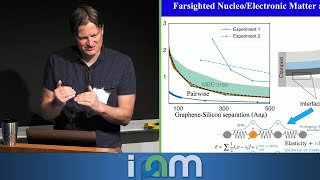
Multiscale Approaches to Quantum Mechanics - Vacuum, Atoms, Engineering-Scale
Explore multiscale quantum mechanics from vacuum to engineering structures, covering experimental evidence, theoretical models, and future research directions in this comprehensive lecture.
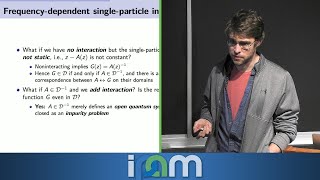
Many-Body Perturbation Theory and Green's Function Methods - IPAM at UCLA
Explore Green's functions and many-body perturbation theory in quantum physics, covering Feynman diagrams, self-energy, and applications like GW method and DMFT. Gain insights into mathematical structures and open problems.
A Mathematical Introduction to Quantum Embedding Theory - IPAM at UCLA
Explore quantum embedding methods for strongly-correlated materials, focusing on computational challenges at the single-particle level and recent optimization approaches.
A Physical-Chemical Motivation Behind Quantum Embedding Theories - IPAM at UCLA
Explore quantum embedding theories, their physical motivations, and applications in many-electron problems. Learn about Green's function embedding and other approaches for accurate, controlled approximations.

Randomized Methods for Quantum Many-Body Problems - A Mathematical Primer
Explore randomized methods for quantum many-body problems, focusing on Monte Carlo techniques to approximate ground and excited states in large systems. Learn about VMC and FCIQMC algorithms.
Many-Body Perturbation Theory and Wavefunction Methods: A Physics Perspective
Explore many-body perturbation theory and wavefunction methods from a physics perspective, covering applications, multiscale modeling, and advanced quantum mechanics concepts.
Elements of Electronic Structure Calculations - HF and DFT - IPAM at UCLA
Explore fundamental concepts of electronic structure calculations, including Hartree-Fock and Density Functional Theory, with insights on modern methodologies and applications in quantum mechanics.
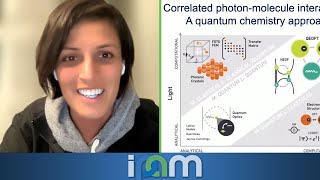
Ab Initio Quantum Chemistry Approaches to Nonequilibrium Interactions in Molecules
Explore ab initio quantum chemistry approaches for nonequilibrium interactions in molecules and materials, covering correlated photon-molecule interactions, molecular strong coupling, and polariton dynamics.

Physically Inspired Machine Learning for Excited States - IPAM at UCLA
Explore machine learning applications in photochemistry, focusing on excited state predictions and light-matter interactions. Discover innovative techniques for overcoming data limitations and enabling accurate photodynamics simulations.
High Accuracy Wavefunctions Using Deep-Learning-Based Variational Monte Carlo
Explore deep learning-based variational Monte Carlo for high-accuracy wavefunctions in computational chemistry, featuring novel architecture and improved methods for ground state energy calculations.
Conditional Probability Density Functional Theory - IPAM at UCLA
Explore conditional probability density functional theory for electronic structure calculations, addressing challenges in DFT and offering insights into ground-state correlations and warm dense matter simulations.
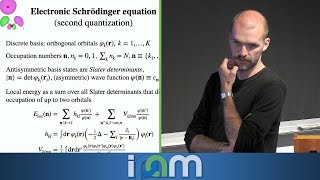
Neural-Network Wave Functions for Quantum Chemistry - IPAM at UCLA
Explore neural-network wave functions in quantum chemistry, covering variational quantum Monte Carlo, antisymmetric ansatzes, and applications to electronic and exciton-phonon Hamiltonians for improved accuracy in molecular modeling.
Stochastic Density Functional Theory - IPAM at UCLA
Explore stochastic density functional theory for efficient ground-state calculations in extended materials, including noise reduction techniques and applications in warm dense matter at elevated temperatures.
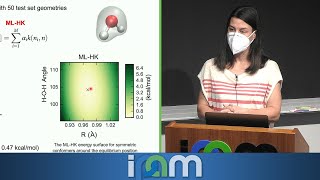
Molecular Electron Densities via Machine Learning - IPAM at UCLA
Explore machine learning techniques for predicting molecular electron densities and energies, with applications in quantum mechanics and molecular dynamics simulations.
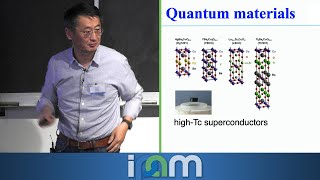
Auxiliary-Field Methods for Quantum Materials - IPAM at UCLA
Overview of auxiliary-field quantum Monte Carlo methods for simulating quantum materials, discussing recent advances in ab initio calculations, including correlated sampling and structural optimization.
Error Bounds for Properties in Planewave Electronic Structure Calculations
Explore error bounds in planewave electronic structure calculations, focusing on ground state density matrix and interatomic forces estimation. Learn efficient approximation methods and see numerical results for materials systems.
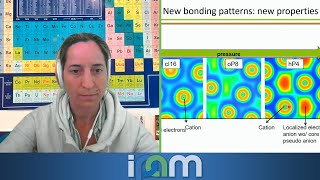
Math-Chimie: Developing Approaches for Predicting New Superconductors
Explore innovative approaches for predicting superconductors, combining mathematics and chemistry to analyze electron density, localization, and high-pressure materials for groundbreaking discoveries in quantum mechanics.