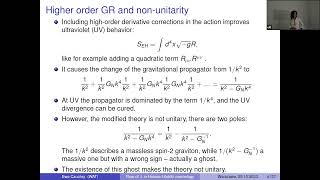
Energy Flow of λ in Hořava-Lifshitz Cosmology
Explore Hořava-Lifshitz cosmology, focusing on λ parameter's energy flow. Analyze two formulations using diverse datasets to bound cosmological parameters and compare with Einstein gravity.
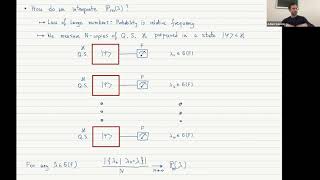
Geometry of Quantum Correlations
Explore the geometric description of quantum correlations using symplectic and algebraic tools. Gain insights into quantum entanglement and its unique features distinguishing quantum from classical systems.
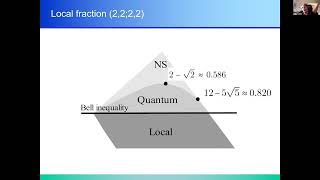
State-Independent Certification of Quantum Observables and Minimal Bipartite Full Nonlocality
Explore state-independent certification of quantum observables and minimal bipartite full nonlocality. Delve into recent findings on unique quantum observable sets and equivalences in quantum correlations.
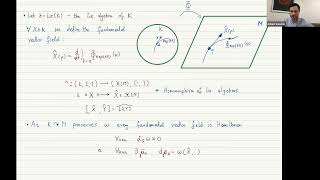
Geometry of Quantum Correlations - Part II
Explore quantum correlations using symplectic and algebraic geometry. Delve into entanglement, nonlocal properties, and the Einstein-Podolsky-Rosen analysis of quantum theory completeness.
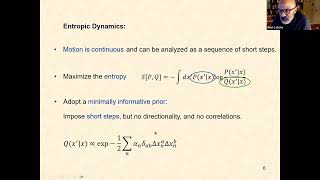
The Entropic Dynamics Approach to Quantum Mechanics
Explore the Entropic Dynamics framework for reconstructing Quantum Mechanics, focusing on ontic and epistemic variables, probability distributions, and the derivation of key quantum principles.
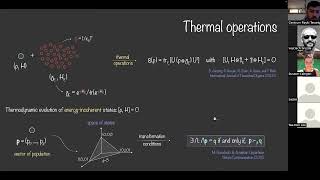
Geometric and Information-Theoretic Aspects of Quantum Thermodynamics
Explore geometric and information-theoretic aspects of quantum thermodynamics, focusing on state transformations, constraints, and practical applications of quantum catalysis in non-classical light generation.
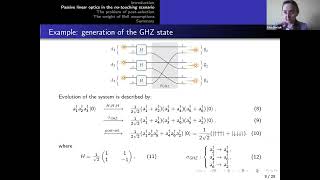
Generation of Entanglement in No-Touching Scenario: Causal Aspects and Protocols
Explore entanglement generation protocols, causal aspects, and quantum foundations. Delve into passive linear optical designs, post-selection issues, and Bell inequality violations in quantum information.
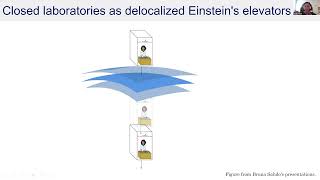
Indefinite Temporal Order on a Superposition of Spherical Shells
Explore indefinite temporal order in quantum theory through a new gravitational quantum switch protocol involving superposed spherical shells and entangled spacetime geometry.
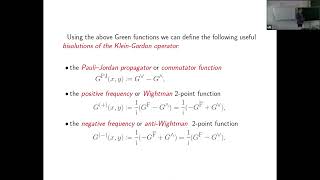
Feynman Propagator on Curved Spacetimes - Definitions and Examples
Explore the Feynman propagator in Quantum Field Theory, examining its definitions and applications across various spacetime models, including stationary, FLRW, and de Sitter.
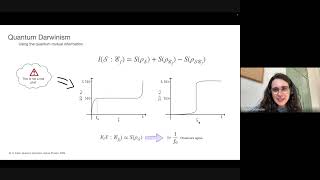
Distinguishing Between Redundancy and Consensus in Quantifying Quantum Objectivity
Explore rigorous definitions of "redundancy" and "consensus" in quantum objectivity, examining their distinct roles in the quantum-to-classical transition and implications for quantum Darwinism.
Attoscience, Nobel 2023 and Quantum Simulators
Explore attoscience, high harmonics generation, and quantum simulators. Delve into QED aspects and recent developments in the field, concluding with insights on Nobel 2023.
Modular Many-Body Quantum Sensors
Explore modular approaches for enhancing quantum sensing precision through multiple phase transitions in many-body systems, achieving Heisenberg scaling at phase boundaries.
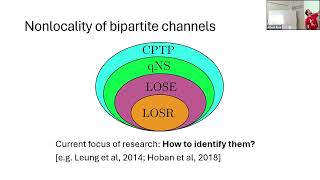
Nonlocality of Channels Under Decoherence
Explore nonlocality in quantum channels, focusing on its persistence under decoherence. Gain insights into identifying nonlocal properties of bipartite channels and their behavior in realistic setups.
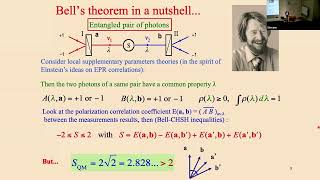
Experimental Tests of Bell's Inequalities: Past Achievements and Future Directions
Explore Bell's inequalities experiments, their historical impact, and future implications in quantum physics and technology. Gain insights from a Nobel Prize-winning research perspective.
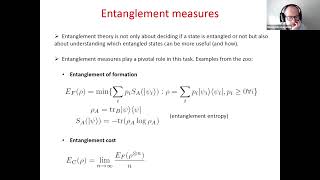
Maximally Entangled Mixed States: Do They Exist?
Explore the existence of maximally entangled mixed states in quantum information theory, examining their potential and implications for practical applications.
Spin-Orbit Related Phenomena in Magnets from Density Functional Theory
Explore spin-orbit physics in magnets using density functional theory. Understand electronic structure changes, magnetic interactions, and their impact on condensed matter phenomena.
Holomorphic-Topological Twists and Their Applications
Explore holomorphic-topological twists in supersymmetric quantum field theories, examining mathematical properties, formality results, categorical wall-crossing, and 't Hooft expansion approaches.
Effective Field Theory for Gravitational Inspiral Dynamics
Explore advanced concepts in gravitational wave physics, focusing on effective field theory applications to binary inspiral dynamics and post-Newtonian expansions.
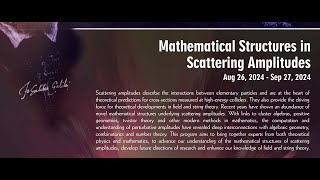
Two-Loop N = 1 SYM Amplitudes via SUSY Decomposition and Massive Spinor-Helicity
Explore advanced techniques in supersymmetric Yang-Mills theory, focusing on two-loop amplitudes, SUSY decomposition, and massive spinor-helicity formalism.
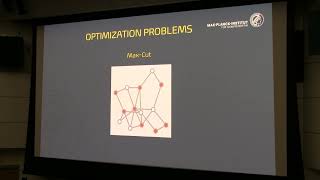
Quantum Computing in the Presence of Errors
Explore quantum computing's potential and challenges, focusing on error impacts in optimization and quantum many-body problems. Gain insights into achieving quantum advantage despite imperfections.
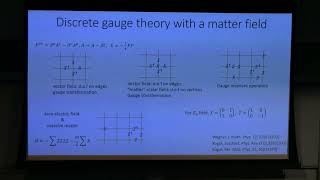
Quantum Error Correction: A Window to Complex Quantum States and Dynamics
Explore quantum error correction's impact on computing feasibility, gauge theories, and many-body physics. Discover connections to topological field theories, fracton physics, and Floquet dynamics.