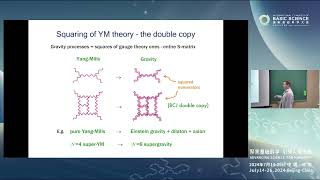
Gravity as a Double Copy of Gauge Theory
Explore the gravitational double copy framework, connecting gravity to Yang-Mills theory and enabling advanced quantum computations and classical general relativity studies.
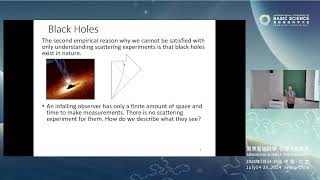
Bulk Locality and Quantum Error Correction in Holography
Explore quantum gravity through AdS/CFT correspondence, unraveling the emergence of local physics and its connection to quantum error correction.
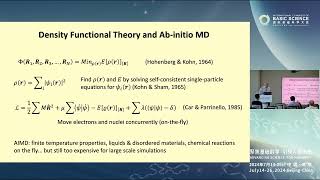
DP-GEN: An Optimal Active Learning Protocol for Constructing Interatomic Potentials - Materials Simulation
Explore DP-GEN, an innovative active learning protocol revolutionizing molecular modeling by constructing accurate interatomic potentials. Learn its three-step iterative process and applications in materials simulation.
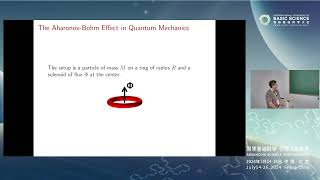
Defects in Quantum Field Theory and Applications
Explore defects in quantum field theory and their applications with expert insights from Zohar Komargodski. Gain advanced knowledge in this cutting-edge area of theoretical physics.
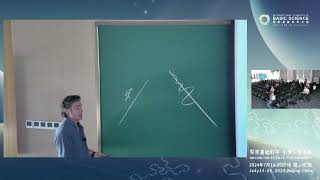
Non-linearities and Gravitational Signals from Black Hole Spacetimes
Explore non-linear behavior of perturbed black holes and its implications for gravitational wave detection and new physics in mergers.
Fixing Ambiguities in String Theory Using String Field Theory
Explore how string field theory resolves ambiguities in string theory computations, focusing on D-instanton corrections and matrix model comparisons.
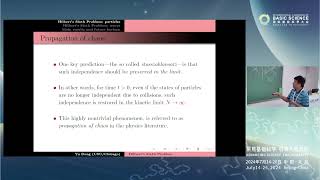
Hilbert's Sixth Problem: From Particles to Waves
Explore Hilbert's Sixth Problem in statistical physics and kinetic theory, examining the derivation of macroscopic laws from microscopic systems in classical and quantum settings.
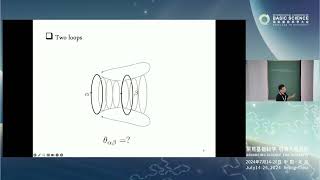
Exploring Loop-Like Topological Excitations in Three Dimensions
Explore loop-like topological excitations in 3D quantum matter, their unique braiding statistics, and role as order parameters for characterizing topological phases.
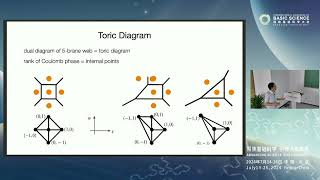
5D Superconformal Field Theories and Quantum Integrable Models
Explore integrable models in 5d Superconformal Field Theories, focusing on non-toric local Calabi-Yau geometry, Dimer graph folding, and codimension two defect probe physics.
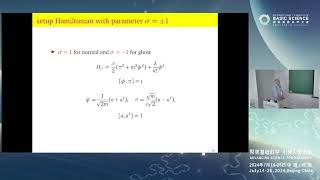
Ghosts on the Way to a Gravity QFT - ICBS 2024
Explore ghost theories in gravity QFT, focusing on 0+1 dimensional models, unitarity, and probability interpretation. Gain insights into spectra and propagators at various coupling strengths.
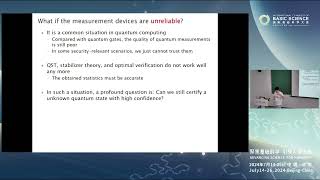
Certifying Bipartite Pure Quantum States Efficiently Using Untrusted Devices
Explore efficient certification of bipartite pure quantum states using untrusted devices, requiring fewer measurements while maintaining reliability in quantum experiments.
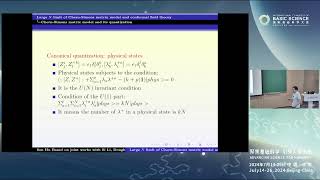
Large N of Chern-Simons Matrix Model and Conformal Field Theory
Explore the emergence of 1+1D conformal field theory from large N limit of 2+1D Chern-Simons matrix models, including Kac-Moody algebra and holographic duality.
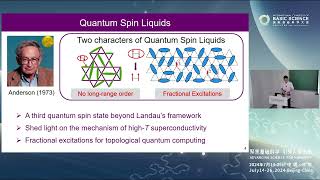
Neutron Spectroscopy Studies of Kitaev Quantum Magnets
Explore Kitaev quantum magnets through neutron spectroscopy, examining the Kitaev model, its realization in α-RuCl3, and extension to higher-spin systems like Na3Ni2BiO6.
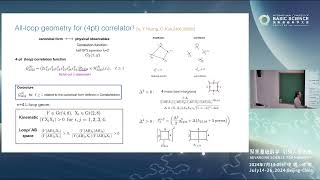
From Combinatorics to Real World Scattering - ICBS 2024
Explore combinatorial geometries in QFT and string theory, focusing on a new formulation for scattering of colored scalars, pions, and gluons.
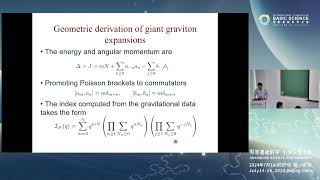
Giant Graviton Expansions, Gauge-Gravity Correspondence, and Emergent Spacetime
Explore giant graviton expansions in gauge-gravity correspondence, uncovering insights into quantum field theory, string theory, and emergent spacetime geometries.
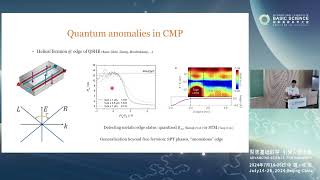
Detecting Quantum Anomalies in Open Systems
Explore novel approach for detecting quantum anomalies in open systems, focusing on mixed anomalies in spin chains and their distinctive characteristics in measurements.
Alterfold Topological Quantum Field Theory
Explore the connection between injective ground states of gapped Hamiltonians and TQFT, bridging topological orders with constructive quantum field theory.
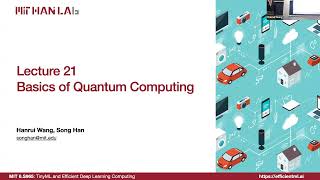
Basics of Quantum Computing - Lecture 21
Explore quantum computing fundamentals, including key concepts and potential applications in computational problem-solving and information processing.
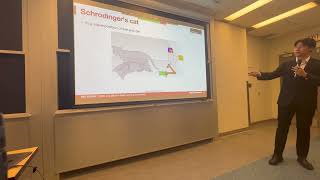
Basics of Quantum Computing - Lecture 21
Explore quantum computing fundamentals, including key concepts and potential applications in computational problem-solving and information processing.
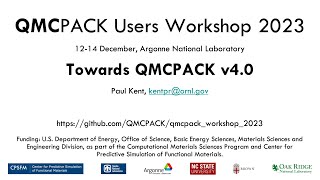
Towards QMCPACK v4
Explore advancements in quantum Monte Carlo simulations with QMCPACK v4, focusing on new features and improvements for computational materials science research.
Accurate Electronic and Magnetic Properties of 2D Materials Using Quantum Monte Carlo Methods
Explore quantum Monte Carlo methods for precise electronic and magnetic property calculations in 2D materials with Daniel Wines from NIST.