
Quantum Supremacy - Checking a Quantum Computer with a Classical Supercomputer
Explore quantum supremacy, error rates, and hardware challenges in quantum computing. Learn about recent advancements and the race to achieve computational superiority over classical systems.
Recent Advances in Quantum Simulation
Explore recent advancements in quantum simulation, focusing on dynamical simulation, unitary access, and applications in quantum chemistry and physics.
Classical Simulation of Quantum Many-body Systems with Tensor Networks
Explore tensor networks for simulating quantum many-body systems, focusing on matrix product states and branching mirror techniques in quantum computation challenges.
The Complexity of the Local Hamiltonian Problem
Explore the complexity of the Local Hamiltonian Problem, its NP-containment proof, and connections to adiabatic computation and open quantum systems in this advanced physics lecture.
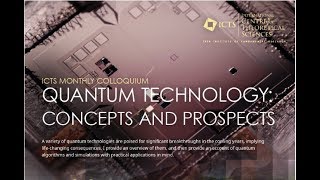
Quantum Technology - Concepts and Prospects
Explore quantum technologies' breakthroughs, from sensors and communications to computation. Learn about quantum algorithms, simulations, and their practical applications in various fields.
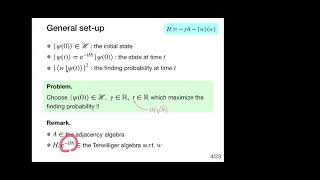
Spatial Search on Johnson Graphs by Continuous-Time Quantum Walk
Explore quantum walks on Johnson graphs for spatial search, covering setup, strategies, and analysis of search algorithms and success probabilities.
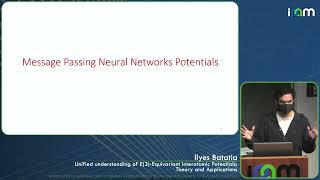
Unified Understanding of E(3)-Equivariant Interatomic Potentials - Theory and Applications
Explore E(3)-equivariant interatomic potentials, covering theory, applications, and advancements in machine learning approaches for quantum mechanics and molecular dynamics simulations.
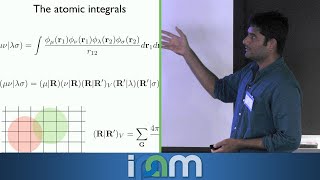
Auxiliary Field Quantum Monte Carlo - AFQMC with Multi Slater Wavefunctions
Explore advanced quantum Monte Carlo techniques, focusing on AFQMC with multi-Slater wavefunctions and efficient exchange matrix evaluation for large-scale quantum systems.
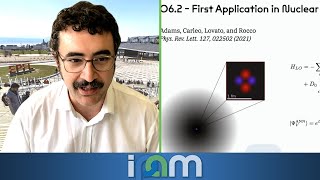
Fermionic Neural-Network Quantum States - IPAM at UCLA
Explore fermionic neural-network quantum states, their efficient representations, and applications in quantum mechanics with Giuseppe Carleo's insightful presentation at IPAM's workshop.

Quantum Simulation - IPAM at UCLA
Explore quantum simulation's origins, relevance, and key concepts with Nathan Wiebe. Delve into Schrödinger equations, Hamiltonian simulation, and Taylor's theorem in this comprehensive lecture.
Advancing Molecular Simulation with Deep Learning - IPAM at UCLA
Explore cutting-edge applications of deep learning in molecular simulation, covering quantum chemistry, force fields, and Markov State Models for advanced scientific research.
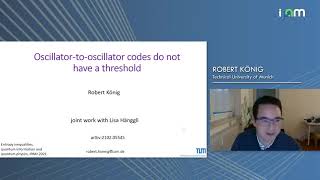
Oscillator-to-Oscillator Codes Do Not Have a Threshold
Explores limitations of oscillator-to-oscillator codes in quantum information, proving they lack a threshold property for error correction when using constant squeezing and maximum likelihood decoding.
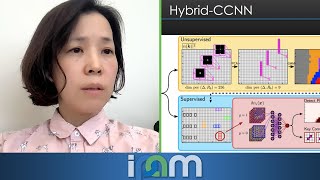
Machine Learning for Quantum Simulation - IPAM at UCLA
Explore machine learning applications in quantum simulation, focusing on neural networks for phase recognition and insights into complex quantum systems.
Tensor Networks -QC-DMRG- in a Complete Active Space Coupled Cluster Method
Explore tensor networks in quantum mechanics, focusing on their application in coupled cluster methods for modeling strongly correlated systems and computing dynamical correlations.
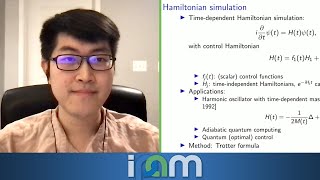
Improved Complexity Estimation for Hamiltonian Simulation with Trotter Formula
Explore improved complexity estimation for Hamiltonian simulation using Trotter formula, focusing on time-dependent effective mass and near adiabatic dynamics scenarios with potential for enhanced efficiency.
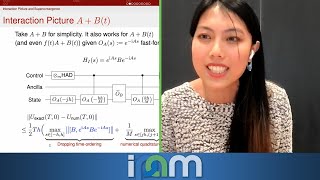
Time-Dependent Hamiltonian Simulation of Highly Oscillatory Dynamics - IPAM at UCLA
Explore highly oscillatory dynamics in quantum systems, focusing on efficient simulation algorithms for time-dependent Hamiltonians with applications in various scientific fields.
Machine Learning Based on Stochastic Magnetic Tunnel Junctions
Explore spintronics-based neuromorphic systems for efficient machine learning, addressing device variability through in situ learning in Boltzmann machines for autonomous AI applications.
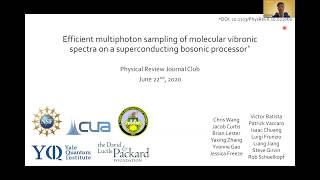
Physical Review Journal Club - Quantum Research with the Authors
Explore efficient quantum simulation for molecular spectroscopy using superconducting bosonic processors, with insights on implementation, photon detection, and algorithmic approaches.
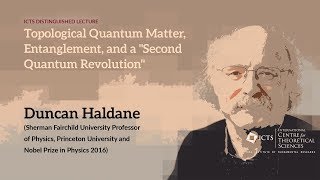
Topological Quantum Matter, Entanglement, and a "Second Quantum Revolution" by Duncan Haldane
Explore topological quantum matter, entanglement, and the "second quantum revolution" with Nobel laureate Duncan Haldane. Discover exotic states, quantum information theory, and potential applications in quantum computing.
Learning to Predict Arbitrary Quantum Processes
Explore quantum learning theory and its surprising ability to predict local properties of arbitrary quantum circuits, contrasting with classical limitations and highlighting potential for efficient quantum dynamics prediction.
Approximating Many-Electron Wave Functions Using Neural Networks - IPAM at UCLA
Explore neural network applications in quantum mechanics, focusing on Fermionic neural networks for approximating many-electron wave functions and enhancing variational quantum Monte Carlo methods.