Fractional Quantum Hall Effect in Multicomponent Systems: Old and New
Explore the intricacies of fractional quantum Hall effect in multicomponent systems, covering both established and emerging concepts in quantum physics.
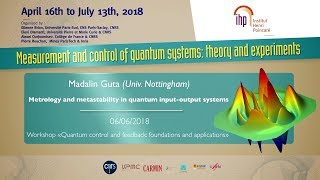
Metrology and Metastability in Quantum Input-Output Systems
Explore quantum metrology and metastability in input-output systems, focusing on parameter estimation, continuous measurements, and precision limits for open quantum dynamics.
Supersymmetry and Trace Formulas: From Atiyah-Singer to Jacobi-Poisson and Selberg
Explore supersymmetry's mathematical origins and applications, from Atiyah-Singer formula to Jacobi-Poisson and Selberg trace formulas, in this advanced mathematics colloquium.
Supersymmetry and Trace Formulas: From Atiyah-Singer to Jacobi-Poisson and Selberg - Part 1
Explore supersymmetry's mathematical origins and applications, from Atiyah-Singer formula to Jacobi-Poisson and Selberg trace formulas, in this advanced mathematics colloquium.
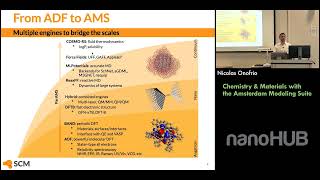
Chemistry and Materials with the Amsterdam Modeling Suite
Explore atomistic simulations using Amsterdam Modeling Suite. Learn about AMS driver, DFT engines, force fields, and PARAMS for novel molecular interactions. Gain insights through demos and practical applications.
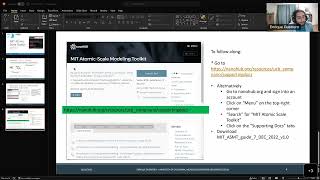
Teaching and Learning with the MIT Atomic Scale Modeling Toolkit - Classical and Quantum Atomic Modeling
Explore classical and quantum atomic modeling using MIT's toolkit. Perform molecular dynamics, Monte Carlo simulations, and quantum chemistry computations. Learn practical applications for various physics and chemistry courses.
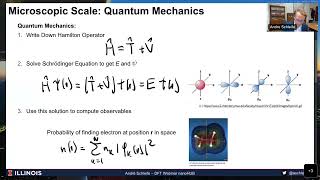
Density Functional Theory: Introduction and Applications
Explore Density Functional Theory fundamentals and applications using Quantum Espresso on nanoHUB. Learn to compute electronic structures, densities of state, total energies, and bulk modulus for materials.
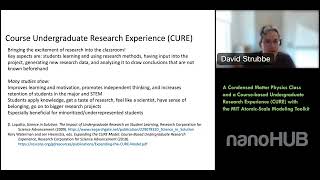
Condensed Matter Physics Class and Research Experience with MIT Atomic-Scale Modeling Toolkit
Explore condensed matter physics through simulations and research experiences using the MIT Atomic-Scale Modeling Toolkit. Learn about covalent bonding, bandstructure, phonons, and magnetic phase transitions.
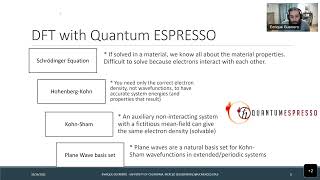
Interactive Modeling of Materials with DFT Using Quantum ESPRESSO - MIT Atomic Scale Toolkit
Explore interactive modeling of materials using density functional theory with Quantum ESPRESSO in the MIT Atomic-Scale Modeling Toolkit. Learn to compute and analyze various material properties through hands-on examples.
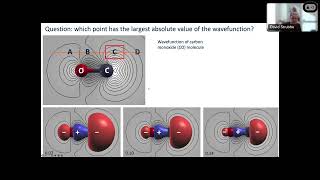
DFT with SIESTA, Data Visualization, and Sophomore-level CURE Using MIT Atomic-Scale Modeling Toolkit
Explore density functional theory, data visualization, and undergraduate research experiences using the MIT Atomic-Scale Modeling Toolkit for modern physics and condensed matter studies.
Simulation of Chemical Reactions on a Quantum Computer
Explore quantum computing algorithms for calculating scattering matrix elements in chemical reactions, focusing on the Møller operator formulation and its application to hydrogen exchange.
Quantum Energy Teleportation - Activating Ground State Energy
Explore quantum energy teleportation and its experimental demonstration using nuclear magnetic resonance. Discover how entanglement enables energy extraction from vacuum fluctuations.
Metamaterials for Broadband Light Absorption - Quantum Today
Explore metamaterials for efficient broadband light absorption and their applications in optical sensors, imaging, and quantum communication.
Revealing Spin Structures with Neutron Beams - Quantum Today
Explore quantum spin and magnetic skyrmions through neutron beam research, uncovering new pathways to rearrange topologically stable formations in disordered materials.
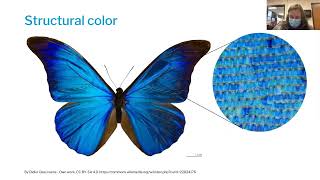
Properties of Nanomaterials - Introduction to Nanotechnology
Explore nanomaterial properties, from structural color to quantum effects. Discover applications in medicine, adhesives, and computing. Learn about surface area, viscosity, and fabrication techniques in nanotechnology.
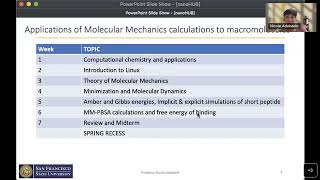
Teaching Electronic Structure Methods in Chemistry Using Simulation Tools in nanoHUB
Explore electronic structure methods in chemistry using nanoHUB simulation tools. Learn to teach computational chemistry concepts and gain hands-on practice with Hartree-Fock and basis sets using ORCA.
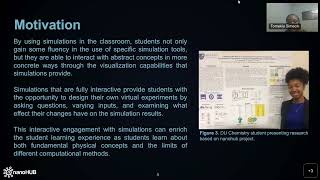
Introduction to Computational Chemistry Using the NUITNS Simulation Toolkit in nanoHUB
Explore computational chemistry using NUITNS toolkit on nanoHUB. Learn to integrate simulations in undergraduate chemistry courses and analyze nanodiamonds through hands-on demonstrations and practical applications.
Quantum Chemistry with a Quantum Computer
Explore quantum chemistry simulations using quantum computers, focusing on strongly correlated systems, digital-analog toolboxes, and extracting spectral properties for practical applications.
New Advances Towards Deployable Quantum Sensors
Explore cutting-edge developments in deployable quantum sensors and their potential applications in real-world scenarios.
AdS/CFT Correspondence - Lecture 3
Explore the intricacies of AdS/CFT correspondence in this advanced physics lecture, delving into the relationship between anti-de Sitter space and conformal field theory.
Superstring Theory - Lecture 4
Explore advanced concepts in superstring theory, including quantum field theory applications and mathematical foundations, in this comprehensive lecture by Oliver Schlotterer.