Quantum Key Distribution - From Theoretical Concept to Practical Applications
Explore the evolution, challenges, and practical implementation of quantum key distribution, from theoretical concepts to real-world network applications and security considerations.
Many-body Ramsey Spectroscopy in the Bose Hubbard Model
Explore quantum physics research on building and probing many-body states of light, focusing on Hubbard physics, crystals of light, and innovative protocols for quantum matter investigation.
Computational Complexity of Quantum Systems - From Theory to Ground State Analysis
Delve into quantum systems' computational complexity, exploring ground states, quantum computing challenges, and algorithmic approaches for simulating quantum phenomena.
Reinforcement Learning for Quantum Technologies
Discover how reinforcement learning techniques can revolutionize quantum devices, from state preparation to error correction, with insights from theoretical proposals and real-time quantum feedback experiments.
Quantum Simulation - Engineering and Understanding Quantum Systems Atom by Atom
Explore quantum simulation using neutral atoms in optical arrays to study topological phases and quantum system thermalization, with insights into cutting-edge experimental techniques.
Using Deep Learning Artificial Neural Networks for Optimizations of Optical Alignment and Magneto-Optical Trap
Discover how deep learning neural networks optimize optical alignment and magneto-optical traps, enhancing efficiency in quantum experiments and cold atomic ensemble manipulation.
Quantum Resource Theories for Sets of Measurements
Delve into quantum measurement resource theories, exploring quantification methods, hierarchies, and applications in quantum information processing tasks and Bell inequality demonstrations.
Hands-on Quantum Computing - Programming and Problem-Solving with Quantum Algorithms
Dive into practical quantum computing fundamentals through hands-on exercises, exploring quantum gates, qubit manipulation, and algorithm implementation for real-world problem-solving.
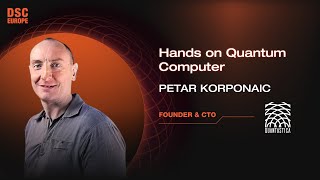
Hands-on Quantum Programming: From Circuit Design to Production Implementation
Master quantum programming fundamentals through hands-on implementation, from circuit assembly to result decoding, with practical Python integration for real-world quantum computing applications.
Quantum Experiments in Satellite Technology - Quantum Key Distribution and Long-Haul Communications
Explore quantum key distribution protocols for satellite-based secure communications, focusing on uplink-based implementation methods and their advantages in long-distance quantum cryptography.
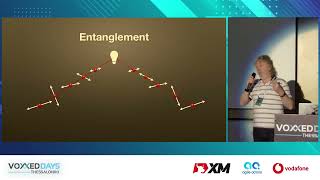
Hello Quantum World - Introduction to Quantum Computing and Algorithms
Explore quantum computing fundamentals, from basic concepts to practical applications, and witness a real quantum program in action while learning about its revolutionary potential in optimization and cryptography.
On the Role of Entanglement and Statistics in Learning in Quantum Statistical Query Models
Delve into quantum statistical query models and explore the intricate relationships between learning systems using entangled, separable, and statistical measurements in quantum computing.
Pseudoentanglement Ain't Cheap - Entropy and Non-Clifford Gates in Quantum States
Explore groundbreaking research on pseudoentangled state ensembles, revealing how their preparation requires significant non-Clifford gates and introducing a novel algorithm for quantum entanglement entropy estimation.
Forward and Backward Mappings for Quantum Graphical Models
Delve into quantum graphical models, exploring forward/backward mapping problems, quantum belief propagation, and innovative algorithms like quantum iterative scaling for enhanced quantum information processing.
Robustness of Fixed Points of Quantum Channels and Application to Approximate Quantum Markov Chains
Explore the mathematical foundations of quantum channels' fixed points and their applications to quantum Markov chains, focusing on approximation methods and dimensional scaling properties.
Quantum Communication on the Bosonic Loss-Dephasing Channel
Delve into quantum communication challenges through analysis of bosonic loss-dephasing channels, exploring anti-degradability conditions and quantum key distribution possibilities with two-way classical communication.
Stochastic Error Cancellation in Analog Quantum Simulation
Explore how stochastic error cancellation improves analog quantum simulation accuracy, demonstrating reduced error scaling and enhanced fidelity in noisy quantum systems.

Sufficiency of Rényi Divergences in Quantum Information Theory
Delve into quantum state equivalence and Rényi divergences, exploring their sufficiency in classical and quantum systems, with applications to state transitions and resource theory.
Information-Theoretic Generalization Bounds for Quantum Learning
Explore a unified mathematical framework for quantum learning theory, covering state discrimination, PAC learning, and generalization bounds using quantum mutual information and optimal transport concepts.
One Clean Qubit Suffices for Quantum Communication Advantage
Delve into groundbreaking research demonstrating how a single clean qubit enables quantum communication advantage, challenging previous assumptions about quantum versus classical communication complexity.

Hamiltonian Property Testing - Testing Locality and Structural Properties
Explore groundbreaking research in Hamiltonian property testing, examining efficient algorithms for quantum systems and the fundamental differences between testing and learning approaches.