Modular Tensor Categories, Quantum Groups and Vertex Algebras - Lecture 1
Explore modular tensor categories, focusing on nonsemisimple theory. Gain insights into these mathematical structures and their connections to quantum symmetries and algebraic concepts.
Braided Fusion Categories - Lecture 5: Witt Equivalence and Categorical Witt Group
Explore advanced concepts in braided fusion categories, including gauging, Picard groups, Witt equivalence, and categorical Witt groups. Suitable for graduate-level mathematics students.
Braided Fusion Categories - Lecture 4
Explore algebraic theory of semisimple braided tensor categories, covering properties, examples, centralizers, equivariantizations, gauging, and Witt equivalence. Suitable for graduate students.
Braided Fusion Categories - Lecture 2
Explore algebraic theory of semisimple braided tensor categories, covering structure, classification, and applications in quantum symmetries and topological quantum field theories.
W-algebras and Lax Operators - Lecture 1
Explore finite W-algebras, twisted Yangians, and Lax operators. Investigate relationships between these mathematical structures using advanced algebraic techniques.
Braided Fusion Categories - Lecture 1
Explore semisimple braided tensor categories, their structure, and classification. Learn about centralizers, non-degeneracy, equivariantizations, gauging, and Witt equivalence in fusion categories.
Dynamics of Quantum Integrable Systems via Coupled Heisenberg Equations
Explore quantum integrable systems dynamics using coupled Heisenberg equations. Analyze Onsager algebra models and Kitaev model, uncovering new analytical results for quench dynamics and related algebras.
Onsager Algebras in Quantum Lattice Models
Explore Onsager algebras in quantum lattice models, their role in exactly solvable systems, and recent developments in integrable quantum physics.
Duality, Onsager Algebra and Ising-Type Structures in Root-of-Unity Six-Vertex Models
Explore duality, Onsager algebra, and Ising-type structures in root-of-unity six-vertex models. Uncover connections between quantum group representations and symmetries in integrable systems.
The Origin of Trigonometric K-matrices - Part III
Explore the universal K-matrix in quantum integrable systems with boundaries, focusing on its role in generating trigonometric K-matrices for finite-dimensional representations.
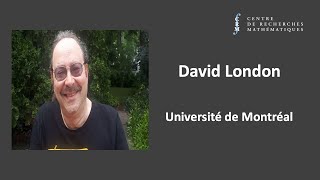
The Search for New Physics
Explore the Standard Model of particle physics, its limitations, and the quest for new physics beyond it with insights from David London's research contributions.
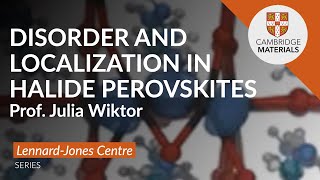
Dynamical Disorder and Carrier Localization in Halide Perovskites
Explore dynamical disorder and carrier localization in halide perovskites, focusing on their soft structure, polaronic states, and computational modeling challenges.
Modelling Physical Phenomena in Alloys and Polymers with Quantum Mechanical Accuracy
Explore data-driven interatomic potentials and Hyperactive Learning for modeling alloys and polymers with quantum accuracy. Gain insights into precipitate formation and chemical ordering.
Thermalization, Hadronization, and Entanglement in Heavy Ion Collisions - Theoretical Physics Colloquium
Explore thermalization, hadronization, and entanglement in relativistic heavy ion collisions through holographic descriptions and ER=EPR duality. Gain insights into quantum mechanics, chaos, and black hole evaporation.
Strong Interaction Matter in the Universe
Explore quantum chromodynamics, hadron formation, and nuclei in the universe. Discover advances in understanding dense matter in neutron stars and high-temperature phenomena in compact object mergers.
Inhomogeneous Dense Matter in Strong Magnetic Fields
Explore mechanisms behind spatially nontrivial order in quantum many-body systems, focusing on dense quark matter in strong magnetic fields and its connection to chiral anomaly and pendulum mathematics.
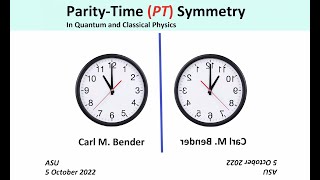
Parity-Time (PT) Symmetry in Quantum Theories - Theoretical Physics Colloquium
Explore complex-variable methods to extend quantum theories, uncovering PT-symmetric theories with remarkable properties verified in recent experiments.
A Possible Half-Integer Quantum Hall Effect: RQED Bulk Perspective and More
Explore the potential half-integer Quantum Hall Effect through RQED bulk perspective, delving into electromagnetic effects in strongly interacting matter.
Aspects of Chiral Symmetry Breaking in RQED
Explore chiral symmetry breaking in RQED with Alfredo Raya, delving into electromagnetic effects in strongly interacting matter.
Statistical Interaction for Quasi-Particles
Explore statistical interactions of quasi-particles in strongly interacting matter, focusing on electromagnetic effects and their implications in particle physics.
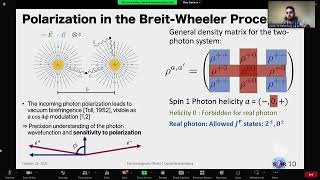
Studying the Electromagnetic Fields of Heavy-Ion Collisions with Photon-Mediated Processes
Explore electromagnetic fields in heavy-ion collisions through photon-mediated processes, focusing on cutting-edge research in nuclear physics.