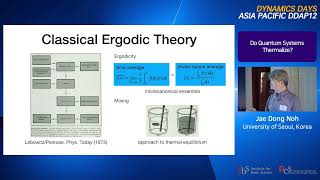
Do Quantum Systems Thermalize? - Understanding Quantum Thermalization and the Eigenstate Thermalization Hypothesis
Explore quantum thermalization, examining recent advances in understanding isolated quantum systems and their relaxation to thermal equilibrium states.
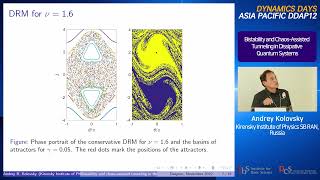
Bistability and Chaos-Assisted Tunneling in Dissipative Quantum Systems
Explore quantum bistability and chaos-assisted tunneling in dissipative systems, focusing on analytical estimates for quantum limit cycles and novel tunneling phenomena.
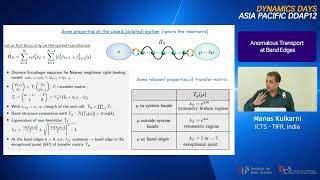
Anomalous Transport at Band Edges
Explore symmetries and transitions in non-Hermitian matrices, focusing on exceptional points in transfer matrices and their impact on conductance scaling and quantum phase transitions.
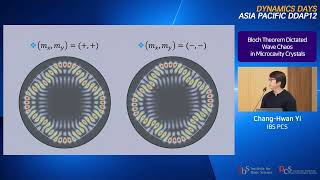
Bloch Theorem Dictated Wave Chaos in Microcavity Crystals
Explore wave chaos theory in cavity lattice systems, uncovering crystal momentum's role in internal cavity dynamics and its impact on light behavior and localization transitions.
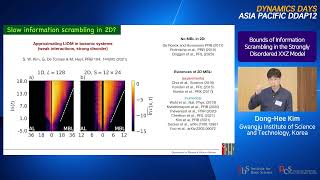
Bounds of Information Scrambling in the Strongly Disordered XXZ Model
Explore perturbative calculation of OTOC in disordered Heisenberg XXZ model, revealing logarithmic bounds of information scrambling in many-body localized systems.
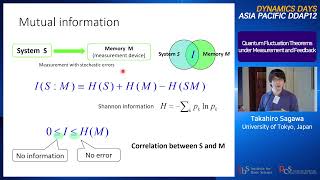
Quantum Fluctuation Theorems under Measurement and Feedback
Explore quantum fluctuation theorems, focusing on measurement and feedback in quantum systems. Gain insights into the connection between quantum thermodynamics and information theory.
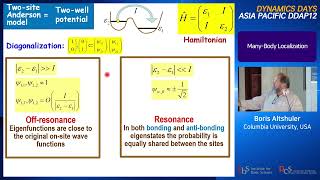
Many-Body Localization: From Anderson Localization to Quantum Chaos
Explore Anderson localization, its applications, and the concept of Many-Body Localization in quantum systems. Gain insights into integrable and chaotic behavior, ergodicity, and related phenomena.
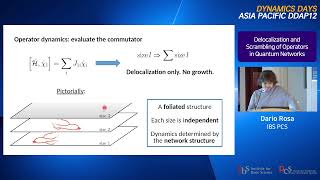
Delocalization and Scrambling of Operators in Quantum Networks
Explore operator delocalization in quantum networks, contrasting with operator growth and uncovering connections to scrambling and quantum chaos.
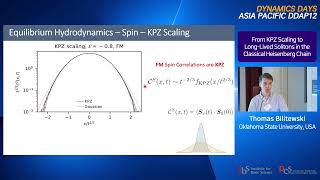
From KPZ Scaling to Long-Lived Solitons in the Classical Heisenberg Chain
Explore KPZ scaling and long-lived solitons in the classical Heisenberg chain, uncovering their origins and properties through innovative model interpolation and soliton analysis.
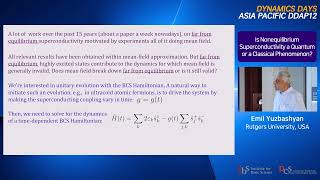
Is Nonequilibrium Superconductivity a Quantum or a Classical Phenomenon?
Explore the dynamics of nonequilibrium superconductivity, comparing quantum and classical descriptions through exact solutions and evaluating local observables in BCS superconductors.
The Moire the Merrier - Introduction to Moiré Materials in Quantum Physics
Explore moiré materials: atomically thin stacked structures enabling tunable quantum phenomena. Discover their potential for engineering exotic states of matter and technological applications.
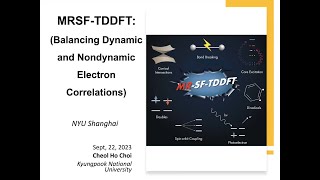
MRSF-TDDFT - Balancing Dynamic and NonDynamic Electron Correlations
Explore advanced quantum chemistry techniques for balancing dynamic and non-dynamic electron correlations in MRSF-TDDFT calculations.
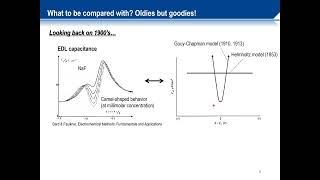
QM-Rooted Multiscale Simulation - Eyes to See the Unseen, Buried Electric Double Layer
Explore advanced QM-rooted multiscale simulation techniques to visualize and analyze hidden electric double layers in complex systems.
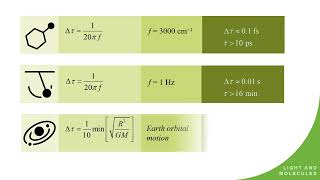
Nonadiabatic Dynamics in the Long Timescale - The Next Challenge in Computational Photochemistry
Explore nonadiabatic dynamics in long timescales and its impact on computational photochemistry. Gain insights into cutting-edge research challenges and potential solutions.
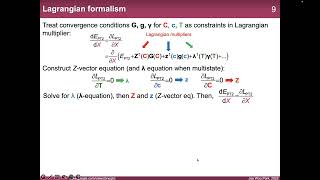
Multireference Quantum Chemistry for Exploring Potential Energy Surfaces
Explore potential energy surfaces using advanced multireference quantum chemistry techniques. Gain insights into complex molecular systems and their behavior.
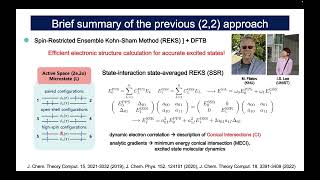
Calculation of Exciton Couplings Based on Density-Functional Tight-Binding Approach with Spin-Restricted Ensemble-Referenced Kohn-Sham Method
Explore density-functional tight-binding and spin-restricted ensemble-referenced Kohn-Sham methods for calculating exciton couplings in quantum chemistry.
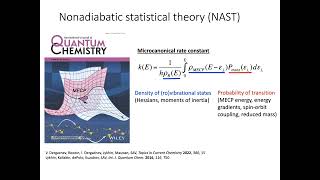
NAST: Nonadiabatic Statistical Theory Package for Predicting Kinetics of Spin-Dependent Processes
Explore nonadiabatic statistical theory for predicting spin-dependent process kinetics, comparing methods and examining real-world applications like ISC and surface reactions.
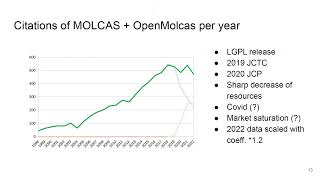
Paragatic Observations Over the Development of Software in Quantum Chemistry
Explore pragmatic insights into quantum chemistry software development, focusing on key trends and practical considerations in this evolving field.
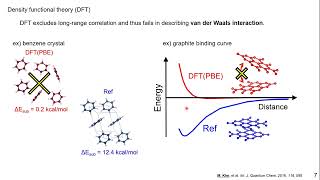
Efficient and Accurate van der Waals Correction for Density Functional Approaches in Material Simulations
Explore efficient van der Waals corrections for density functional approaches in material simulations, enhancing accuracy in computational chemistry.
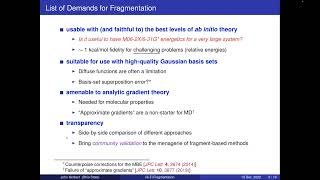
Energy-Screened Fragmentation Approach for Large-Scale Electronic Structure Calculations
Explore an innovative fragmentation approach for large-scale electronic structure calculations, enhancing computational efficiency in quantum chemistry.
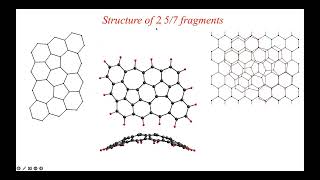
Towards Smart Algorithms of Structural Minimization of Low-Dimensional Lattices: Quantum Stability and Topology Conservation Theorem
Explore quantum stability and topology conservation in structural minimization of low-dimensional lattices through smart algorithms.