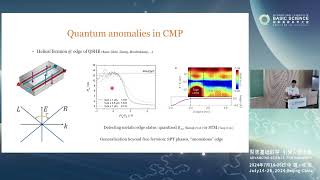
Detecting Quantum Anomalies in Open Systems
Explore novel approach for detecting quantum anomalies in open systems, focusing on mixed anomalies in spin chains and their distinctive characteristics in measurements.
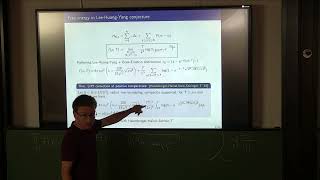
The Free Energy of the Dilute Bose Gas at Low Temperatures
Explore effective theories in classical and quantum particle systems, focusing on the free energy of dilute Bose gas at low temperatures.
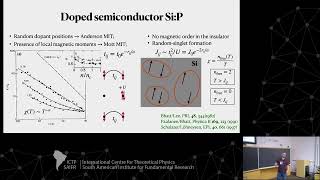
Kondo Screening Versus Random Singlet Formation in Highly Disordered Systems
Explore Kondo screening and random singlet formation in highly disordered systems, examining their interplay and implications for condensed matter physics.
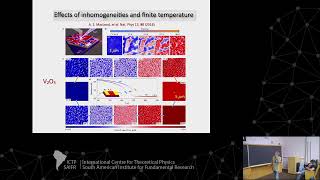
The Domain Wall Between a Mott Insulator and a Metal is an Anomalous Metal
Explore the intriguing properties of the domain wall between Mott insulators and metals, uncovering its anomalous metallic nature.
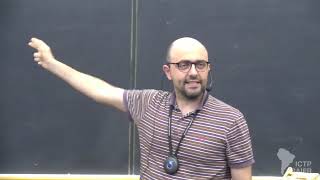
Tutorial Session on Emergent Phenomena in Non-Equilibrium Quantum Many-Body Systems
Explore emergent phenomena in non-equilibrium quantum many-body systems through an in-depth tutorial session led by expert Marcello Dalmonte from ICTP-Trieste, Italy.
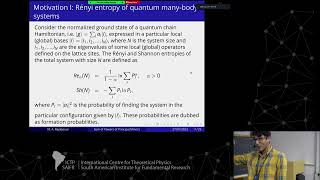
Minors: How I Learned to Stop Worrying and Love the Exponential
Explore exponential complexity in quantum systems through minors, gaining insights into non-equilibrium phenomena and many-body physics.
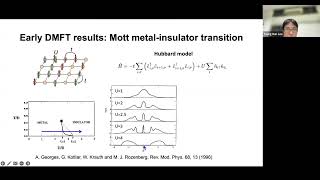
An Efficient and Accurate Approach to Strongly Correlated Materials
Explore an enhanced method for simulating strongly correlated materials using ghost-rotationally-invariant slave-boson (g-RISB) approach, improving accuracy in describing material properties with realistic parameters.
ITensorNetworks.jl - Introduction to Tensor Network Algorithms in Julia
Explore tensor network algorithms and their implementation in Julia using ITensorNetworks.jl for efficient quantum many-body simulations.
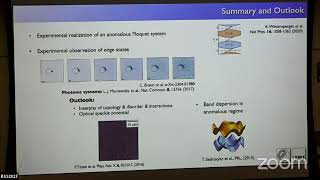
Ultracold Atom Quantum Simulators II - July 27
Explore advanced concepts in ultracold atom quantum simulators with Professor Immanuel Bloch's in-depth lecture at BSS2023.
Ultracold Atom Quantum Simulators I - July 26
Explore ultracold atom quantum simulators with Immanuel Bloch, delving into cutting-edge physics research and applications.
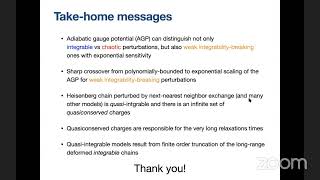
Adiabatic Eigenstate Deformations and Weak Integrability Breaking of Heisenberg Chain
Explore adiabatic eigenstate deformations and weak integrability breaking in the Heisenberg chain, investigating quasiconserved charges and the adiabatic gauge potential's behavior in perturbed XXX chains.
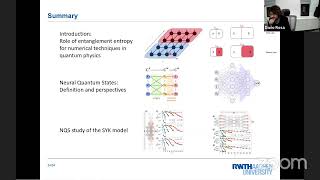
Neural Quantum States Approach to Volume Law Ground States
Explore neural quantum states for representing volume law ground states, focusing on limitations and applications in computational quantum physics.
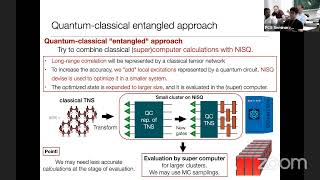
Quantum-Classical Entangled Approach with Tensor Networks for Spin Liquid
Explore quantum-classical entangled approaches using tensor networks for spin liquid states. Delve into efficient quantum circuit design for near-future noisy quantum computers, focusing on the honeycomb lattice Kitaev model.
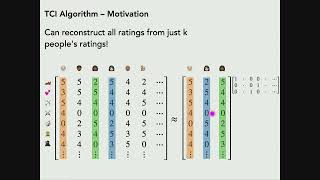
Tensor Network for Machine Learning Applications - Lecture 3
Explore advanced tensor network techniques for machine learning, focusing on applications and practical implementations in data analysis and modeling.
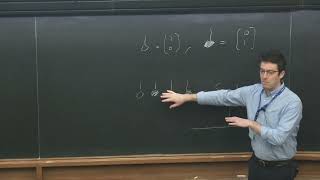
Tensor Network for Machine Learning Applications - Part 2
Explore advanced tensor network techniques for machine learning, focusing on applications and recent developments in the field.
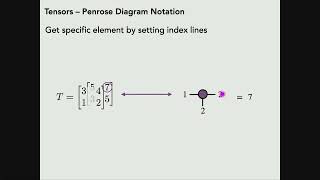
Tensor Network for Machine Learning Applications - Lecture 1
Explore tensor networks' applications in machine learning, focusing on their potential to enhance computational efficiency and model complexity.
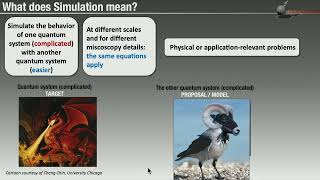
Quantum Simulations - Lecture 1
Explore quantum simulations with expert Francesca Ferlaino, delving into advanced concepts and cutting-edge research in this field of condensed matter and statistical physics.
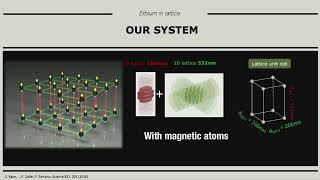
Quantum Simulations - Part 2
Explore advanced quantum simulation techniques and their applications in condensed matter physics, guided by expert Francesca Ferlaino from the University of Innsbruck and IQOQI.
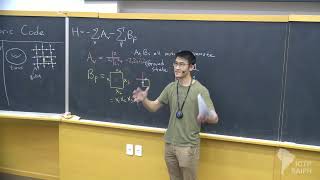
From Pure to Mixed Quantum Phases of Matter - Class 4
Explore quantum phases of matter, transitioning from pure to mixed states, in this advanced theoretical physics lecture by Tim Hsieh from Perimeter Institute.
From Pure to Mixed Quantum Phases of Matter - Class 1
Explore quantum phases of matter, from pure to mixed states, in this advanced theoretical physics lecture by Tim Hsieh at the Perimeter-SAIFR-IFT Journeys.
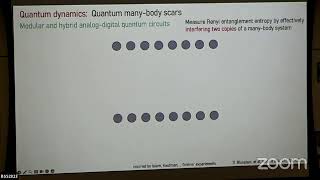
Quantum Simulation with Rydberg Atoms II - July 19
Explore advanced quantum simulation techniques using Rydberg atoms, focusing on cutting-edge applications and recent developments in the field.