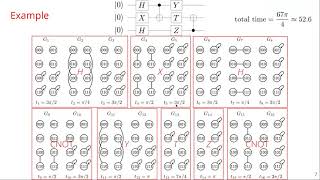
Simplifying Dynamic Quantum Walks for Quantum Gates
Explore simplification techniques for dynamic quantum walks in quantum gate implementation, focusing on Hadamard gates and cubic gates with practical examples and observations.
David Gross: Stabilizer Formalism & Quantum Error Correction Through the Lens of Tensors
Explore advanced quantum error correction techniques, focusing on the stabilizer formalism and its applications in quantum fault tolerance, using tensor-based approaches and group theory.
Oscillator-to-Oscillator Codes Do Not Have a Threshold
Explores limitations of oscillator-to-oscillator codes in quantum information, proving they lack a threshold property for error correction when using constant squeezing and maximum likelihood decoding.
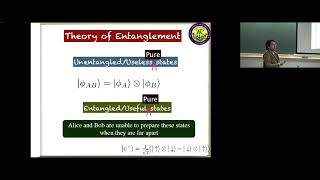
Quantum Phase Transitions Through Quantum Information Window by Aditi De
Explore quantum phase transitions through entanglement, focusing on bipartite and multipartite entanglement as detectors. Discover how entanglement plays a crucial role in detecting dynamical quantum phase transitions.
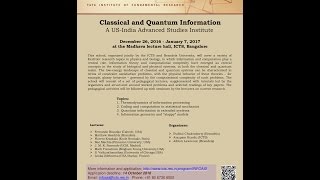
From Information Theory to Learning via Statistical Physics - Introduction
Explore connections between information theory, statistical physics, and learning. Delve into classical statistics, high-dimensional problems, and Bayesian approaches, with applications in signal processing and regression.
Quantum Control for Trapped Ion
Explore advanced quantum control techniques for trapped ions, including Hamiltonians, gates, error mitigation, and robust sequences for improved quantum operations.
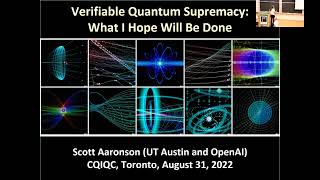
Verifiable Quantum Supremacy - What I Hope Will Be Done
Explore the future of quantum computing, challenges in verifying quantum supremacy, and potential solutions with Scott Aaronson's expert insights and analysis.
A Single T-Gate Makes Distribution Learning Hard
Explore the complexity of distribution learning in quantum computing, focusing on the impact of a single T-gate on computational hardness.
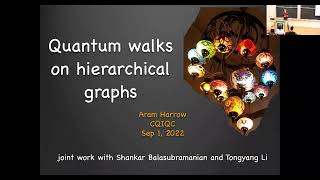
Quantum Walks on Hierarchical Graphs
Explore quantum walks on hierarchical graphs, examining their properties and applications in quantum information theory and quantum computing.
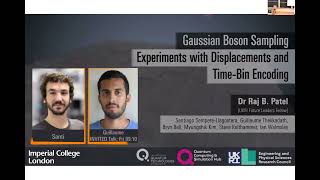
Gaussian Boson Sampling Experiments with Displacements and Time-Bin Encoding
Explore cutting-edge quantum information experiments using Gaussian Boson Sampling, focusing on displacements and time-bin encoding techniques in this advanced physics lecture.
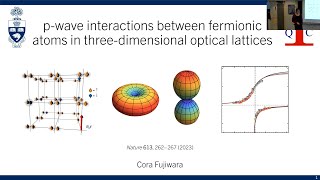
Strongly Interacting P-Wave Fermionic Atoms in Three-Dimensional Optical Lattices
Explore p-wave fermionic atoms in 3D optical lattices, focusing on strong interactions and their implications for quantum information and condensed matter physics.
Information-Theoretic Quantum Cryptography Part 2 of 2 - IPAM at UCLA
Explore advanced quantum cryptography topics, including secure delegated computation, quantum key distribution, and certified deletion, with a focus on security against unbounded adversaries.
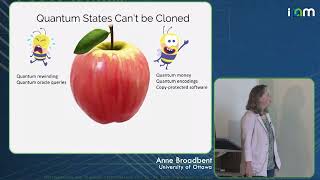
Information-Theoretic Quantum Cryptography Part 1 of 2 - IPAM at UCLA
Explore information-theoretic quantum cryptography, covering topics like quantum money, secure computation, and key distribution. Gain insights into the interplay between quantum information and cryptography.
Introduction to Quantum Computing - Part 3 - IPAM at UCLA
Explore density matrices, mixed states, and quantum channels in cryptography. Learn about POVM measurement and distance measures for quantum states and operators.
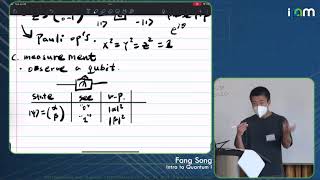
Introduction to Quantum Computing - Part 1 of 3
Explore quantum computing basics: qubits, unitary operations, superposition, entanglement, and no-cloning. Discover quantum circuits, information processing protocols, and elementary algorithms like Deutsch-Josza.
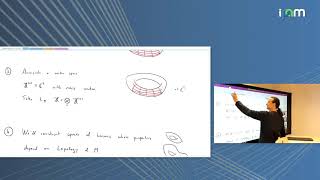
Stabilizer Formalism & Quantum Error Correction Through the Lens of Tensors - Part 1
Explore stabilizer formalism and quantum error correction using tensor methods. Learn about many-body systems, error correction challenges, and connections to finite symplectic geometries.
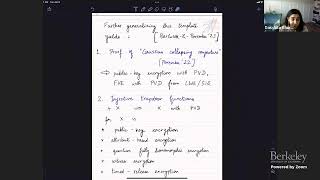
Cryptography with Certified Deletion
Explore quantum cryptography's certified deletion, enabling verifiable information-theoretic deletion of encrypted secrets, with applications in various cryptosystems and recent advancements in public verification.
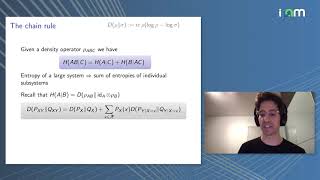
A Chain Rule for the Quantum Relative Entropy
Explores a chain rule for quantum relative entropy, its implications for quantum statistics, and the comparison of adaptive vs non-adaptive strategies in quantum channel discrimination.
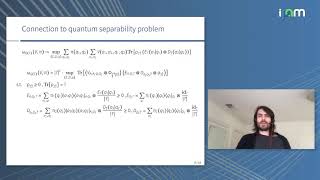
Characterising Quantum Correlations of Fixed Dimension
Explores semidefinite programming for quantum correlations, improving approximation algorithms for two-player free games with quantum assistance using entropy inequalities and de Finetti theorems.
Quantum "Supremacy" - Lecture 25 of Quantum Computation at CMU
Explore quantum supremacy, its challenges, and implications in computational theory. Delve into error correction, threshold theorems, and the potential of quantum systems.
Quantum Complexity - Quantum Computation at CMU
Explore quantum complexity, error probabilities, and complexity classes in this advanced lecture on quantum computation and information theory.