Empowering the Quantum Revolution with Q#
Explore quantum computing's revolutionary potential and learn to develop quantum solutions using Microsoft's Quantum Development Kit and Q# programming language.
Quantum Gates and Circuits - Part 2 - Lecture 9
Explore quantum gates and circuits, focusing on multi-qubit operations, CNOT gates, and circuit identities. Gain insights into superposition and universality in quantum computing.
Quantum Mass Production Theorems - Implementing Multiple Copies of Quantum Circuits
Delve into quantum circuit optimization through mass production theorems, exploring efficient implementations of multiple copies of quantum transformations and their theoretical implications.
The Learnability of Pauli Noise in Quantum Gate Characterization
Delve into quantum benchmarking algorithms and Pauli noise characterization in Clifford gates, exploring learnable information through cycle space analysis and experimental CNOT gate validation.
Optimizing Control of Quantum Information in Higher Dimensions
Explore optimal control of quantum information in higher dimensions, focusing on qutrit control and speed limits for two-qubit gates with weakly anharmonic qubits.
Platonic Ququart Benchmarking - Characterizing 4-Level Quantum Systems
Explore ququart systems, implement character randomized benchmarking, and assess quantum gate errors using platonic solid symmetries and NMR techniques.
The Hadamard Test: Analysis - Quantum Computer Programming - Lesson 83
Analyze the Hadamard Test and summarize the Rotation Estimation algorithm in quantum computing, enhancing understanding of these key concepts.
IncrL's Rotation Planes: Perpendicular - Quantum Computer Programming - Lesson 93
Explore perpendicular rotation planes for Increment-mod-L operation in quantum computing, completing a crucial concept in the series.
Detecting Medium 1-Qubit Rotations - Quantum Computer Programming Lesson 61
Learn to detect medium-range rotations in 1-qubit systems for Rotation Estimation, a crucial skill in quantum computing. Explore techniques to identify rotations between 30-60 degrees.
1-Qubit Rotation Estimation to Factor 2 - Lesson 62
Learn to estimate 1-qubit Mystery Rotation angles within a factor of 2, a key skill in quantum computing. Part of a comprehensive series on quantum programming fundamentals.
One Steering Wheel Vector for IncrL - Lesson 89
Explore IncrL's 2-D rotation planes and discover the first vector in this advanced quantum programming lesson, part of a comprehensive series.
All the Planes of Rotation for IncrL - Quantum Computer Programming - Lesson 91
Explore all 2-D rotation planes for the Increment-mod-L operator in quantum computing, advancing understanding of quantum operations and transformations.

What Is Quantum Machine Learning?
Friendly introduction to quantum computing and machine learning, covering qubits, quantum gates, entanglement, and their applications in generative modeling and optimization.
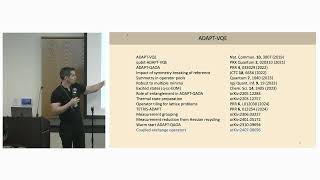
Control-Based Variational Quantum Algorithms and Dynamical Noise Suppression
Explore quantum control optimization techniques and noise suppression methods for variational algorithms, focusing on pulse design and geometric approaches to enhance quantum computations.
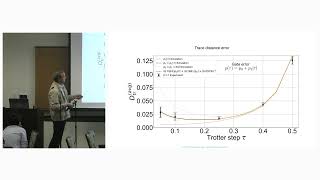
Characterizing the Noise in Quantinuum's Quantum Computers - Methods and Measurements
Explore advanced quantum computer error modeling and validation techniques, focusing on Quantinuum's systems and their implications for near-term quantum applications and logical-level operations.
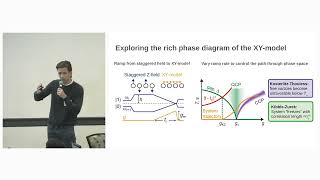
Thermalization and Criticality on an Analog-Digital Quantum Simulator
Explore quantum thermalization dynamics and phase transitions using a 69-qubit superconducting quantum simulator, examining state preparation, evolution patterns, and energy transport mechanisms.
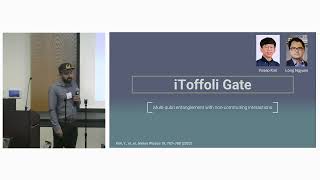
Realizing Multi-Qubit Entangling Interactions on a Superconducting Circuit Testbed with Quantum Control
Discover how to implement efficient three-qubit gates in superconducting quantum processors using microwave control techniques to achieve high-fidelity multi-qubit entanglement.
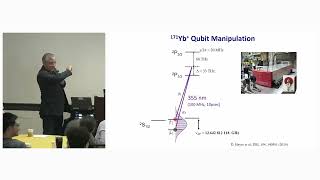
Gate and Analog Quantum Processing with Trapped Ions
Explore trapped ion quantum computing fundamentals, from qubit manipulation to architectural scaling, emphasizing the unified nature of gate-based and analog processing methods.
Optimal Hadamard Gate Count for Clifford+T Synthesis of Pauli Rotations Sequences
Discover an algorithm for minimizing Hadamard gates in quantum circuits, optimizing T-count reduction and improving fault-tolerant quantum computing efficiency through Pauli rotation sequence synthesis.
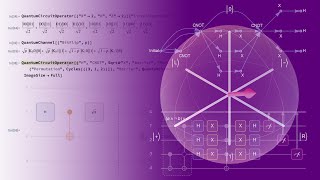
Introduction to the Wolfram Quantum Computation Framework
Explore the Wolfram Quantum Computation Framework, covering quantum states, transformations, algorithms, and circuits using Wolfram Language for quantum hardware implementation.
Basics of Quantum Computing - Lecture 21
Explore quantum computing fundamentals, including key concepts and potential applications in computational problem-solving and information processing.