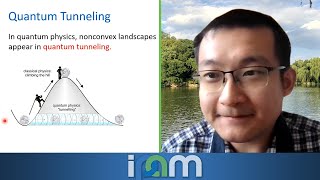
On Quantum Speedups for Nonconvex Optimization via Quantum Tunneling Walks
Explore quantum speedups for nonconvex optimization using quantum tunneling walks, offering advantages over classical algorithms for problems with high, thin barriers between local minima.
Generating Approximate Ground States of Molecules Using Quantum Machine Learning
Explore quantum machine learning for generating molecular ground states, focusing on potential energy surfaces and efficient state preparation using variational quantum circuits and neural networks.
Learning to Predict Arbitrary Quantum Processes - IPAM at UCLA
Efficient machine learning algorithm for predicting quantum processes, combining state and observable learning techniques. Demonstrates potential for fast prediction of complex quantum dynamics outputs.
Learning Beyond Stabilizer States - IPAM at UCLA
Exploring efficient learning algorithms for quantum states produced by Clifford circuits with T gates, using Bell difference sampling and property testing for stabilizer nullity.
Overview of Learning Structured Quantum States - IPAM at UCLA
Explore efficient methods for learning structured quantum states, focusing on models and classes that require fewer copies for estimation, with insights on Boolean functions and alternative learning approaches.
Should We Use Parameterized Quantum Circuits for Machine Learning?
Exploration of parameterized quantum circuits for machine learning, discussing evidence for and against their use, focusing on learning output distributions and supervised learning applications.
Exponential Concentration in Quantum Generative Modeling and Quantum Kernel Methods
Explore exponential concentration in quantum generative modeling and kernel methods, examining causes, consequences, and the impact of shot noise on these quantum machine learning models.
A Unified Theory of Barren Plateaus for Deep Parametrized Quantum Circuits
Unified theory explaining barren plateaus in deep parametrized quantum circuits, covering expressiveness, entanglement, locality, and noise effects on variational quantum computing schemes.
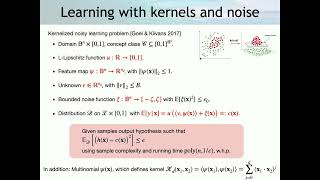
Learning of Neural Networks with Quantum Computers and Learning of Quantum States with Graphical Models
Explores quantum algorithms for neural network learning and quantum state learning using graphical models, showcasing advancements in computational efficiency and sample complexity for specific quantum states.
Signal and Noise - Learning with Random Quantum Circuits and Other Agents of Chaos
Explores quantum learning in noisy computation, discussing error mitigation limitations and the surprising benefits of non-unital noise in quantum machine learning, challenging conventional understanding.
Training Binary Neural Networks in Quantum Superposition - IPAM at UCLA
Explore quantum hypernetworks for training binary neural networks, unifying parameter, hyperparameter, and architecture optimization in a single quantum-based approach for efficient deep learning deployment.
How to Rethink Quantum Machine Learning - IPAM at UCLA
Explore the intersection of quantum computing and machine learning, challenging conventional approaches and examining core quantum routines from a generalization perspective.
Nathan Wiebe - Quantum Machine Learning
Explore quantum machine learning concepts and applications in this comprehensive lecture by Nathan Wiebe, delving into mathematical aspects and cutting-edge research in the field.
Do Quantum Computers Have Applications in Machine Learning and Combinatorial Optimization
Explores quantum computing's potential in machine learning and optimization, discussing recent developments, comparative power, limitations, and future prospects in these fields.
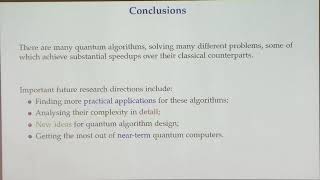
An Overview of Quantum Algorithms
Explore quantum algorithms' applications in cryptography, search, optimization, and quantum system simulation, covering both large-scale and near-term quantum computing approaches.
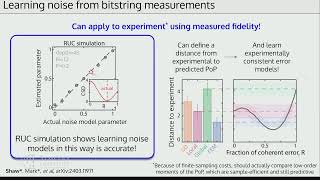
Using Chaos to Characterize a Programmable Analog Quantum Simulator
Explore chaos in analog quantum simulators, uncovering random behavior, estimating fidelity, and learning noise models for large-scale entangled states using Rydberg atom arrays.
High-fidelity and Fault-tolerant Teleportation of a Logical Qubit on a Trapped-ion Quantum Computer
Explore fault-tolerant quantum teleportation using trapped-ion technology, focusing on error correction codes, circuit designs, and real-time decoding for future large-scale quantum devices.
Why You Should Believe in Quantum Computing
Explore quantum computing basics, advantages, and potential applications in cryptography and sensors. Gain insights into this revolutionary technology's impact on society and economy.
Evidence for the Utility of Quantum Computing Before Fault Tolerance
Explore noise mitigation in quantum computing, demonstrating reliable results from a 127-qubit processor and discussing the potential of pre-fault-tolerant quantum devices.
Fundamental Limits to Quantum Computation
Explores quantum computing's potential and limitations, discussing learnability, error mitigation, and non-unital noise impacts on near-term devices and fault-tolerant systems.
Hardware-Efficient Quantum Computing Using Qudits
Explore hardware-efficient quantum simulations using qudits, enabling complex gauge field computations and opening doors for near-term quantum devices.