Lattice QCD - Class 4
Delve into advanced Lattice QCD concepts with expert Amy Nicholson, exploring quantum chromodynamics applications in nuclear physics and few-body systems through computational methods.
Relativistic Scattering Theory - Class 4
Delve into relativistic scattering theory fundamentals, exploring advanced concepts in nuclear physics and quantum chromodynamics through expert insights and theoretical frameworks.
Finite-Volume Physics - Class 2
Delve into advanced concepts of finite-volume physics through expert discussions on nuclear physics, quantum chromodynamics, and few-body systems in theoretical particle physics.
Finite-Volume Physics - Class 1
Dive into fundamental concepts of finite-volume physics and its applications in nuclear physics, exploring connections between quantum chromodynamics and few-body systems.
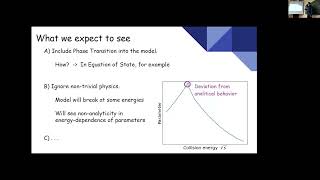
Dynamic Picture of Relativistic Heavy-Ion Collisions
Delve into the fundamental physics of relativistic heavy-ion collisions and their dynamic behavior through advanced theoretical analysis and modeling techniques.
Broad Questions in Neutrino Physics - Panel Discussion
Panel discussion exploring broad questions in neutrino physics, covering topics from short baseline anomalies to cross-sections, experiments, and future directions. Experts discuss challenges, opportunities, and interdisciplinary approaches in the field.
Isovector Axial Vector Form Factors of the Nucleon from Lattice QCD - Konstantin Ottnad
Exploración de factores de forma axial vectorial isoescalares del nucleón mediante cálculos de QCD en retículo, presentando resultados, métodos y comparaciones con datos experimentales.
Introduction to Lattice and Neutrino Cross Sections - Andre Walker Loud
Explore lattice QCD techniques for calculating neutrino cross sections, addressing challenges and future directions in this interdisciplinary field of particle physics.
Status of Existing Neutrino Experiments - Panel Discussion
Panel discussion on current neutrino experiments, exploring challenges, advancements, and future directions in experimental neutrino physics, with focus on data analysis, cross-sections, and collaboration opportunities.
The Concept of Mass - With Jim Baggott
Explore the evolution of our understanding of matter, from ancient Greek atoms to quantum fields and the Higgs boson, in this engaging talk by science writer Jim Baggott.
Thermalization in Quantum Chromodynamics - Ab Initio Approaches and Interdisciplinary Connections
Explore thermalization in quantum chromodynamics, focusing on ab initio approaches and interdisciplinary connections. Discover universal phenomena and the effectiveness of hydrodynamics in various physical systems.
Perturbative QCD for Colliders - Lecture 1
Comprehensive introduction to perturbative QCD for colliders, covering quantum chromodynamics, color theory, gluon fields, asymptotic freedom, and renormalization group equations with practical examples.
The QCD Axion - Lecture 1
Comprehensive lecture on QCD axions, covering theoretical foundations, strong CP problem, spontaneous symmetry breaking, and axion models. Explores potential solutions to dark matter mysteries.
A Golden Age in Physics - Heavy Ion Physics at High Energies
Explore the fascinating world of heavy ion physics, from quantum chromodynamics to quark-gluon plasma. Discover cutting-edge experiments, theoretical challenges, and the future of this exciting field.
Lattice Gauge Theory
Explore color confinement, flux tubes, and lattice simulations in non-Abelian gauge theories. Gain insights from experts on this fundamental physics phenomenon and its implications.
Neutrinos and Astrophysics Open Questions - Panel Discussion
Expert panel explores cutting-edge developments in neutrino astrophysics, discussing open questions and interdisciplinary connections to advance our understanding of these elusive particles and their cosmic implications.
Outstanding Questions in Cross Section Physics - Panel Discussion
Panel discussion exploring cutting-edge questions in neutrino cross section physics, featuring experts addressing precision measurements, experimental challenges, and interdisciplinary connections in the field.
Future Neutrino Experiments - Panel Discussion
Panel discussion on future neutrino experiments, exploring new physics potential, precision measurements, and interdisciplinary connections in neutrino physics. Experts discuss advancements and challenges in the field.
Hadronic Contribution to the Muon Anomalous Magnetic Moment From Lattice QCD - Thomas Blum
Explore lattice QCD calculations of hadronic contributions to muon's anomalous magnetic moment. Learn about recent advances and future opportunities in particle physics theory.
Passion Extreme Light - Exploring High Energy Physics and Laser Technology
Nobel laureate Gérard Mourou explores extreme-light lasers as universal sources for high-energy radiation, particles, and extreme conditions, discussing their potential to address fundamental physics questions and advance laser-matter interactions.
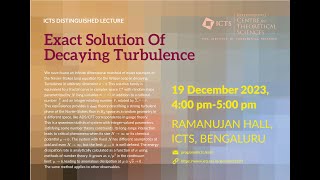
Exact Solution of Decaying Turbulence by Alexander Migdal
Explore an infinite dimensional manifold of exact solutions for the Navier-Stokes loop equation in decaying turbulence, presented by renowned physicist Alexander Migdal.