
Host a Python Discord Bot on AWS Lambda
Create and host a Python Discord bot on AWS Lambda for free. Learn to use Discord's Interaction HTTP endpoints, Flask, and AWS CDK for a scalable and cost-effective solution.
Visualizing SpaceX Launches With Python - Full Tutorial
Learn to create a web application visualizing SpaceX launch data using Python, Flask, HTML, and CSS. Covers API integration, data display, and deployment for global access.
How to Host Flask App on Ubuntu 18 VPS Using Virtual Environment
Learn to deploy a Flask application on Ubuntu 18 VPS using a virtual environment, covering setup, configuration, and hosting best practices for Python web applications.

Python Lambda Functions - Using Anonymous Functions
Learn to create and use anonymous Lambda functions in Python, exploring their syntax, arguments, and comparison with standard functions.

Python Regular Expressions - Defining Search Patterns and More
Learn to define search patterns and manipulate text using Python's regular expressions module, enhancing your ability to extract and process information from various data sources.
Beets - A Open Source, CLI Tool for Identifying and Tagging Your Music with Correct Metadata
Discover Beets, a CLI tool for effortlessly identifying and tagging music with accurate metadata. Learn installation methods, troubleshooting tips, and how to use Beets to organize your music library.
Exploring AWS CloudShell - 2020 Feature Launch
Discover AWS CloudShell: a virtualized environment with pre-installed tools like AWS CLI, PowerShell, Python, and Node.js. Explore its features and learn how it inherits your AWS Console permissions.
Implementing AWS Step Functions with Lambda and PowerShell Activity Tasks
Learn to implement AWS Step Functions using Lambda and PowerShell, covering task states, activity tasks, and various state types for efficient workflow management in cloud environments.
Integrate Self-Hosted Windmill and Baserow Database Low-Code Services with Python
Integrate self-hosted Windmill and Baserow using Python to build applications with low-code tools and database storage, leveraging REST APIs for data management.
Traveling Through a Secure API with Python and Auth0
Learn to build a secure "Where Have I Been" map application using Python and Auth0, covering API endpoints, data handling, and deployment in this step-by-step tutorial.
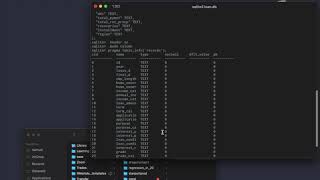
Introduction to SQLite - CSV to SQLite Import
Learn to import CSV data into SQLite databases efficiently using Python, with practical examples for financial data management in banking contexts.
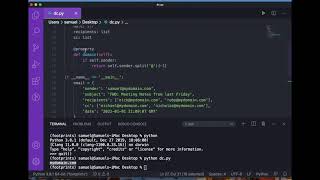
Dataclasses in Python 3.7 - Implementation and Usage
Learn to implement and utilize Python 3.7's dataclasses feature, enhancing code efficiency with automatic special method generation for user-defined classes.
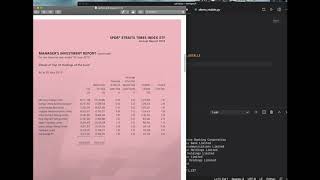
Automated Research: Extracting Companies from PDF and Googling Them Using PyPDF2 and Regex - Python Tutorial
Extract company names from PDFs and automate research using Python, regex, and web browsing. Ideal for beginners looking to streamline data extraction and analysis tasks.
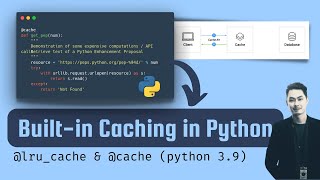
Python's Cache and LRU Cache Decorators - Optimizing Computations
Explore Python's @cache and lru_cache decorators to optimize performance, reduce computations, and save resources with practical examples and comparisons.
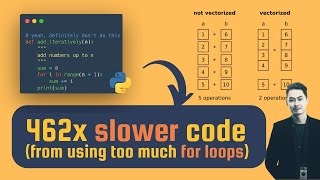
Use Less For-Loops, Use More Vectorization - Improving Code Efficiency
Optimize Python code by replacing for-loops with vectorization techniques, improving efficiency and speed while maintaining readability and functionality.
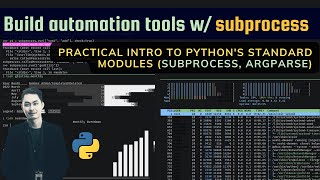
Practical Introduction to Python's Subprocess Module for Developer Workflow Automation
Learn to automate developer workflows using Python's subprocess module. Build a CLI tool to create directories, initialize Git, set up virtual environments, and manage tasks efficiently.
Python Unit Testing and Package Submission - Build with Python 5
Learn Python unit testing techniques, mock print outputs, and update PyPI packages to enhance your development skills and package management abilities.
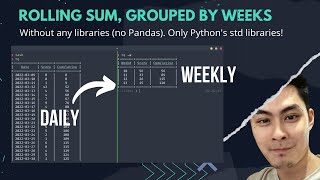
Creating Rolling Sum Grouped by ISO Weeks Using Python - No Pandas Required
Learn to implement weekly rolling sums using Python's standard library, exploring itertools' groupby, enumerate, and isocalendar. Enhance your data manipulation skills without relying on external libraries like pandas.
Python Code Refactoring - Writing Modular Functions
Explore techniques for refactoring monolithic Python functions into smaller, modular, and testable units. Learn mental models for writing maintainable and predictable code.
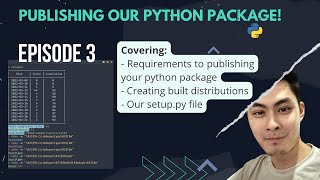
Building and Publishing a Python Package - How to Distribute on PyPI
Learn to create, structure, and publish a Python package on PyPI, covering setup.py, distribution types, and the upload process in under 15 minutes.
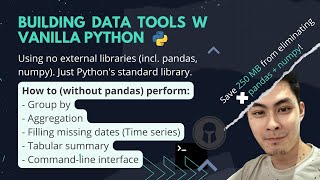
TaskWarrior Command Line Productivity Scoreboard - Build with Python
Build a CLI productivity scoreboard for TaskWarrior using Python's standard libraries. Learn data manipulation techniques without external dependencies like pandas or numpy.