A Double-Categorical Framework for Constructive Cognitive Architectures
Explore a mathematical framework for cognitive architectures using category theory, examining rewriting, virtual equipments, and profunctor optics to formalize complex cognitive mechanisms.

Making Up Our Minds
Explore how minds and thoughts are constructed through cognitive processes, examining the nature of consciousness, memory, and perception using interdisciplinary models and mathematical frameworks.
An Integrated Information Decomposition Account of Emergent Mental Phenomena
Explore the intersection of Integrated Information Theory and Partial Information Decomposition to understand consciousness and causal emergence, offering new perspectives on mental phenomena and selfhood.
How Morphological Computation Shapes Integrated Information in Embodied Agents
Exploring the relationship between morphological computation and integrated information in embodied agents, highlighting their antagonistic nature and impact on brain-body-environment interactions.
Sketches of a Mathematical Theory of Qualia
Exploración matemática de los qualia: definición, estructura y relación con la teoría cuántica. Propone un modelo de conciencia basado en principios abstractos del comportamiento de dispositivos que detectan qualia.

Socially Assistive Robotics - SAR - with Maja Matarić
Explore socially assistive robotics: AI-powered machines that motivate and coach humans through social interaction, revolutionizing healthcare, education, and rehabilitation.

Working Memory Influences Reinforcement Learning Computations in Brain and Behavior
Explore how working memory influences reinforcement learning in the brain, examining experimental results, genetic factors, and EEG data to uncover neural mechanisms of learning.
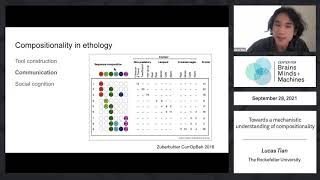
Towards a Mechanistic Understanding of Compositionality
Explore the concept of compositionality across various domains, including language, tool use, and drawing, with insights into its mechanisms and applications in cognitive science.
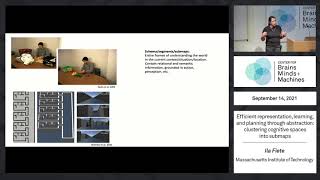
Efficient Representation, Learning, and Planning Through Abstraction - Clustering Cognitive Spaces Into Submaps
Explore efficient representation and learning through abstraction, focusing on cognitive space clustering and its impact on memory, navigation, and planning in complex environments.
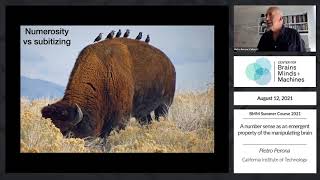
A Number Sense as an Emergent Property of the Manipulation Brain
Explore how number sense emerges from brain manipulation, examining experiments, perceptions, and the role of supervised learning in developing numerical understanding.
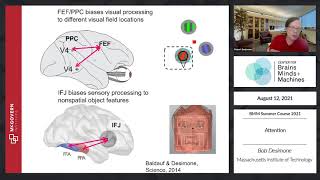
Attention
Explore selective attention, eye movements, and neural synchrony in this comprehensive examination of cognitive processes and perceptual mechanisms.

Computational Models of Cognition - Reverse-Engineering Common Sense in the Human Mind and Brain Pt 1
Explore cognitive modeling to reverse-engineer human common sense, examining AI progress, scientific context, and probabilistic programming techniques for capturing learning and constructing models.

Cognitive and Computational Foundations for Collective Human Intelligence
Explore cognitive and computational foundations of collective human intelligence with MIT's Josh Tenenbaum in this insightful presentation from IPAM's workshop.
Is Mathematical Interest Just a Matter of Taste?
Explore the nature of mathematical interest with Fields Medalist Timothy Gowers, examining whether it's subjective or rooted in objective criteria.

Is Pavlovian Password Management the Answer? - Exploring Operant Conditioning in Cybersecurity
Explore Pavlovian conditioning in cybersecurity, focusing on password management strategies, reinforcement techniques, and practical applications through examples and demonstrations.
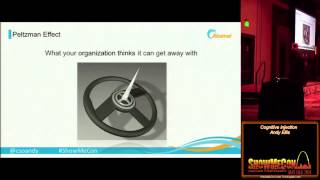
Cognitive Injection: Understanding and Improving Decision-Making - Lecture 9
Explore cognitive biases in decision-making, risk assessment, and security through interactive discussions and real-world examples. Learn strategies to improve critical thinking and risk management.
Alluring Euphoria - Happiness as Defined by a Drag Queen
Eva Le Queen shares her journey through nursing, corporate life, and drag, revealing insights on finding genuine happiness and achieving personal euphoria.

From Struggles to Smiles - A Journey of Resilience and Personal Growth
Inspirational journey from poverty to success, highlighting resilience, determination, and keys to happiness. Dr. Pankaj's story offers insights on personal growth and finding fulfillment despite life's challenges.
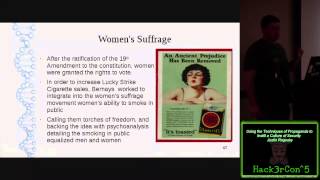
Using Propaganda Techniques to Instill a Culture of Security
Learn effective security awareness techniques using propaganda methods, from historical examples to practical implementation strategies for cultural change in organizations.
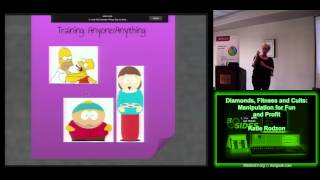
Diamonds, Fitness and Cults - Manipulation for Fun and Profit
Explore manipulation techniques in marketing, psychology, and social engineering, covering topics like desensitization, habit formation, and hypnosis for ethical understanding and defense.
Information Security - The Psychological Gap
Explore the psychological aspects of information security and their impact on cybersecurity practices with expert insights from Ivan Salter.