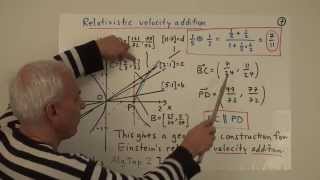
Relativistic Velocity and Core Circles in Rational Geometry - Lecture 4
Exploring relativistic velocity and core circles in rational geometry, extending Paul Miller's protractor concept to projective quadrance and comparing Euclidean and relativistic geometries.
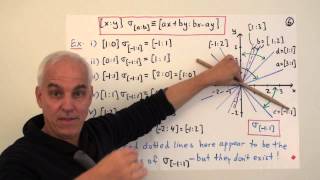
Isometry Groups of the Projective Line - Rational Geometry Math Foundations 138
Explore isometry groups of the projective line, focusing on rotations and reflections. Learn about symmetry, group theory, and their algebraic relationships in a concrete, accessible way.
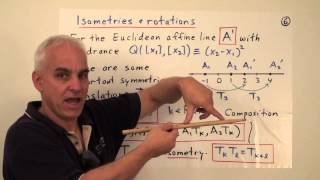
Algebraic Structure on the Euclidean Projective Line - Rational Geometry Math Foundations 137
Explores algebraic structure on the Euclidean projective line, covering projective formulas, isometries, rotations, and their compositions. Connects to chaos theory and complex number multiplication.
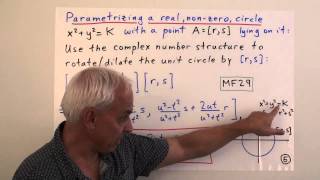
The Projective Line, Circles and the CQQ Theorem - Part 2
Explores advanced geometry concepts including general circles, complex numbers, and the Cyclic Quadrilateral Quadrea theorem, emphasizing projective parametrization and transformations in the complex plane.
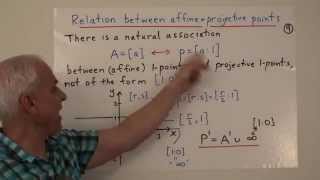
Mathematical Space and Basic Duality in Geometry - Rational Geometry Math Foundations 122
Exploring fundamental concepts of mathematical space, including the duality between affine and projective views, Cartesian geometry, and the relationship between affine and projective lines.
Complex Numbers and Curves in 19th Century Mathematics
Explore complex numbers, algebraic curves, and their intersection with projective geometry and topology. Discover how these concepts revolutionized 19th-century mathematics and laid the foundation for modern algebraic geometry.
The Rational Number Line and Irrationalities - Famous Math Problems 19b
Geometric approach to modeling the continuum using the rational number line. Explores properties, projective view, and introduces irrationalities through Euclidean geometry and polynomial equations.
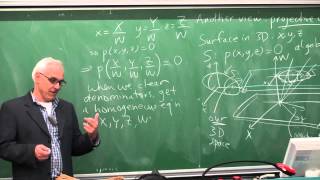
More General Surfaces in Differential Geometry - Lecture 22
Explores advanced surface types in differential geometry, including ruled and developable surfaces, minimal surfaces, algebraic surfaces, and projective constructions, with historical context and mathematical insights.
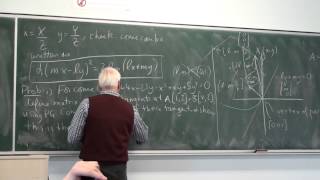
Curvature for the General Parabola - Differential Geometry Lecture 13
Explores curvature of general parabolas using projective geometry, focus-directrix definition, and local behavior. Introduces formulas for parabola curvature as a foundation for understanding curvature of general curves.
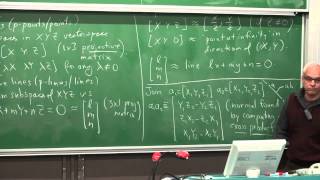
Duality, Polarity and Projective Linear Algebra in Differential Geometry - Lecture 10
Explore projective geometry's impact on differential geometry, focusing on conics, projective linear algebra, and duality between points and lines in the projective plane.
Duality, Polarity and Projective Linear Algebra - Differential Geometry Lecture 11
Explores projective geometry, quadratic forms, and pole-polar duality in relation to the unit circle. Connects these concepts to Lorentz/Einstein/Minkowski geometry and Apollonius' work.
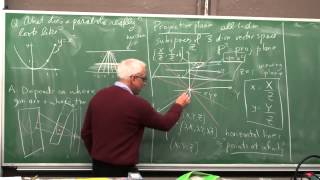
Projective View of Conics and Quadrics - Differential Geometry Lecture 9
Explore projective geometry's application to conics and quadrics, using homogeneous coordinates to unify the study of algebraic curves and surfaces in plane and space.
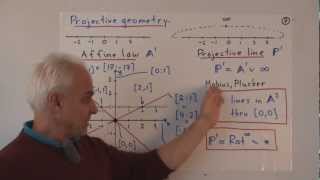
Extended Rational Numbers in Practice - Real Numbers and Limits
Explore extended rational numbers, their applications in mathematics, and connections to projective geometry. Gain insights into graphing polynomials, parametrizing circles, and visualizing infinity in novel ways.
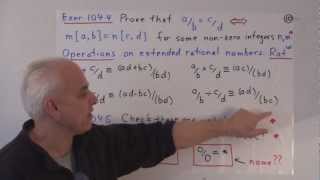
Rational Number Arithmetic with Infinity - Extended Rational Numbers and Limits
Explore arithmetic operations on integral points, extended rational numbers, and the intriguing concept of 0/0. Gain insights into projective geometry and homogeneous coordinates in this mathematical journey.
The Perspective Image of a Square - Number Theoretic Approach - Lecture 18d
Explores the number theoretic aspects of perspective images of squares, including algebraic solutions, quadratic equations, and harmonic ranges, with applications to spheres and algebraic theorems.
Perspective Image of a Square - More Projective Geometry - Lecture 18b
Explore advanced projective geometry concepts, including perspective images, vanishing points, and Desargues' theorem, with applications in 2D and 3D space.
The Perspective Image of a Square - Famous Math Problems 18a
Explore projective geometry concepts like quadrilaterals, quadrangles, duality, and cross ratios in relation to perspective images of squares. Novel approach using planar vector cross products.
Extending Archimedes' Parabolic Area Formula to Cubics - Algebraic Calculus
Extending Archimedes' parabolic area formula to cubics using Algebraic Calculus and projective geometry. Explores unique aspects of cubic functions and their areas without relying on infinite processes.

Incidences and Dimers in Projective Geometry - Statistical Mechanics and Discrete Geometry
Explore the connection between linear incidence theorems in projective geometry and bipartite graphs on surfaces, incorporating dimer model dynamics to derive dynamic linear incidence theorems.
Mathematical Games - Episode 14: Hexagrammum Mysticum
Explore mathematical games and puzzles involving hexagrammum mysticum with Ed Pegg Jr. in this engaging 48-minute episode.
Algebraic Geometry and Pythagorean Triples
Explore algebraic geometry through Pythagorean triples, bridging classical mathematics with modern perspectives for a broad audience.