
The Expected Outcome: Error Handling with std::expected in C++
Explore unified error handling with std::expected in C++23, advanced usage patterns, and integration with C++20 coroutines for a more familiar syntax without exception baggage.
Standard C++ Toolset: Ecosystem and Evolution
Explore the evolving C++ ecosystem, from compilers and debuggers to build systems and code analyzers. Gain insights into standard tools for efficient C++ development and project management.
Reflection without Reflection in C++ - Current Techniques and Possibilities
Explore advanced C++ reflection techniques without macros or markup, including SFINAE, struct reflection, and innovative approaches to enhance code introspection capabilities.
Type-Safe Web Development with C++ Using WebAssembly and Typescripten
Explore type-safe C++ web development using WebAssembly, emscripten, and typescripten. Learn to create wrappers for JavaScript APIs and overcome challenges in translating prototype-based semantics to C++.

AI Assistants for C++ Developers - Effective and Responsible Use
Explore AI assistants for C++ development: understand LLMs, evaluate their impact, and learn effective, safe usage through live demonstrations and practical insights.
Introduction to C++ Containers - Know Your Data Structures
Explore C++ Standard Library containers, their organization, trade-offs, and usage. Gain insights into data structure selection, time complexity, and new C++23 features.

Performance Matters: New Tricks for Old Dogs - Lecture 1
Explore performance-oriented C++ techniques, including faster erasure methods, cache-friendly linked lists, and efficient random-access containers. Suitable for both newcomers and experienced developers.

Variable Monitoring with Declarative Interfaces - Lecture
Explore a scalable framework for monitoring industrial signals using declarative APIs and builder patterns, enhancing readability and extensibility in control software.
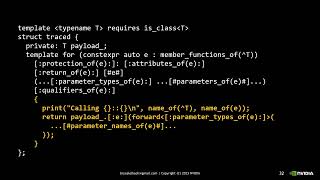
C++ Horizons: Reflection, Pattern Matching, and Senders - Future Features
Explore upcoming C++ features: reflection/injection, pattern matching, and senders. Discover how these advancements will transform coding practices and enhance C++ capabilities.
Importing CSV Files in C++ - Challenges and Solutions
Explore CSV file handling in C++, covering basics, pitfalls, and interactions with Qt through a real-world EventBrite import example.
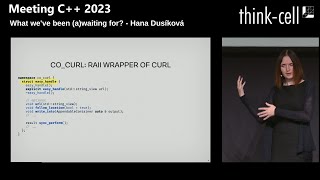
What We've Been Awaiting For - Coroutines in C++
Explore coroutines in C++, starting from simple functions and progressing to complex coroutine tasks. Learn to demystify and implement this powerful programming concept.
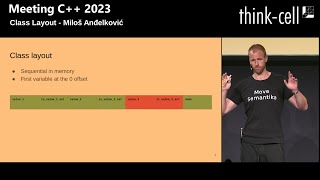
Class Layout in C++ - Memory Structure and Compiler Optimization
Explore class layout in C++, including compiler behavior, memory representation, and performance impact. Learn key concepts with examples suitable for beginners and experienced programmers alike.
Taming Lambdas' Uniqueness in C++ - Techniques and Workarounds
Explore techniques to overcome lambda expression limitations in C++, including creating multiple lambdas of the same type and using them with standard containers while maintaining readability and performance.
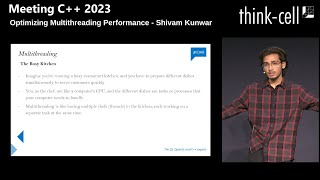
Optimizing Multithreading Performance - False Sharing and Hardware Destructive Interference
Explore false sharing and hardware destructive interference to optimize multithreaded performance. Learn strategies to mitigate cache-related bottlenecks and improve efficiency in C++ applications.
Minimal Logging Framework in C++20
Develop a minimal, optimized C++20 logging framework from scratch, exploring performance enhancements and efficient data collection techniques for large-scale systems.
C++ Common Knowledge - Exploring Core Language Fundamentals
Explore essential C++ concepts like one-definition rule, deterministic object destruction, lookup rules, and initialization. Deepen your understanding of core language features for well-rounded programming expertise.
Typical C++ But Why - Leveraging the Type System for Better Code - Meeting C++ 2023
Explore how leveraging C++'s type system strengths enhances code quality, prevents errors, improves readability, and reduces risks during code modifications.
Throwing Tools at Ranges - Performance Analysis of C++ Styles
Explore runtime performance and memory usage of ranges code vs. non-ranges code using various analysis tools. Compare C-style C++, C++17, and C++23/ranges to understand modernization effects on performance.
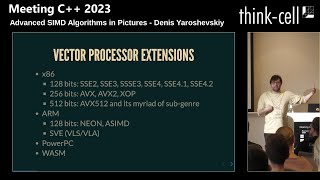
Advanced SIMD Algorithms in Pictures
Explore non-trivial SIMD algorithms like strcmp, set_intersect, and sort through visual explanations. Demystify vectorized algorithms for those with basic CS knowledge.
Tooling Intuition - Improving Development with Compiler and Static Analysis Tools
Explore compiler outputs, static analysis, and cross-platform best practices to enhance C++ development. Build intuition for interpreting and leveraging advanced tooling features effectively.
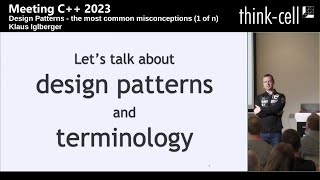
Design Patterns: The Most Common Misconceptions
Uncover common misconceptions about design patterns in software development. Gain clarity on Factory, Builder, Bridge, Strategy, Visitor, and Decorator patterns for improved communication and architecture.