
Standardizing the Data Distribution Service API for Modern C++
Explore modern C++ standardization for DDS API, covering data-centric publish-subscribe architecture, exception safety, and forward compatibility in distributed real-time systems.
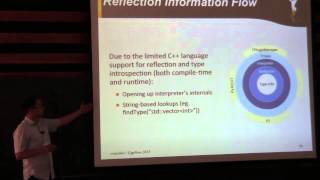
Interactive, Introspected C++ at CERN
Explore CERN's interactive C++ interpreter Cling, built on LLVM/Clang. Learn about its role in ROOT Framework, challenges in implementation, and impact on data analysis and C++ learning.
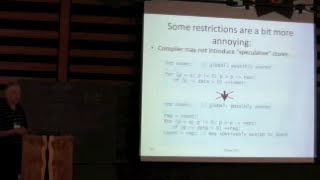
Threads and Shared Variables in C++0x
Explores C++0x's introduction of threads and shared variable semantics, focusing on the memory model, atomic operations, and challenges in designing meaningful multithreaded programs with sequential consistency.
Distributed Parametric Optimization with the Geneva Library
Explore Geneva, an open-source library for distributed optimization algorithms, leveraging Boost libraries to solve large-scale parametric problems on multi-core systems, clusters, and cloud environments.

Toward Native XML Processing Using Multi-paradigm Design in C++
Explore advanced C++ techniques for native XML processing, leveraging multi-paradigm design to bridge the gap between object-oriented and XML programming paradigms.

A Complete Overview on Boost.Jam and Boost.Build
Comprehensive guide to Boost.Jam and Boost.Build, covering language constructs, project setup, and advanced concepts for efficient C++ project management and customization.
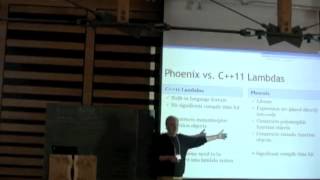
Phoenix V3 - An Overview
Overview of Phoenix V3, a next-gen library for creating unnamed, inlined polymorphic function objects. Combines Boost.Bind and Boost.Lambda functionality, focusing on functional programming in C++ and its applications.
C++0x Progress and Status
Comprehensive update on C++0x ratification progress, new features, and controversies since BoostCon 2010. Insights from an experienced C++ Standards Committee member on the language's evolution.

Thinking Asynchronously - Designing Applications with Boost.Asio
Explore asynchronous design principles using Boost.Asio, covering alternative approaches, common pitfalls, and techniques for managing complexity and optimizing performance in C++ applications.
The Proposed Boost B-tree Library
Explore B-trees and a proposed library for disk-resident associative containers, covering implementation, performance, and relation to C++ standard library containers.
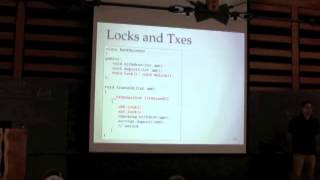
Intel's C++ STM Compiler and Transactional Language Constructs for C++
Explore Intel's C++ STM compiler and transactional language constructs, focusing on type-safety, optimization, and complex operations in parallel programming using transactional memory.

Spirit.Qi in the Real World
Develop a Spirit.Qi parser for printf()-style format strings, exploring real-world challenges and solutions to create a typesafe and efficient printf() replacement.
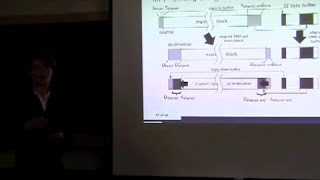
Mastering the Cell Broadband Engine via a Boost-Based Library
Explore optimizing the Cell Broadband Engine using Boost-inspired design, discussing performance improvements and potential applications in embedded systems.
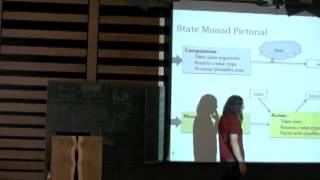
Haskell - The Pseudocode Language for C++ Template Metaprogramming
Explore functional programming concepts in Haskell to improve C++ template metaprogramming skills. Learn to read and write complex metaprograms using Haskell as pseudocode for C++.
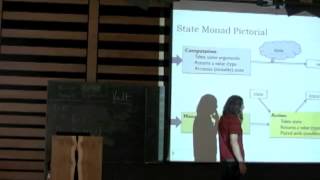
Haskell - The Pseudocode Language for C++ Template Metaprogramming - Part 2
Explore functional programming concepts in Haskell to enhance C++ template metaprogramming skills. Learn to write and analyze complex metaprograms using Haskell as pseudocode.
Are You Ready for IPv6?
Explore IPv6 basics, Boost.Asio support, and design strategies for protocol-independent networked applications as IPv4 address space exhausts and IPv6 adoption grows.
Generic Conversion & Segmentation for Ranges - A Solution for Unicode
Presentation on a generic, flexible Unicode solution for C++ using Range concepts, including a spin-off library for range conversion and segmentation with potential SIMD acceleration.

Design Journeys with Skoot, a Peer Oriented Generic Networking Library
Explore the design process of Skoot, a generic C++ networking library. Learn about template-based techniques, Boost libraries usage, and API refinement for effective peer-oriented distributed processing.
Creating Boost.Asio Extensions
Learn to extend Boost.Asio's asynchronous framework beyond networking, exploring custom operations and limitations through practical examples like directory monitoring.
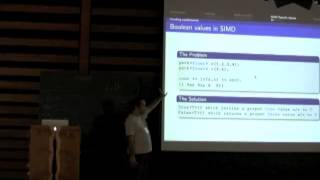
Practical SIMD Acceleration with Boost.SIMD
Explore SIMD acceleration techniques using Boost.SIMD library. Learn to optimize algorithms, abstract hardware, and leverage SIMD registers for efficient parallel computing across various platforms.
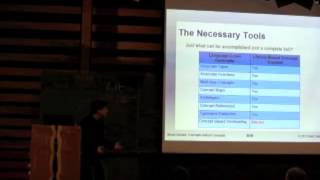
Boost.Generic - Concepts without Concepts
Explore Boost.Generic, a C++0x library for creating concepts, concept maps, and concept-based function template overloads. Learn to implement powerful generic programming techniques without direct language support.