C++ MythBusters
Debunking C++ myths and misconceptions with expert insights, optimization techniques, and modern best practices for efficient and effective programming.

What C and C++ Developers Can Learn from Rust
Explore how Rust's ownership model, memory safety features, and modern practices can enhance C/C++ development, improving code reliability and efficiency.

Stop Writing Test Doubles You Are Using
Discover strategies to eliminate unnecessary test doubles, improving code quality and maintainability. Learn practical techniques for more effective and efficient unit testing.
Modules in C++
Explores options for introducing modules in C++, discussing challenges and opportunities to address preprocessor limitations and improve development tools and build times.
A Whirlwind Overview of C++11
Comprehensive overview of C++11 features, covering lambdas, uniform initialization, auto, rvalue references, multithreading, smart pointers, and new STL containers for improved code clarity and performance.
Fresh Paint
Explore C++11's focus on writing simpler, cleaner, and more elegant code. Learn techniques for effective programming without delving into cutting-edge features.

Now What? A Vignette in Three Parts
Exploring C++11's potential for beautiful, efficient code, addressing performance challenges, and adapting to the evolving landscape of networked devices and ubiquitous data access.
Lambda Functions
Lambda functions in C++11: syntax, usage, and benefits. Explore anonymous function objects, capture mechanisms, and practical applications through examples and exercises to enhance code expressiveness and reduce bugs.

C++11 - High-Level Threading
Explore C++11's high-level threading capabilities, including locks, mutexes, and futures. Learn to solve common threadsafe programming challenges using these components.
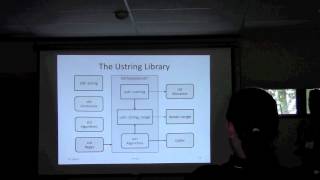
Ustring - A Modern Alternative to std::string
Explore Ustring, a modern C++11 alternative to std::string, addressing limitations and offering enhanced Unicode support and flexibility for efficient string handling.
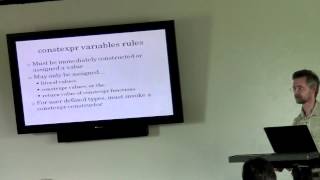
C++11 - New Tools for Class and Library Authors
Explore advanced C++11 features like variadic templates, static assert, constexpr, and decltype, enhancing your ability to create robust classes and libraries with improved functionality and performance.
Compile-Time - Run-Time Functional Programming in C++
Explore advanced C++ programming techniques at the compile-time/run-time boundary, including functional concepts like monads and continuations, with a focus on practical applications.
Refactoring C++ with Clang
Explore automated C++ refactoring using Clang, covering recognition of patterns, source-to-source translation, and API updates. Learn to build safe, efficient tools for modernizing codebases.
How We Switched to C++11 at SolidFire and How It Worked Out
Explore SolidFire's transition from C++03 to C++11, including team motivation, testing strategies, and new coding possibilities. Gain insights on overcoming challenges and leveraging modern C++ features.
Type to String Conversions, and Vice-Versa
Explore options for type-to-string conversions in C++, from traditional methods to modern solutions like std::stoi and boost::lexical_cast. Introduces boost::coerce, highlighting its speed and extensibility.
Regex in C++11 and Boost
Comprehensive introduction to regular expressions in C++11 and Boost, covering basics to advanced usage. Learn powerful string manipulation techniques for efficient coding.

Don't Try This at Work - Low Level Threading with C++11
Explore C++11's memory model, atomic operations, and low-level threading concepts with expert insights and practical examples.

Using Boost.Coroutine to Untangle a State Machine
Simplifying complex event-driven programming with Boost.Coroutine, transforming convoluted state machines into clear, maintainable code with improved control flow and easier debugging.
ConceptClang - An Implementation Model for C++ Concepts
Exploring ConceptClang: An infrastructure for implementing C++ concepts in Clang. Discusses concept-based lookup, overloading, constrained templates, and design exploration for constraint-based polymorphism in C++.
Robust and Efficient Multi Precision Algorithms Design
Exploring design principles for complex numeric algorithms, balancing usability, extensibility, efficiency, and robustness. Insights from Boost.Polygon.Voronoi library implementation.
C++ Component Extensions for WinRT
Exploring approaches to integrate C++ with foreign object models, focusing on Microsoft's WRL library and C++ syntax extensions for cross-language component interaction in heterogeneous environments.