Automating Resilience Testing with Docker and Property Based Testing
Explore automated resilience testing using Docker and property-based testing to enhance system reliability against various failure modes and unexpected scenarios.
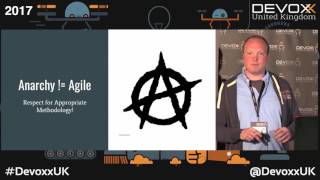
Agile is NOT a Process
Explore the concept of Agile as an organizational culture rather than a process, examining its relationship with the Agile Manifesto and discussing how to truly embody Agile principles in the workplace.

They Do It With Mirrors - Java Process Memory in Microservices Environment
Explore effective memory management in microservices, including potential pitfalls and solutions for distributing memory across distributed systems. Learn about Java process memory and its impact on performance.
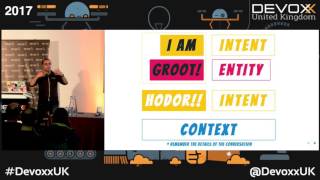
Ok Google, Is There Any Presentations About Chat Bots at Devoxx UK?
Explore building voice assistants using Google Cloud APIs and API.AI services. Learn to create chatbots for conference management, integrating speech recognition and natural language processing.
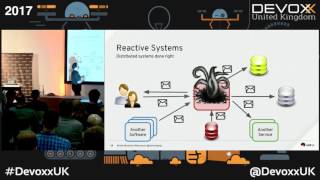
The Reactive Landscape
Explore the reactive landscape, understanding key concepts like asynchronous programming, RX libraries, and reactive systems. Learn practical applications using Eclipse Vert.x through live coding demonstrations.
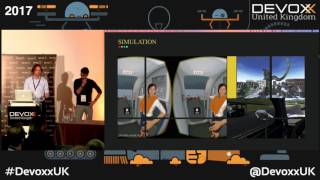
Virtual Reality in Java - Is It Possible?
Explore the possibilities and challenges of developing Virtual Reality applications using Java, including insights on VR technology, coding practices, and feasibility compared to popular platforms like Unity3D.
A Pragmatist’s Guide to Functional Geekery
Explore advanced functional programming concepts like pattern matching and type classes, with practical examples in JVM languages to improve code maintainability and safety.
Data Visualization with R
Learn to create impactful data visualizations using R and RStudio. Explore R's capabilities for transforming data into actionable insights through hands-on demonstrations and expert guidance.
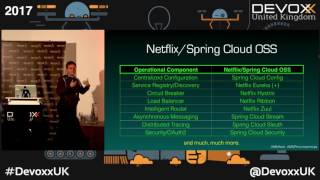
Services Assemble
Learn proven patterns and open source tools for building robust microservices, covering configuration, discovery, circuit breakers, load balancing, messaging, security, and more. Gain insights from Netflix's approach to global streaming.
The End of Polling - Why and How to Transform a REST API into a Data Streaming API
Explore real-time data streaming technologies like WebSockets and Server-Sent Events. Learn to transform static APIs into dynamic streams, optimize data transfer, and apply streaming to innovative use cases like drone control.
JVM Toolbox 2017 - Live Coding
Live coding session exploring JVM languages for efficient task handling, including Java 9, Scala, Groovy, and ECMAScript. Demonstrates specialized language use for mathematical expressions, text templates, collections, and JSON processing.
I Have a NoSQL Toaster
Explore key-value, document, columnar, and graph data models in NoSQL databases, understanding their differences and ideal use cases for modern data management.
Busy Developer's Guide to Building Languages
Explore language creation from concept to implementation, covering key decisions, grammar definition, parsing, and code generation. Learn tools and techniques for building custom languages efficiently.

Rethinking Microservices with Stateful Streams
Explore stateful stream processing for building event-driven services using Apache Kafka, balancing data accessibility and service encapsulation for improved scalability in microservices architecture.
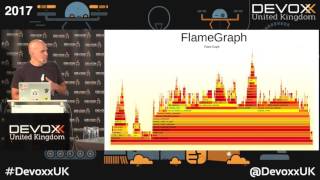
Using FlameGraphs to Illuminate the JVM
Explore FlameGraphs for JVM profiling, combining Linux perf and JDK options to visualize execution profiles across OS, JVM, and Java code. Learn advanced usage and insights into performance optimization.
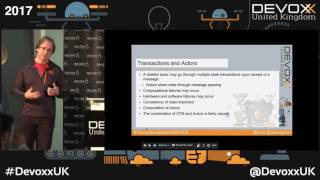
Transactional Actors with Eclipse Vert.x
Explore integrating transactional actor model with Eclipse Vert.x using Narayana transactions and Software Transactional Memory for asynchronous, event-driven applications with volatile, persistent, and nested transactions.
Git Workflow Strategies for Technical Debt Management
Explore Git workflow strategies to incrementally reduce technical debt, focusing on measurement, backlog management, and continuous inspection for improved code quality.
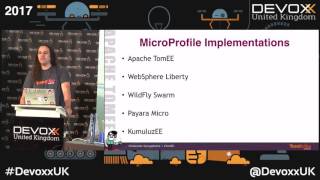
Cluster Your MicroProfile Application Using CDI and JCache
Learn to cluster MicroProfile applications using CDI and JCache. Explore live coding demos, Hazelcast integration, and running clusters on Raspberry Pi's for high availability and scalability.
Welcome Alexa, Your New Personal Assistant
Learn to create and integrate Alexa, the voice-controlled personal assistant, using Raspberry Pi and Java. Explore custom skills, home automation, and serverless AWS Lambda implementation.
How Modern SQL Databases Come Up With Algorithms That You Would Have Never Dreamed Of
Discover how modern SQL databases outperform hand-written algorithms with cost-based optimization, enabling complex queries on large datasets to run in milliseconds. Learn why SQL is the ideal language for business logic.
The Diabolical Developer's Guide to Performance Tuning
Learn a systematic approach to diagnose and fix Java/JVM application performance issues quickly using the Performance Diagnostic Methodology (PDM), reducing troubleshooting time from weeks to hours.