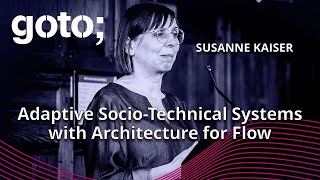
Adaptive Socio-Technical Systems with Architecture for Flow
Explore designing adaptive socio-technical systems using Team Topologies, Wardley Mapping, and Domain-Driven Design to optimize for fast flow of change in uncertain business environments.

Platform as a Product - Transforming Internal Platforms into Strategic Assets
Explore platform engineering as a strategic asset, focusing on user-centric design, continuous improvement, and value-driven development to empower teams and accelerate business outcomes.
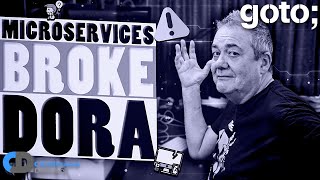
Did Microservices Break DORA? - Analyzing the State of DevOps Report 2022
Exploring DORA's 2022 DevOps report findings on loose-coupled architecture, burnout, and metrics. Analyzing surprising results and their implications for software development practices.
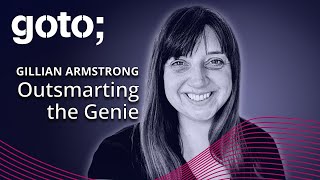
How to Make Smart Architecture Decisions when Building Generative AI Apps
Explore architectural decisions for building reliable, performant generative AI apps. Learn to make smart choices, enhance safety and accuracy, and apply best practices through real-life use cases.

How Event-Driven Architectures Go Wrong and How to Fix Them - Common Pitfalls and Solutions
Explore common pitfalls in Event Driven Architectures and learn effective strategies to avoid them. Gain insights on improving distributed cloud applications for better speed and agility.
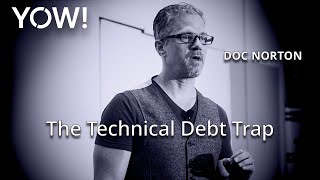
The Technical Debt Trap - Understanding and Managing Code Rework
Explore technical debt's true meaning, impact, and management strategies. Learn to identify, address, and prevent technical debt for better software development practices.
Patterns for Building Event-driven Web and Mobile App Backends
Explore patterns for asynchronous, event-driven integrations between frontend and backend, enhancing agility and responsiveness in web and mobile app development.
A Short Summary of the Last Decades of Data Management - GOTO 2024
Explore the evolution of data management over decades, from monolithic systems to open-source engines and cloud computing, examining key trends, successes, and failures in this trillion-dollar industry.
Building a Web Version of a Board Game - Learn with Jason
Learn to create a web-based board game using HTML, CSS, and JavaScript. Explore game logic implementation, UI design, and leveraging web technologies for interactive gameplay experiences.
Productive Parallel Programming with Dagger.jl - JuliaCon 2024 Workshop
Learn to write fast, parallel Julia code using Dagger.jl. Explore various programming interfaces, build example programs, and gain insights into parallelism through logging and profiling capabilities.
Machine Learning with EEG Time-Series - Easy Python Project - Part 0
Learn to classify EEG data between awake and asleep states using Python and random forest. Covers data loading, preprocessing, feature engineering, and machine learning implementation.
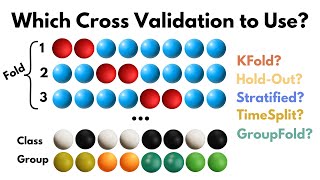
Selecting the Right Cross-Validation Method in Machine Learning
Learn to choose the right cross-validation method for your machine learning model based on data characteristics, including hold-out, k-fold, time-split, and group-fold techniques.

Sleep Classification with Python Using EEG, Sklearn and MNE - Part 1
Enhance EEG sleep stage classification using Python, Sklearn, and MNE. Expand dataset, add new class, and implement Leave-One-Subject-Out cross-validation for improved results.
Easy GLSL Chromatic Aberration in TouchDesigner
Implement chromatic aberration effects in TouchDesigner using GLSL pixel shaders. Learn to shift and scale RGB channels for subtle vintage looks or extreme visual experiments.
Microsoft AI: ML.NET Framework in C# - Transfer Learning for Image Classification
Aprende a entrenar modelos de aprendizaje profundo personalizados utilizando transferencia de aprendizaje, TensorFlow y ML.NET para clasificar imágenes de superficies de concreto.
Discrete Flow Matching for High-Dimensional Discrete Data Generation
Explore Discrete Flow Matching for generating high-dimensional discrete data. Learn about probability paths, sampling techniques, and improved generative perplexity in AI applications.
Text Summary Model with BERT
Explore BERT-based text summarization: task overview, algorithm implementation, and model weight importing for effective summary generation.

Function Extraction: Mapping Programs into Mathematica Equations
Extract precise program functions by mapping C-like code to Mathematica equations, enabling correctness verification and solving for program behavior.
Computational Tools for Blockchain Forensics
Harness Wolfram Language for blockchain analysis, forensics, and visualization. Learn to read and write transactions, explore FTX token case study, and integrate with ChatGPT.
What Is ChatGPT Doing? Training Neural Networks - Episode 4
Explore the inner workings of ChatGPT and large language models, covering neural network training, fine-tuning, reinforcement learning, and parameter optimization in this insightful discussion.
What Is ChatGPT Doing? Understanding Large Language Models - Episode 2
Explore the inner workings of ChatGPT and large language models, understanding their token-by-token generation process and the complexities behind their seemingly intelligent outputs.