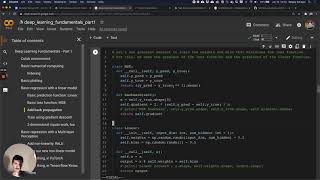
Coding a Neural Network - Full Stack Deep Learning - Spring 2021
Code a neural network from scratch using Google Colab, NumPy, PyTorch, and Keras. Learn linear regression and multi-layer perception models through hands-on implementation and visualization.
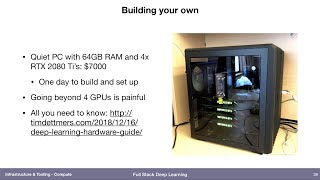
Computing and GPUs - Infrastructure & Tooling - Full Stack Deep Learning
Explore hardware options for deep learning, from NVIDIA GPUs to cloud providers. Learn to choose the right setup for solo developers, startups, and large companies.

Testing and Deployment - Full Stack Deep Learning - March 2019
Learn about testing and deploying ML projects, covering project structure, evaluation, continuous integration, Docker, REST APIs, and various deployment options for efficient and scalable systems.
Data Management - Full Stack Deep Learning - March 2019
Explore data management essentials: labeling, storage, versioning, and processing. Learn about data flywheels, annotation techniques, and efficient workflows for deep learning projects.
Infrastructure and Tooling - Full Stack Deep Learning - March 2019
Explore infrastructure and tooling for deep learning projects, covering GPU machines, experiment tracking, and all-in-one solutions like AWS SageMaker.
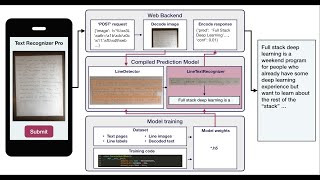
Introduction to the Text Recognizer Project - Full Stack Deep Learning - March 2019
Hands-on labs introducing text recognition project, covering setup, data handling, model creation, training, and deployment in a full-stack deep learning context.

Breadth First Search (BFS) and Level Order Tree Traversal in Binary Trees - C++ Implementation
Comprehensive tutorial on Breadth First Search in binary trees, covering theory, pseudocode, and C++ implementation. Includes step-by-step explanations and practical coding examples.
Efficient AutoML with Ludwig, Ray, and Nodeless Kubernetes
Explore efficient AutoML using Ludwig and Ray, leveraging heuristics for model production. Learn how Nodeless Kubernetes optimizes GPU resource management, reducing costs in cloud environments.
Falco and eBPF: Optimizing Large-Scale Tracing Tools
Explore eBPF's potential in high-throughput scenarios, focusing on Falco's syscall tracing. Learn about challenges, mitigations, and future enhancements for large-scale tracing tools.
Debugging Machine Learning on the Edge with MLExray
Explore MLExray for efficient debugging of edge-deployed machine learning models, covering benefits, deployment challenges, and practical demonstrations.
Get More Computing Power by Helping the OS Scheduler
Optimize CPU performance in Kubernetes by managing thread scheduling and memory locality with CRI Resource Manager, enhancing database and AI training without workload-specific configurations.
Knative Functions - Introduction, Demonstration and Roadmap
Explore Knative Functions: a platform between CaaS and FaaS for deploying serverless applications. Learn its evolution, capabilities, and how to create, build, and deploy event-driven functions in multiple languages.
Efficient Deep Learning Training with Ludwig AutoML, Ray, and Nodeless Kubernetes
Explore efficient deep learning training using Ludwig AutoML and Ray on nodeless Kubernetes, optimizing GPU resource management for cost-effective and scalable model development.
Connecting the World to Knative with Kamelets
Explore Kamelets as event sources in Knative, learn installation, discovery, deployment, and management. Live demo showcases integration with event-driven applications using Apache Camel connectors.
Resource Orchestration of HPC on Kubernetes - Where We Are Now and the Journey Ahead
Explore NUMA-aware scheduling in Kubernetes for HPC workloads, addressing challenges, solutions, and future developments in resource orchestration and performance optimization.
The Past, Present and Future of the Knative Community
Explore Knative's evolution from Elafros to CNCF incubation, its community growth, upcoming features, and how to get involved in this serverless computing platform.
Kn - The One-Stop Shop for Knative
Explore Knative's serverless application deployment simplification and learn to use 'kn' CLI for efficient developer workflows, from service creation to production rollout.
Kueue: Kubernetes-Native Job Queueing for Batch Workloads
Explore Kueue, a Kubernetes-native job queueing solution for efficient resource management and fair sharing in batch workloads, addressing limitations in pod-centric scheduling.
Apache YuniKorn - A Kubernetes Scheduler Plugin for Batch Workloads
Explore Apache YuniKorn's advanced batch scheduling capabilities for Kubernetes, including workload queueing and quota sharing, while seamlessly coexisting with traditional non-batch workloads.
How Fast is FaaS? Reducing Cold Start Times in Knative
Explore Knative's autoscaling, cold start challenges, and innovative solutions like container pausing to enhance serverless performance and reduce latency in cloud-native systems.
Building an ML Inference Platform with Knative - Serverless Containers on Kubernetes
Leveraging Knative for scalable ML inference platforms: simplifying deployment, enabling serverless containers, and optimizing performance for production-ready machine learning applications.