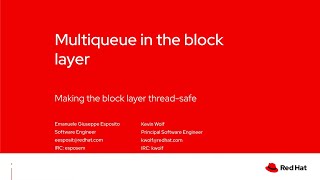
Multiqueue in the Block Layer: Challenges and Solutions for Thread Safety in QEMU
Explore challenges and solutions for making QEMU's block layer thread-safe, enabling true parallel processing of multiple I/O queues for improved performance.
Juju Charmed Operator Debugging with Jhack
Explore jhack CLI devtool for Juju charms, learning its popular commands and advanced debugging techniques for operator framework charms.

Terraforming Your Juju World: The Many Ways to Run Operators - Operator Day Europe 2023
Explore integrating Juju with Terraform for enhanced infrastructure provisioning and application lifecycle management. Learn about use cases and roadmaps for Juju tools and libraries.
Fast and Reusable GitHub CI - Community Workshop
Optimize GitHub CI with caching, parallel testing, and shared workflows for faster, more efficient charm development and integration testing.

LLM Projects - A Quick Tutorial on Multi-Agent Workflows with AutoGen
Explore multi-agent workflows using AutoGen framework for RAG-based question answering with Wikipedia integration. Learn to implement and leverage this powerful approach for dynamic information retrieval.

Why I'm Staying Away from Crew AI - A Critical Analysis
Explore limitations of Crew AI for production, understand multi-hop questions, and learn alternative approaches for building AI applications. Gain insights on future multi-agent frameworks.

Building Custom AI Agents: Beyond CrewAI and AutoGen
Develop a custom web search AI agent in Python. Learn why building your own agents can be more effective than using existing frameworks for AI and multi-agent workflows.

Build Your Own Local "Perplexity" with Ollama - Deep Dive
Develop a custom web search agent running locally using Ollama and Llama 3. Learn to build, test, and compare with different models in this comprehensive technical deep dive.

LangGraph Simplified: Master Custom AI Agent Creation - Web Search Agent Tutorial
Simplify LangGraph concepts and create a custom web search AI agent through a Python tutorial. Learn core principles and practical implementation for AI development.

Meta-Prompting Technique for Building High-Level AI Agents
Explore meta-prompting techniques to build flexible AI agents. Learn implementation, web search integration, and evaluate strengths and weaknesses of this powerful prompt engineering approach.

Neo4j Knowledge Graphs for Smarter AI-Agent Search
Explore how Neo4j knowledge graphs enhance AI agent search, improving response quality through advanced AI engineering techniques like meta-prompting and RAG.
Performing CRUD Operations on Kubernetes Using Golang - API Guide
Learn to perform CRUD operations on Kubernetes resources using Go. Master client libraries, environment setup, and essential operations like reading, creating, updating, and deleting pods.
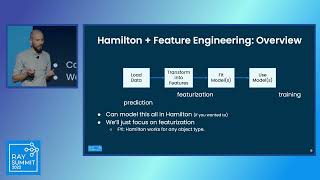
Scalable Feature Engineering with Hamilton on Ray
Explore scalable feature engineering using Hamilton and Ray at StitchFix. Learn declarative dataflow, team scaling, and efficient computation for thousands of time-series features.
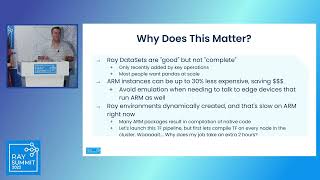
A Cross-Platform, Cross-Tool Ray on Kubernetes Deployment
Deploy Ray, Spark, Dask, and Jupyter on mixed-architecture Kubernetes clusters. Learn cross-building containers, handling Ubuntu versions, and glibc versioning for heterogeneous Ray clusters.

C++ Zero Overhead Pass by Value Through Invocable Abstractions - Lecture
Explore techniques for eliminating copy/move overhead when passing non-trivial objects by value through invocable C++ abstractions, enhancing performance in function calls.

The Cryptography Packages in Julia: What is Missing?
Explore Julia's cryptography ecosystem, comparing it to other languages and identifying areas for improvement to enhance adoption beyond scientific computing.

ITensorNetworks.jl - Introduction to Tensor Network Algorithms in Julia
Explore tensor network algorithms and their implementation in Julia using ITensorNetworks.jl for efficient quantum many-body simulations.
FastIce.jl: A Massively Parallel Ice Flow Model Running on GPUs
Explore FastIce.jl, a Julia-based ice flow model for GPUs. Learn about its modular architecture, performance on supercomputers, and applications in efficient large-scale ice sheet modeling.

Reviewing the JDK 23 Release Notes
Explore JDK 23's release notes, covering new features, changes, and updates in Java development. Gain insights into performance improvements, security enhancements, and tooling modifications.

Building Local Food Scene Apps - Web Development Challenge
Participate in a web development challenge to create innovative apps promoting local food scenes using tools like Clerk, Convex, and Raycast. Learn from expert developers as they plan and build in just 4 hours.
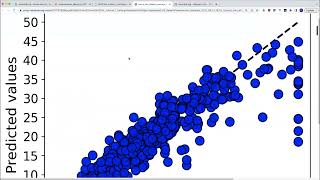
The Materials Simulation Toolkit for Machine Learning (MAST-ML): Automating Development and Evaluation of Machine Learning Models for Materials Property Prediction
Automate machine learning model development for materials property prediction using MAST-ML. Learn data import, feature engineering, model evaluation, and uncertainty quantification through hands-on activities.