Movement in Video Game AI - Lecture 4
Explore movement techniques in video games, including pathfinding, steering behaviors, and obstacle avoidance for realistic AI-controlled characters.
Grid Representations in Video Game AI - Lecture 5
Explore grid representations in video game AI, covering localization, optimization, pathfinding, and hierarchical structures for efficient game world modeling and navigation.
Grid Algorithms in Video Game AI - Lecture 7
Explore grid algorithms for game AI, including connectivity, BFS, vector fields, and distance maps. Learn techniques for efficient pathfinding and spatial analysis in video games.
Introduction to Artificial Intelligence - Connect 4 and Alpha-Beta Pruning - Lecture 11
Explore Connect 4 AI implementation, focusing on UI controls, game state management, player strategies, and evaluation functions. Learn to develop and debug an intelligent game-playing agent.

Making C++ Fun, Safe, and Accessible
Explore strategies to make C++ more enjoyable, secure, and approachable for a wider audience. Learn how to overcome common challenges and misconceptions about the language.

The Singleton Pattern - Anti-Pattern or Solution?
Explore the Singleton pattern in C++: pros, cons, and proper implementation techniques for global aspects. Learn to overcome disadvantages and ensure testability in software design.

Safety in C++: All the Safeties - Lecture
Explore C++ safety concepts, their relation to correctness and security, and learn strategies for writing better code. Gain insights from Sean Parent's expertise in software architecture and development.
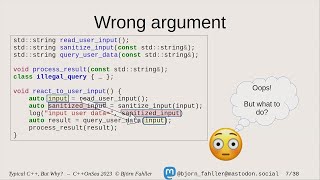
Typical C++ - Leveraging the Type System for Better Code
Explore how leveraging C++'s type system strengths improves code quality, prevents errors, enhances readability, and reduces risks during modifications.
How to Build C++ Interfaces That Are Hard to Use Incorrectly - Lecture
Discover techniques for designing C++ interfaces that prevent misuse, leveraging the type system to catch errors at compile-time and enhance code safety and reliability.
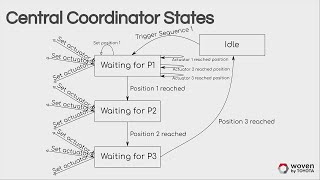
Designing for Concurrency Using Message Passing in C++
Explore message passing for concurrent C++ design, reducing synchronization errors. Learn practical implementation through examples like dining philosophers and robot control systems.

C++ Features You Might Not Know - Obscure Language Elements and Surprising Behaviors
Explore obscure C++ features, from strange syntax to surprising behaviors, and learn how to leverage them for better or worse programming practices.

What Happens After the Compiler in C++ - How Linking Works
Explore the post-compilation process in C++, including linking, relocations, and memory management. Gain insights into how compilers, linkers, and operating systems collaborate to create executable programs.
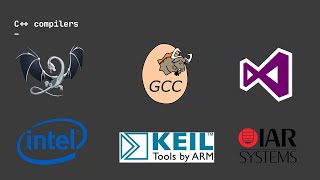
Standard C++ Toolset
Explore the evolving C++ ecosystem, from compilers and debuggers to build systems and dependency managers. Gain insights into standard tools for effective C++ development.

Tips and Tricks for Becoming a CMake Master - C++ on Sea 2023
Master CMake for C++ projects: learn to set up builds, integrate unsupported libraries, and efficiently handle embedded SQL preprocessing in a case study on building a database application.
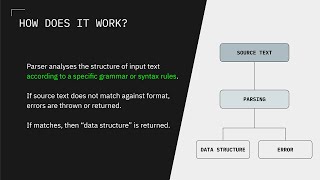
Comparing Libraries to Parse JSON Data in C++
Explore the fastest and simplest C++ libraries for parsing JSON data, comparing their performance and ease of use for efficient data handling in various applications.

Coroutine Intuition in C++ - Lecture
Gain intuition on coroutines in C++20. Explore stackless asyncrony, generators, and senders/receivers through concise examples to improve code readability, maintainability, and composability.
Throwing Tools at C++ Ranges - Runtime Performance and Memory Usage Analysis
Explore C++ Ranges with tools for deep analysis, focusing on runtime performance and memory usage. Gain insights through practical examples and tool demonstrations.

Why Clean Code Is Not the Norm
Explore why clean code remains uncommon, debunk misconceptions, and learn strategies to promote better coding practices in software development.
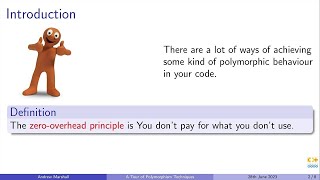
A Tour of Polymorphism Techniques in C++ - Lecture
Explore diverse polymorphism techniques in C++ projects, covering build-time, compile-time, and runtime approaches for enhanced code flexibility and efficiency.

Shared Libraries in Windows and Linux - Linking and Loading Deep Dive
Dive deep into linking and loading operations, exploring binary structures, static vs dynamic linkage, and Linux vs Windows differences. Gain clarity on opaque linker error messages.
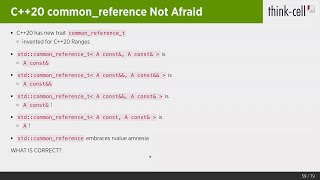
The C++ Rvalue Lifetime Disaster - Understanding and Mitigating Issues
Explore rvalue reference lifetime issues in C++, their impact on code safety, and potential solutions for improved memory management and generic programming.