Optimistic Stack Allocation and Dynamic Heapification for Managed Runtimes
Explore innovative techniques for optimizing memory allocation in managed runtimes, combining static analysis with dynamic strategies to enhance performance and reduce garbage collection overhead.
A HAT Trick: Automatically Verifying Representation Invariants Using Symbolic Finite Automata - PLDI 2024
Explore a novel approach using symbolic finite automata for verifying representation invariants in functional programs interacting with stateful libraries, enhancing data structure implementation efficiency.
The Landscape of Formal Verification in APL - A Review with a Case Study in Quantum Computing
Explore formal verification in APL, focusing on its potential for building dependable software. Examine a case study in quantum computing and discuss future implications for software development.
Specializing Dynamic Language C Extensions Using Type Information
Explore a technique for optimizing C extension functions in dynamic language interpreters using typed methods, reducing call and return overhead for improved performance.
ValBench: Benchmarking Exact Value Analysis
Explore ValBench, a comprehensive benchmark suite for evaluating value analysis tools in Java and Android. Learn about its test cases, evaluation framework, and insights into current challenges in program analysis.
Static Analysis for CHERI - SOAP 2024
Explore custom static analyses supporting C/C++ code transition to CHERI hardware, enhancing memory protection and software compartmentalization for RISC-V and AArch64 architectures.
jGuard - Programming Misuse-Resilient APIs
Explore jGuard, a Java extension enabling API designers to encode specifications directly, preventing misuse without additional tooling for users. Enhance API resilience effortlessly.
Gradual Grammars: Syntax in Levels and Locales
Explore gradual syntax definition for programming languages, enabling level-based learning and internationalization. Enhance accessibility for diverse users while minimizing impact on language processors.
Contextualized Programming Language Documentation - Enhancing Learning with Adaptive Explanations
Generate contextualized programming language documentation tailored to specific code, improving learning efficiency and understanding for developers working with new languages.
Bridging the Syntax-Semantics Gap in Programming - A Novel Programming-by-Demonstration Approach
Explore a novel programming-by-demonstration paradigm that bridges the syntax-semantics gap, enabling intuitive and visual program creation without learning complex syntax.
Semantic Encapsulation Using Linking Types
Explore semantic encapsulation with linking types to preserve language invariants when integrating foreign code, ensuring sound interoperability in multi-language systems.
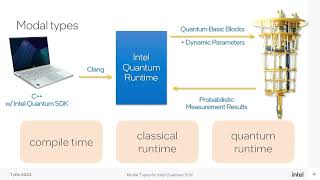
Exploring Modal Types for the Intel Quantum SDK
Explore modal types for Intel Quantum SDK, focusing on a proposed type system with three modes to ensure proper data handling in quantum kernels.
A Semantics of Core Erlang with Handling of Signals
Explore a small step semantics for Core Erlang's monitoring and signal systems, aimed at enabling causal explanations for property violations in concurrent programs.
Generation and Refinement of Testing Models - Erlang 2023
Explore Faktory, an Elixir tool for generating property-based testing models from function specifications and contracts. Learn to improve test-case generation and refine models for various applications.
GHC-Specter: A Plugin for Live Inspection of GHC Internal States
Explore ghc-specter, a GHC plugin for real-time inspection and visualization of GHC's internal states during compilation, enabling interactive debugging and performance analysis.
Severing Ties: The Need for Non-Updateable Thunks
Explore non-updateable thunks in Haskell to prevent memory leaks and optimize garbage collection in streaming abstractions and control flow scenarios.
GHC Plugin for Setting Breakpoints in Concurrent Programs
Explore a GHC plugin for improved breakpoint functionality in concurrent programs, addressing limitations in GHCi's built-in debugger.
Integrating Liquid Haskell with GHC - Challenges and Trade-offs
Explore challenges and trade-offs of integrating Liquid Haskell with GHC, examining maintenance issues, potential benefits, and implications for Haskell development.
Why Code in Python+C When You Can Code in Lisp+Zig
Explore the benefits of combining GNU Guile Lisp and Zig for bioinformatics, offering quick coding and high performance without fighting Rust's borrow checker.
Modal FRP for All: Functional Reactive Programming Without Space Leaks in Haskell
Explore Modal FRP in Haskell: Learn to prevent space leaks in functional reactive programming and implement a Pong game using this technique.
Etna: An Evaluation Platform for Property-Based Testing - Experience Report
Explore Etna, a platform for evaluating property-based testing techniques. Compare popular frameworks in Coq and Haskell to understand best practices and tradeoffs in functional programming.