
The Curiously Recurring Pattern of Coupled Types
Explore affine spaces in programming, their properties, and applications in C++ for stronger type safety and improved program semantics. Learn to create expressive APIs with affine types.

Securing the Web with AI
Explore innovative AI-driven web security methods, including facial recognition for 2FA, user behavior analysis, and machine learning to detect fraudulent content, enhancing protection for all users.
Functional Web Programming in .Net with the SAFE Stack
Explore building type-safe web applications with F# using the SAFE stack. Learn about Saturn, Fable, and functional programming concepts for full-stack development in the .NET ecosystem.
Write Your Own Domain Specific Language with F#
Explore creating a domain-specific language in F#, focusing on readability for non-technical users while leveraging functional programming concepts and type safety.
Logging, Metrics and Events in ASP NET Core
Explore effective application monitoring in ASP.NET Core, covering logging, metrics, and events. Learn to implement visibility tools and gain actionable insights for distributed systems.
Correcting Common Async - Await Mistakes in .NET
Learn to optimize async/await in C# by analyzing .NET compilation, improving performance, exception handling, and app size through practical examples and code optimization techniques.
An In-Flight Port from Angular to React, a Tale of Performance and Happiness
Discover how a team gradually rewrote an e-commerce payment app from Angular to React, improving performance, reducing footprint, and increasing developer happiness while maintaining stability and adding new features.
The Most Average Function There Is
Explore programming language design through implementing an average function, examining language features, and challenging conventional notions of what makes a language "good".
C++ Concepts for Developers
Explore C++20 concepts: their capabilities, limitations, and applications in improving code quality. Learn how concepts enhance type safety, metaprogramming, and design patterns in C++ development.
C++ in Containers
Explore leveraging C++ in containers for performant services, covering code integration, library inclusion, and deployment strategies, with practical demonstrations in editor and shell.
A Short Life Span - For A Regular Mess
Explore std::span through a Regular lens, examining its relation to Regular types and other C++20 concepts. Gain insights into designing and implementing regular types for intuitive usage in everyday programming.

How to Build Python-C++ Libraries
Explore challenges and solutions for building Python libraries with native code, including automation, CI pipelines, Python-CMake integration, and cross-platform compilation techniques.
The Hitchhiker's Guide to Faster Builds
Comprehensive guide to optimizing C++ build times, covering hardware, tooling, code techniques, and upcoming modules. Explores strategies for faster compilation and linking.
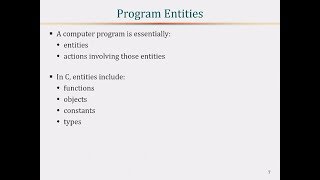
Storage Duration and Linkage in C and C++
Clarifies storage duration and linkage in C/C++, offering insights to improve programming and control storage layout. Explores static and extern keywords, and their impact on compile, link, and run time behaviors.

Anchored Metadata
Explore anchored metadata: a technique for associating external metadata with code regions using context-aware anchors, improving code organization and maintainability.
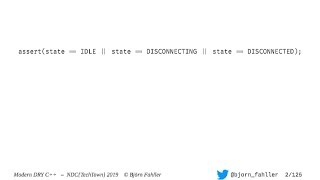
Modern Techniques for Keeping Your Code Dry
Explore modern C++ techniques for creating zero-cost abstractions to eliminate code repetition, improve clarity, and enhance functionality without compromising performance.
C++ Smart Pointers - Usage and Secrets
Explore C++ smart pointers, focusing on shared_ptr and unique_ptr. Learn usage, performance implications, and advanced techniques for effective memory management in modern C++ programming.
C++ Code Smells
Explore C++ code smells and best practices to improve your coding skills, focusing on common pitfalls and how to avoid them for cleaner, more maintainable code.

New Features in C
Explore C99, C11, and C18 standards, covering inline functions, complex arithmetic, extended integers, and more. Understand modern C features often overlooked by programmers still using C90.
Embracing Modern CMake
Explore modern CMake practices for simplified, maintainable build systems. Learn to recognize legacy code, refactor effectively, and leverage new APIs for improved developer experience in C/C++ projects.

Scaling Qt from Desktop to Servers and Micro-controllers
Explore Qt's versatility across platforms, from desktop to servers and micro-controllers. Learn to leverage C++ and Qt skills for web services, embedded UIs, and optimized micro-controller development.