How CPython Parser Works, and How to Make It Work Better
Explore CPython's parsing process, its impact on performance, and potential optimizations. Learn about syntax trees, memory footprint reduction, and opportunities for improving Python's overall efficiency.
Pythonic JavaScript for Web Developers
Discover modern JavaScript tools and frameworks for Python web developers, focusing on Vue.js, testing, and build tools to write cleaner, more efficient front-end code.
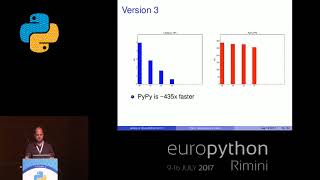
The Joy of PyPy JIT - Abstractions for Free
Explore how PyPy JIT optimizes Python code, removing abstraction costs and improving performance without sacrificing code quality or maintainability.
Fast Python! Coding Competitions with CPython and PyPy
Discover strategies for winning coding competitions using Python, exploring problem-solving techniques, stress management, and the advantages of PyPy over raw processing speed.

Call a C API from Python Becomes More Enjoyable with CFFI
Explore CFFI for efficient Python-C integration, comparing it to traditional C extensions and demonstrating its advantages through real-world examples like Vulkan API wrapping.
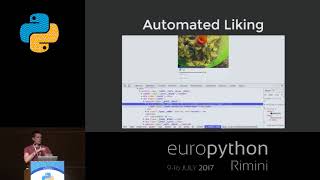
Automating Instagram with Python and Selenium
Explore Instagram automation using Python and Selenium, learning about open-source project growth, tackling challenges, and implementing the Page Object design pattern for effective social media automation.
A Gentle Introduction to Data Science
Explore data science fundamentals, from AI's influence to practical machine learning in Python. Covers key concepts, problem-solving applications, and essential Python tools for aspiring data scientists.
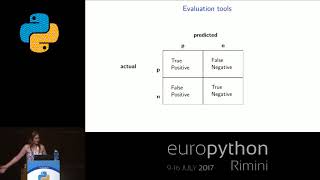
Baby Steps in Short-Text Classification with Python
Explore short-text classification using Python, from problem approach to model deployment. Learn about Naive Bayesian models, alternative algorithms, and practical implementation in production environments.
Help Us Build the Next Edition
Découvrez comment contribuer à l'organisation d'EuroPython 2018. Apprenez le fonctionnement des groupes de travail et identifiez les domaines où vous pouvez apporter votre aide pour cet événement majeur.
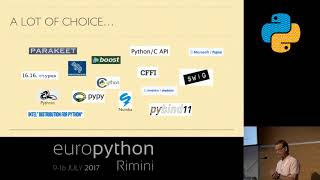
A Faster Python? You Have These Choices
Explore options for optimizing Python performance, from C extensions to PyPy. Learn trade-offs between speed and code maintainability, with real-world examples and benchmarks.
A Journey into Git Internals with Python
Explore Git's inner workings using Python, demystifying its principles and commands. Gain deeper understanding of Git's structure, content addressing, and operations like branching and merging.
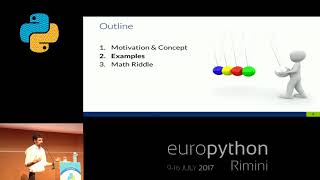
Declarative Thinking and Programming
Explore declarative programming paradigms, their advantages, and practical Python applications. Learn to write more efficient, scalable code using list comprehensions, dictionaries, and PyDatalog.
Community Teaching Practices
Panel discussion sharing experiences and best practices for teaching Python to newcomers from diverse backgrounds, featuring insights from volunteers of various coding education initiatives.
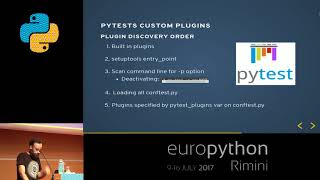
Dockerized Pytests
Explore containerizing pytest environments to replicate Jenkins setups locally, addressing challenges in custom plugins and dependencies for improved debugging and team collaboration.
Scripting Across Hosts with Chopsticks
Explore Chopsticks, a Python tool for remote code execution over SSH, enabling parallel processing across hosts without deployment. Learn its API, clever tricks, and versatile applications.
How Booking.com Serves Deep Learning Model Predictions
Discover Booking.com's approach to deploying deep learning models in production, covering training, automated retraining, deployment, and optimization for latency and throughput.
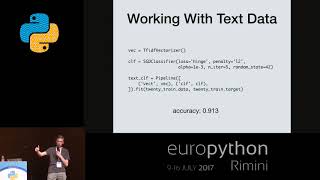
Explaining Behavior of Machine Learning Models with ELI5 Library
Explore techniques for interpreting and debugging ML models using eli5 library. Learn to explain linear models, decision trees, ensembles, and classifiers, improving trust and quality in ML solutions.
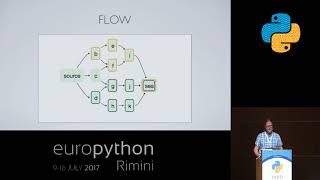
Developing Elegant Workflows in Python Code with Apache Airflow
Learn to orchestrate data processing pipelines using Apache Airflow. Discover how to define, manage, and extend workflows with Python code, creating resilient and efficient data processing systems.
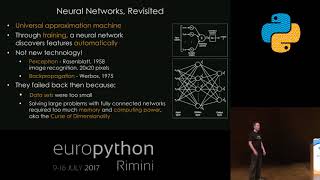
AI on a Pi
Explore Deep Learning with Python and MXNet, including practical demonstrations on a Raspberry Pi for computer vision and natural language processing tasks.
Cloud Native Python in Kubernetes
Explore cloud-native Python in Kubernetes: containerization, scaling, logging, health checks, and monitoring. Learn to optimize applications for dynamic cloud environments and improve operational efficiency.
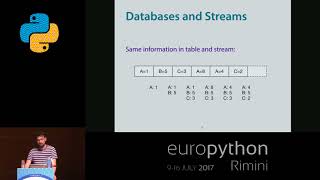
Streaming - Why Should I Care?
Discover how stream-oriented processing can revolutionize your approach to application development, offering natural service boundaries, flexible data schemas, and improved scalability.