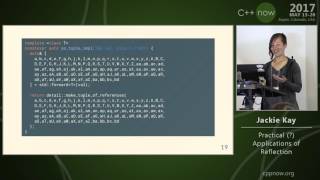
Practical Applications of Reflection
Exploring static type introspection in C++: benefits, costs, and comparison of recent reflection proposals. Analyzes library solutions, standard proposals, and potential impact on C++20 metaprogramming.
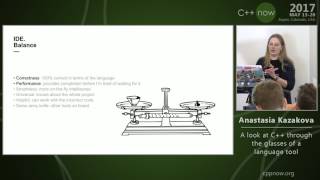
A Look at C++ Through the Glasses of a Language Tool
Explore C++ complexities through the lens of language tool development, uncovering tricky situations and best practices for more accurate and error-free programming.

What Boost Could Learn from QT
Exploring lessons Boost can learn from Qt, including coding style, events, marketing, and adapting to new C++ standards. Insights for C++ library development and community growth.
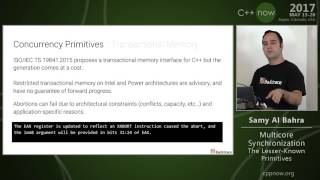
Multicore Synchronization - The Lesser-Known Primitives
Explore advanced multicore synchronization primitives, their performance properties, and practical challenges in complex concurrent systems, with examples from the Concurrency Kit project.
Type-Safe Programming
Explore advanced C++ type system techniques to prevent bugs at compile-time. Learn to leverage types for safer code, from minimizing implicit conversions to expressing preconditions and designing type-safe classes.
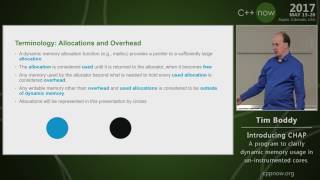
Introducing CHAP - A Program to Clarify Dynamic Memory Usage in Un-Instrumented Cores
Introducing CHAP: A tool for analyzing memory usage, leaks, and corruption in un-instrumented core files. Offers reliable leak detection, automated checks, and insights into memory growth issues without code instrumentation.
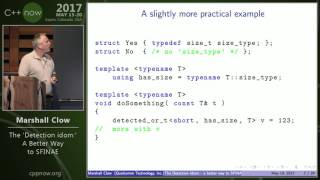
The Detection Idiom - A Better Way to SFINAE
Exploring the Detection idiom: A powerful SFINAE alternative for type distinction in C++. Learn its implementation, benefits, and practical applications for more efficient template metaprogramming.

Effective CMake
Comprehensive guide to CMake, CTest, and CPack, covering best practices for building, testing, and packaging C++ projects, including dependency management and cross-platform development.
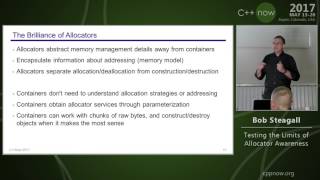
Testing the Limits of Allocator Awareness
Exploring allocator-aware containers in modern C++: conformance, performance implications, and custom allocator design for stateful allocation strategies and synthetic pointers across major compilers.
Promises in C++ - The Universal Glue for Asynchronous Programs
Explore promises in C++ for asynchronous programming, covering fundamental operations, construction helpers, continuations, and real-world examples to enhance your ability to write efficient and scalable code.
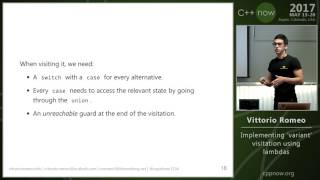
Implementing Variant Visitation Using Lambdas
Explore lambda-based visitation for std::variant, including overloading function objects and implementing Y combinator for recursive variants. Enhance C++17 skills with elegant, zero-overhead solutions.

Postmodern C++
Explore advanced C++ concepts and best practices in the "postmodern" era, covering evolving language features, design patterns, and coding techniques for more effective and efficient programming.

Call - A Library that Will Change the Way You Think about Function Invocations
Explore a powerful C++ library for flexible function invocations, unifying concepts like std::invoke and std::visit with dynamic argument lists and easy-to-use syntax.
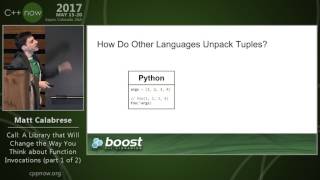
Call - A Library that Will Change the Way You Think about Function Invocations
Explore a revolutionary C++ library for dynamic function invocations, unifying concepts like std::invoke and std::visit with a clean, easy-to-use syntax. Discover its potential impact on generic programming and multimethods.
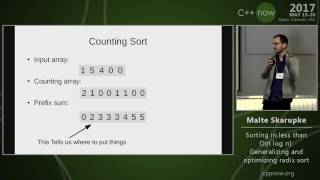
Sorting in Less Than O(n log n) - Generalizing and Optimizing Radix Sort
Explore advanced sorting techniques beyond O(n log n), focusing on generalizing and optimizing radix sort for various data types in C++. Learn to implement faster sorting algorithms for improved performance.
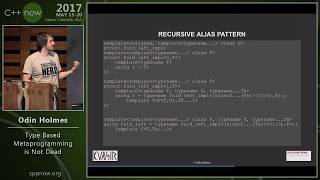
Type Based Template Metaprogramming is Not Dead
Exploring advanced C++ template metaprogramming techniques for improved compilation speed and efficiency, with a focus on type-based approaches and algorithm-data separation.
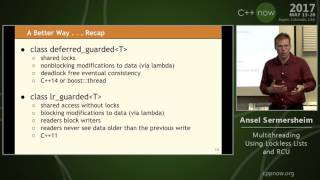
Multithreading Using Lockless Lists and RCU
Explore lockless lists and RCU technology for efficient multithreading in C++. Learn implementation techniques, benefits, and real-world applications in high-performance network daemons.
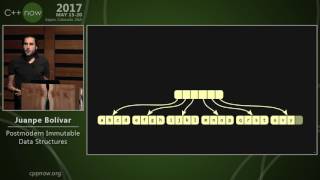
Postmodern Immutable Data Structures
Explore modern immutable data structures in C++, their benefits for concurrent systems, and efficient implementation techniques using Relaxed Radix Balanced Trees and the Immer library.
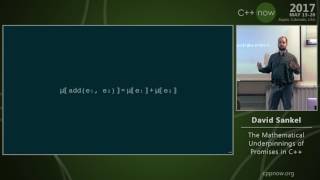
The Mathematical Underpinnings of Promises in C++
Explore the mathematical foundations of promises in C++ and their practical implementation, covering functional design principles, algebraic concepts, and real-world applications in library development.

Mocking C++
Explore mocking in C++ for efficient unit testing without dependencies. Learn techniques to create mock objects, overcome limitations, and improve test reliability and speed.
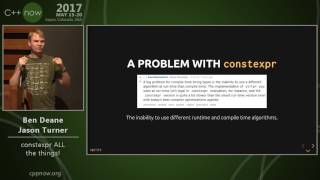
Constexpr ALL the Things!
Explore the power of constexpr in C++17, examining techniques for compile-time computation, data structures, and algorithms. Learn to effectively combine compile-time and runtime computations for optimal performance.