
Next-Generation React Databases
Highly scalable, reactive database for React and React Native. Offers lazy loading, relational queries, and cross-platform support. Optimized for performance and built-in sync capabilities.
Self Hosting Mobile Applications
Learn to self-host mobile app bundles, control version distribution, and implement over-the-air updates for real-time user experiences.
React Developer - How Are Your Production Skills?
Explore production challenges in React development, from minification issues to browser caching, with insights on error handling and webpack optimization for robust deployments.
Lifting & Shifting Entire React Ecosystem into New Languages
Explore the process of migrating React, Jest, and GraphQL to a new language and system, accelerating maturity and uncovering hidden issues in React and TypeScript.

A Peek into React Navigation 7 - React Native 2023
Explore upcoming features in React Navigation 7, including the new optional static API. Learn about refinements and long-requested additions from the creator of React Navigation 5.
Unveiling the Open Source Visualization Engine for Busy Hackers
Open source engine for creating advanced data visualizations, enabling visual learners to interpret complex data sets efficiently. Useful for security practitioners, incident responders, and malware researchers.

48 Dirty Little Secrets Cryptographers Don't Want You to Know
Explore 48 cryptographic attacks through hands-on challenges, covering block ciphers, public key algorithms, and real-world vulnerabilities. Gain practical insights into crypto exploitation across multiple programming languages.

Pivoting in Amazon Clouds
Explore cloud application vulnerabilities and exploitation techniques in Amazon Web Services, from initial access to gaining root account control. Learn about EC2, SQS, IAM, RDS, and more.
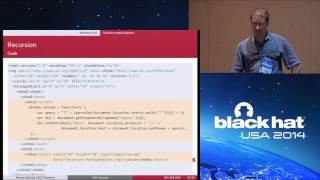
SVG - Exploiting Browsers without Image Parsing Bugs
Explore SVG's hidden potential for web exploitation, including JavaScript execution and external resource imports, challenging traditional browser security assumptions.

Libinjection - A C Library for SQLI Detection and Generation Through Lexical Analysis
Innovative C library for SQL injection detection using lexical analysis, offering high precision and accuracy. Trained on real attacks, it categorizes threats and provides templates for new attack detection.
PRNG Pwning Random Number Generators in PHP Applications
Techniques for exploiting randomness vulnerabilities in PHP applications, focusing on password reset token predictability and demonstrating account takeover through PRNG prediction.

Owning Bad Guys and Mafia with Javascript Botnets
Explore mitm attacks on anonymous services and learn to create JavaScript botnets for analyzing connections, uncovering activities of malicious actors behind these services.
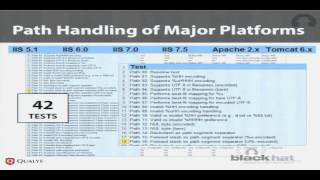
Confessions of a WAF Developer - Protocol-Level Evasion of Web App Firewalls
Explores protocol-level evasion techniques for bypassing web application firewalls, focusing on vulnerabilities in virtual patches and demonstrating real-world examples and countermeasures.

HTExploit - Bypassing Htaccess Restrictions
Explore HTExploit, an open-source Python tool that bypasses htaccess authentication, allowing unauthorized directory listing and exposing web security vulnerabilities.
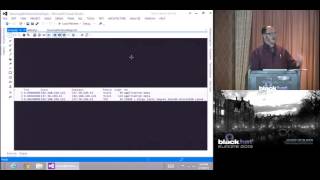
Hardening Windows 8 Apps for the Windows Store
Explore security considerations for Windows 8 Store apps, covering HTML5, backend services, cloud computing, and WinRT to ensure robust and privacy-focused mobile development.
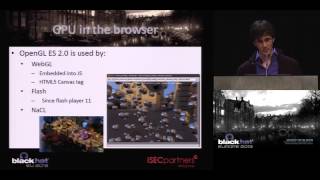
Harnessing GPUs - Building Better Browser Based Botnets
Explore browser-based botnets using GPUs for powerful computations. Learn about XSS, HTML5, and WebGL techniques to create efficient, cross-platform botnets capable of breaking strong encryption and impacting cybersecurity.

Javascript Static Security Analysis Made Easy with JSPrime
Explore JSPrime, a user-friendly tool for JavaScript static security analysis. Learn about its features, including library-aware scanning, variable tracing, and minimal false positives, to enhance your code security.
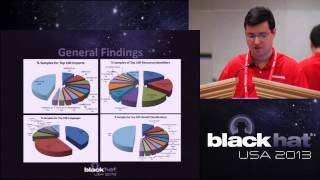
BinaryPig - Scalable Malware Analytics in Hadoop
Scalable malware analytics framework using Hadoop for processing large volumes of malware samples. Enables efficient feature extraction, machine learning, and data exploration for security researchers.
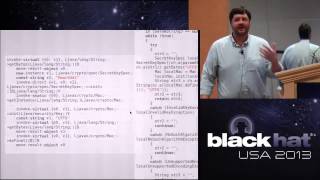
Abusing Web APIs Through Scripted Android Applications
Exploiting Android app vulnerabilities to abuse web APIs, using JRuby for scripting and Burp Suite for testing. Demonstrates attacks bypassing security measures and exposes potential weaknesses in mobile app ecosystems.
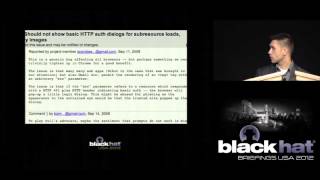
Blended Threats and JavaScript - A Plan for Permanent Network Compromise
Explore advanced browser-based attacks using JavaScript and HTML5, focusing on exploiting network devices and achieving persistent compromise of intranet systems.

Million Browser Botnet
Explore how online advertising networks can be exploited to create massive browser botnets, enabling DDoS attacks, spam campaigns, and password cracking without malware or zero-day vulnerabilities.