Nonreciprocity as a Generic Route to Traveling and Oscillatory States - Zhihong You
Explores nonreciprocity in many-body physics, focusing on traveling and oscillatory states. Discusses universal aspects of non-equilibrium systems across various fields of physics.

How Gemstones Form From Igneous & Metamorphic Processes - GEO GIRL
Explore the formation of 12 gemstones through igneous and metamorphic processes. Learn about their unique colors, properties, and geological origins, from diamonds to turquoise.

Massive Stars and Supernovae – With Thomas Haworth
Explore the formation, life, and explosive death of massive stars, their impact on galaxies, and recent discoveries in planetary science through engaging demonstrations and simulations.

Challenges and Prospects for Low-Level End-to-End Reconstruction With Machine
Explore challenges and prospects of low-level end-to-end reconstruction using machine learning in high-energy physics, focusing on innovative techniques and future applications.

Data-Driven Cosmology by Jia Liu
Explore data-driven approaches in cosmology, leveraging statistical methods and machine learning to analyze vast datasets and uncover insights about the universe's structure and evolution.
Neural Simulation-Based Inference by Elham E Khoda and Aishik Ghosh
Explore neural simulation-based inference techniques for high energy physics, focusing on advanced machine learning applications in data analysis and new physics discovery.
Machine Learning in High Energy Physics by Michael Kagan
Explore applications of deep machine learning in high energy physics, covering classification, identification, and estimation strategies for analyzing LHC data and searching for new physics.
Machine-Learned Symmetries by Konstantin Matchev
Explore machine-learned symmetries in high-energy physics with Konstantin Matchev. Discover innovative approaches to uncover hidden patterns and symmetries in particle physics data using advanced machine learning techniques.
Statistical Methods and Machine Learning in High Energy Physics - Project Presentation Session 2
Explore cutting-edge statistical methods and machine learning applications in high energy physics through expert presentations, fostering collaboration and innovation in data-driven research.
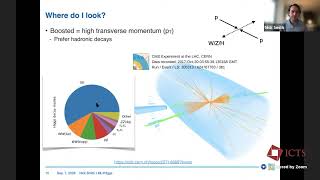
ML4Higgs - Success and Future Prospects by Nick Smith
Explore machine learning applications in high-energy physics, focusing on Higgs boson research. Learn about successful ML techniques and future prospects in analyzing LHC data for new physics discoveries.
Generative Models by Elham E Khoda and Aishik Ghosh
Explore generative models in high-energy physics, focusing on applications for data analysis and new physics discovery. Learn techniques to handle large datasets and improve classification strategies.

Mapping Particle Physics
Explore the standard model and particle physics with Jon Butterworth as he delves into the universe's building blocks, forces, and ongoing discoveries at the energy frontier.
Computation and the Fundamental Theory of Physics
Stephen Wolfram explores using computational systems to develop a new fundamental theory of physics, discussing discoveries and innovations in science, technology, and business over four decades.
New Kind of Physics? Exploring Particle Decay Discrepancies at CERN
Explore the exciting possibility of a new force of nature through recent LHCb experiment findings. Particle physicists discuss unexpected discrepancies in B meson decay data and their potential implications for fundamental physics.
Astronomy with Gravitational Waves
Explore gravitational waves and their role in astronomy with Dr. Alexander Nitz. Learn about neutron star and black hole mergers, and the open-source PyCBC library used in gravitational wave detection.

Emerging Technologies for Quantitative Interpretation of Carbonate Rock Images
Explore machine learning applications for automatic identification of carbonate facies using core images, improving accuracy and consistency in geological classifications.
Wave Function Evolver - Fun Potential Energies - Episode 5
Explore intriguing potential energies in quantum mechanics through interactive coding and visualization using VPython, enhancing understanding of wave function evolution.
Rope Simulator: Adding Surface Interactions - Episode 4
Enhance rope simulation with surface interactions, including dangling and sliding, using lists and conditions in VPython. Learn advanced physics modeling techniques.
Wave Function Evolver - Calculating Expectation Values and the Heisenberg Uncertainty Principle - Episode 4
Explore the Heisenberg Uncertainty Principle through expectation value calculations, gaining insights into fundamental quantum mechanics and chemistry concepts.
Rope Simulator: Implementing Lists for Efficient Element Tracking - Episode 2
Streamline a rope simulator using lists to track elements, velocities, and forces, resulting in a convincing animation that can handle any number of rope segments.
Rope Simulator - Building a Simple Rope Model - Episode 1
Explore the physics of ropes in video games by building a simple rope simulator using three atoms and two springs. Learn about the Euler-Cromer Method and VPython programming.