Math4ML Exercises - Calculus
Hands-on calculus exercises for machine learning, covering little-o notation, gradients, linear approximations, and optimization techniques using Python and SymPy.
Formal Mathematics for Mathematicians and Mathematics Students - IPAM at UCLA
Explore formal mathematics' potential to revolutionize mathematical exposition, focusing on benefits beyond proof verification and its impact on mathematicians and students.
Axel Målqvist - Localization of Multiscale Problems
Explore multiscale problem-solving techniques, focusing on Local Orthogonal Decomposition for PDEs. Learn about convergence, high-contrast data, and applications to time-dependent problems.
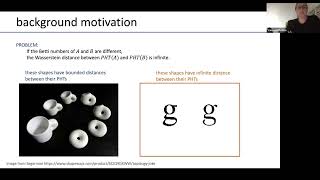
Vanessa Robins - The Extended Persistent Homology Transform for Manifolds with Boundary
Explore extended persistent homology transform for shape analysis, offering finite distances between shapes with different Betti numbers and applications in shape clustering.
Saecular Persistence
Explore saecular persistence, a method to decompose persistence modules with non-field coefficients. Learn about applications in topology, generalized persistence diagrams, and scientific data analysis.
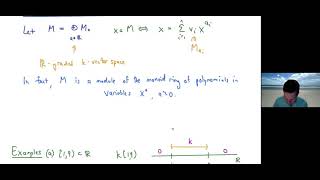
Homological Algebra for Persistence Modules
Introduction to persistence modules in algebraic topology, exploring tensor products, Hom operations, and their role in homological algebra. Insights into preserving exact sequences and advanced concepts.
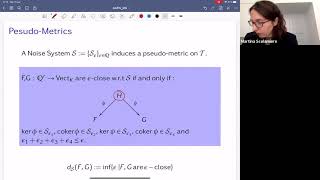
Extracting Persistence Features with Hierarchical Stabilisation
Explore hierarchical stabilisation for extracting stable invariants from persistence modules, focusing on the stable rank and its applications in data analysis and classification tasks.
On the Algebraic Geometry of Spaces of Persistence Modules
Explore algebraic geometry's application to persistence modules in topological data analysis, offering insights into data structure and shape analysis.
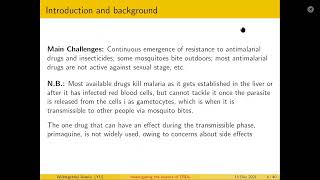
Investigating Transmission-Blocking Anti-malarial Drugs: A Mathematical Modelling Approach
Explore mathematical models assessing transmission-blocking antimalarial drugs' impact on disease control, focusing on treatment coverage, drug efficacy, and protective effects in malaria hotspots.
Pendulum Simulation: In Search of Chaos - Part 6
Explore chaos in double pendulum systems through simulation, analyzing different initial conditions and observing complex behavior patterns.

Why π Is in the Normal Distribution - Beyond Integral Tricks
Explore the mathematical origins of π in the normal distribution through geometric insights, classic proofs, and the Herschel-Maxwell derivation, offering a deeper understanding beyond integral tricks.
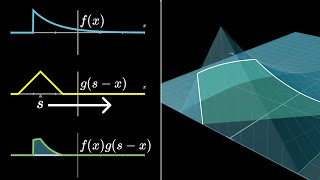
Convolutions and Adding Random Variables, Visually Explained
Visual explanation of convolutions and adding random variables, exploring discrete and continuous cases, with connections to the central limit theorem and practical examples.
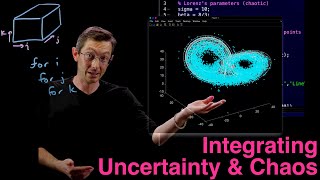
Numerical Integration of Chaotic Dynamics - Uncertainty Propagation & Vectorized Integration
Explore chaos and uncertainty propagation in dynamical systems through numerical integration. Learn efficient vectorization techniques in Python and MATLAB for faster computations.
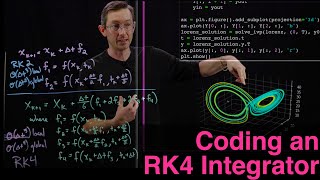
Coding a Fourth-Order Runge-Kutta Integrator in Python and Matlab
Learn to implement a 4th-order Runge-Kutta integrator in Python and Matlab, and apply it to simulate the chaotic Lorenz 1963 system. Gain practical coding skills for numerical integration.
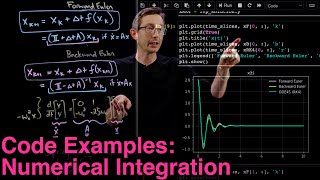
Numerical Integration of ODEs with Forward Euler and Backward Euler in Python and Matlab
Explore Forward and Backward Euler integration methods for ODEs using Python and Matlab. Compare stability, error, and implementation on a spring-mass-damper system with analytic solutions.

Mini Python Projects for Beginners
Learn to build three fun Python projects: Pig game, Madlibs generator, and timed math challenge. Gain practical coding experience and improve problem-solving skills through hands-on tutorials.
Python Mathematics - Python Tutorial from Two Lazy Programmers
Explore essential mathematical operations in Python, from basic arithmetic to advanced calculations, enhancing your programming skills for various applications.
Matrix Multiplication - C Programming
Learn to implement matrix multiplication in C, covering algorithm design, memory allocation, and efficient coding techniques for handling multi-dimensional arrays.

Rendering a Sphere Using Ray Tracing - Ray Tracing Series
Learn to render a sphere using ray tracing techniques in C++. Covers creating a Renderer class, structuring code like a pixel shader, and implementing sphere rendering with optimized performance.
Statistics for Data Analysis with Exercises - Lecture 1
Comprehensive introduction to statistical methods for data analysis in high-energy physics, covering fundamental concepts and practical applications through exercises and examples.
An Alternative Approach to Formal Mathematics - Prioritizing Communication over Certification
Exploring a communication-oriented approach to formal mathematics, emphasizing accessibility and practicality for a wider range of practitioners without sacrificing rigor.