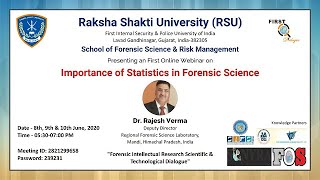
Importance of Statistics in Forensic Science - Dr. Rajesh Verma
Explore the crucial role of statistics in forensic evidence interpretation, covering uncertainty, key concepts, and practical applications through case studies and hypothesis testing.
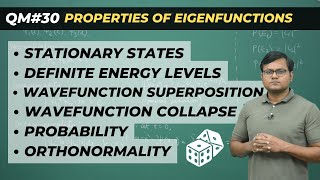
Stationary States, Energy Levels, Superposition and Wavefunction Collapse in Quantum Mechanics
Explore quantum mechanics concepts: stationary states, energy levels, superposition, and wavefunction collapse. Gain insights into fundamental principles shaping quantum systems.
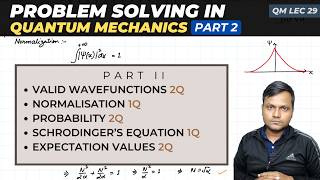
Problem Solving in Quantum Mechanics - Part II: Quick Revision for Competitive Exams
Intensive problem-solving session covering key quantum mechanics topics, including wavefunctions, normalization, probability, and Schrödinger's equation, ideal for exam preparation.
Logistic Regression and Ensemble Learning - Bagging and Boosting - AdaBoost
Explore logistic regression, ensemble learning, bagging, and boosting in this AI/ML course. Learn AdaBoost and decision stumps for strong non-linear classification.
Introduction to Patterns in Humanities Analytics
Explore patterns in humanities analytics: theory, practice, and meaning extraction from digital sources. Gain skills for innovative scholarship in cultural and textual analysis.
Structures in Random Graphs - New Connections
Exploring structures in random graphs, including cliques and independence numbers in Cayley graphs, thresholds for monotone properties, and edge-colorings of bipartite graphs.
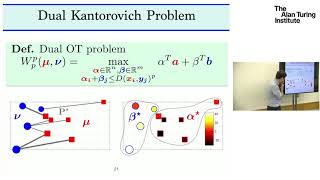
Regularization for Optimal Transport and Dynamic Time Warping Distances - Marco Cuturi
Explore regularization techniques for optimal transport and dynamic time warping distances, focusing on smoothing strategies to enhance machine learning applications and Fréchet mean computation.
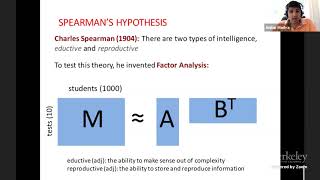
Recent Progress in High-Dimensional Learning
Explore recent advancements in high-dimensional learning, covering factor analysis, phylogenetic reconstruction, and hidden Markov models, with applications in genetics and machine learning.
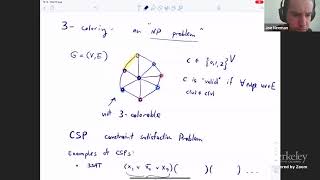
Crash Course on Probabilistically Checkable Proofs - Introduction
Explore probabilistically checkable proofs, including recoloring, constraint satisfaction, and the PCP theorem. Learn about verifier parameters and hardness of approximation in this comprehensive introduction.
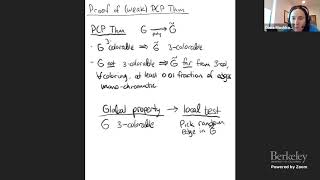
Crash Course on Probabilistically Checkable Proofs - PCP
Explore probabilistically checkable proofs, their formulation, global vs local tests, and computational implications in this comprehensive lecture on advanced theoretical computer science concepts.
Understanding Unstructured Data with Language Models - Alex Peattie
Explore language models for unstructured data analysis, covering classification, predictive modeling, and information retrieval. Learn key concepts and practical applications in various fields.
Introduction to Quantum Algorithms - IPAM at UCLA
Explore quantum algorithms, focusing on Grover's algorithm, with mathematical foundations, quantum circuits, and practical applications in this comprehensive introduction.
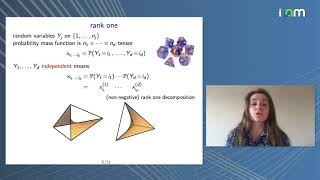
Tensors in Statistics and Data Analysis
Explore tensors in statistics and data analysis, covering probability tensors, biological measurements, and signature tensors for time-series data. Learn about decompositions and algebraic properties in this comprehensive overview.
Basics of Quantum Computing - Lecture 10 of Quantum Computation at CMU
Explore quantum computing fundamentals, including efficiency, probabilities, circuits, gates, and reversible computation. Gain insights into key concepts and important questions in this field.
Adaptive Sampling via Sequential Decision Making - András György
Explore adaptive sampling methods using multi-armed bandit algorithms and MCMC samplers to optimize resource allocation and improve sample quality in machine learning applications.
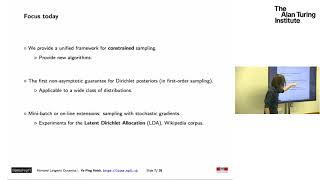
Mirrored Langevin Dynamics - Ya-Ping Hsieh
Explore posterior sampling in constrained distributions, focusing on Latent Dirichlet Allocation. Learn about a unified framework for deriving novel sampling schemes with improved convergence rates.
Building Efficient Learning Algorithms: A Computational Regularization Perspective - Lorenzo Rosasco
Explore efficient learning algorithms through a computational regularization lens. Unify algorithmic tricks in least squares learning for accuracy and resource efficiency.

The Startling Reason Entropy and Time Only Go One Way
Explore the fascinating connection between entropy, probability, and the unidirectional flow of time. Discover why natural phenomena tend towards lower energy states and how this relates to the universe's increasing disorder.

Die dreckige Empirie
Kritische Betrachtung empirischer Studien: Methoden, Probleme und Interpretationen. Grundlagen der Statistik und wissenschaftlichen Denkweise für ein besseres Verständnis von Forschungsergebnissen.
The Mindset of a Trader
Discover essential tools for successful trading: myth-busting, poker face, probability mindset, clarity, focus, and realistic expectations in this insightful TEDx talk.
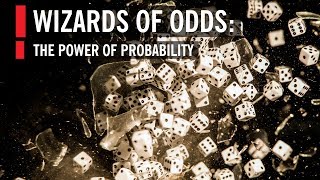
Wizards of Odds - The Power of Probability
Experts explore probability's subtle nature and its crucial role in science, technology, medicine, and daily life, offering insights into common misconceptions and its powerful applications.