Quantum and Classical Probability Distributions - Computational Quantum Mechanics Lecture 10
Explore the transition from quantum to classical mechanics through probability distributions, using computer animations to visualize quantum behaviors in VPython.
Ancestors' Genetic Weights in Biparental Populations
Explore genetic composition in biparental populations using a Moran model. Analyze ancestral genome proportions and their convergence as population size increases.
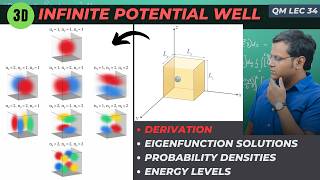
Particle in a 3D Box - Quantum Mechanics Fundamentals
Explore quantum mechanics through the particle in a 3D box problem. Learn about wavefunctions, energy quantization, and their implications for understanding atomic and molecular systems.
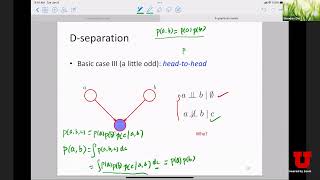
Probabilistic Graphical Models and Maximum Likelihood Estimation - Lecture 13
Dive into probabilistic graphical models, exploring likelihood estimation, Gaussian models, and network structures while learning to analyze real-world data using conditional independence concepts.
Innovations in Theoretical Computer Science 2020 - Session 9
Cutting-edge research in theoretical computer science, covering topics like distribution testing, random object sampling, probability distribution learning, agreement expansion, neural networks, and influence maximization.
Optimal Gradient-Based Algorithms for Non-Concave Bandit Optimization
Explore optimal gradient-based algorithms for non-concave bandit optimization, covering stochastic problems, low-rank linear rewards, and high-order polynomials with applications to reinforcement learning.
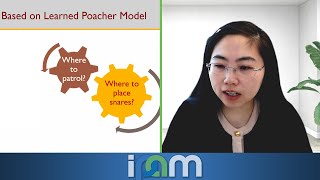
Machine Learning and Game Theory for Social Impact
Explore machine learning and game theory applications in security, sustainability, and food rescue, featuring real-world deployments and innovative solutions for societal challenges.
Replacing Probability Distributions in Security Games via Hellinger Distance
Explore statistical distance in security games, focusing on Hellinger distance as an alternative to max-log for bit security frameworks and leftover hash lemma applications.
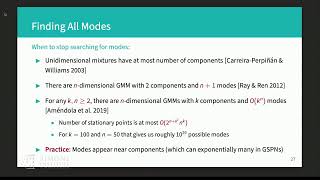
On Finding Modes of Gaussian Sum-Product Networks
Explore challenges and tractability of finding modes in Probabilistic Circuits, focusing on Gaussian Sum-Product Networks for machine learning tasks like structured prediction.
Tracking Significant Changes in Bandit - IFDS 2022
Explores significant changes in bandit algorithms, focusing on adaptive procedures and random replays for tracking environmental shifts in reward and context distributions.

Uncertainty-Tracking Computation Hardware for Processing Data from the Physical World
Explore innovative processor architecture for tracking uncertainty in computations, enhancing accuracy and efficiency in various domains from quantum algorithms to sensor data processing.
What Is ChatGPT Doing? Understanding Large Language Models - Episode 2
Explore the inner workings of ChatGPT and large language models, understanding their token-by-token generation process and the complexities behind their seemingly intelligent outputs.
GFlowNet Foundations and Applications in Biological Sequence Design
Explore GFlowNet foundations and applications in biological sequence design. Learn about flow conservation, transition probabilities, and practical implementations for molecule generation and peptide design.
What's in Your Risk Assessment?
Accelerate your risk assessment approach to meet evolving regulatory demands and stakeholder needs for high-quality decision data in this informative session on effective risk management strategies.
A Careful Walk Through Probability Distributions, Using Python
Explore probability distributions using Python, demystifying key concepts like sampling, joint, conditional, and marginal distributions for a solid foundation in Bayesian statistics.
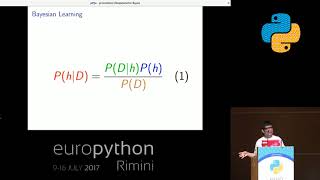
Introduction to Nonparametric Bayesian Models
Explore flexible machine learning with Nonparametric Bayesian Models. Learn about Dirichlet Process, compare parametric vs nonparametric approaches, and discover relevant Python libraries for advanced data analysis.
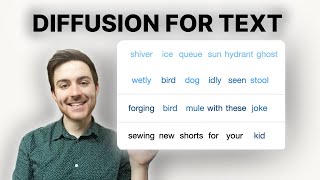
Understanding Text Generation Through Diffusion Models - From Theory to Implementation
Dive into discrete diffusion modeling for text generation, exploring probability distributions, score-based modeling, and practical applications in generative AI that rival GPT-2's capabilities.
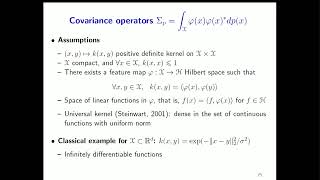
Information Theory with Kernel Methods
Explore entropy estimation in data science using kernel methods and quantum information theory for covariance matrices.
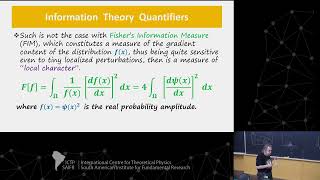
Information Theory Tools for Neuroscience Applications - Class 1 of 3
Explore information theory tools for neuroscience, covering dynamical systems, chaos, complexity measures, and probability distributions in this comprehensive lecture.

Boltzmann Machines - The Grandfather of Generative Models
Explore Boltzmann Machines, early generative models learning data probability distributions using stochastic rules and latent representations. Understand their goals, distribution, update rules, and evolution to Restricted Boltzmann Machines.

Optimal Transport for Distributionally Robust Optimization and Applications in Machine Learning
Explore optimal transport in distributionally robust optimization, focusing on its applications in machine learning, distribution shifts, and responsible AI. Gain insights into solving challenging optimization problems.