
Machine Learning Full Course for Beginners
Comprehensive introduction to machine learning, covering key concepts, algorithms, and practical applications using Python libraries. Ideal for beginners seeking a solid foundation in ML.

Variation in the Skull of Anchiceratops
Explore skull variations in Anchiceratops, examining sexual dimorphism, fossil evidence, and statistical analyses to understand dinosaur evolution and extinction implications.
Covariance and Subspace Inference: Handling Robustness, Variability and Heterogeneity
Explore covariance matrix inference and PCA for non-regular data, covering mixed effects models, Gaussian assumptions, outlier handling, and applications in radio-interferometry calibration and imaging.
Weighted Gene Co-expression Network Analysis - Step-by-Step Tutorial - Part 1
Learn step-by-step Weighted Gene Co-expression Network Analysis (WGCNA) for RNA-Seq data, covering data manipulation, outlier detection, normalization, module identification, and visualization techniques.

Principal Component Analysis
Explore dimensionality reduction through PCA, covering variance, covariance, eigenvectors, and eigenvalues. Learn key concepts with visual explanations and practical applications in data analysis.
Parsimonious Representations in Data Science - Dr. Armin Eftekhari, University of Edinburgh
Explore geometric structures in data, from linear subspace models to nonlinear approaches, for efficient data analysis and representation in the era of big data.

Clustering and Markers Identification for ScRNA-Seq - Seurat Package Tutorial
Learn to analyze single-cell RNA-seq data using Seurat package, covering data import, QC, normalization, clustering, and marker identification. Gain insights into cell interactions and create visualizations.
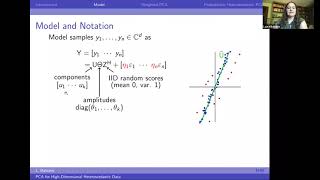
PCA for High-Dimensional Heteroscedastic Data
Explore optimal weighting for PCA in high-dimensional heteroscedastic data, improving recovery of underlying components and addressing challenges in modern applications with heterogeneous datasets.
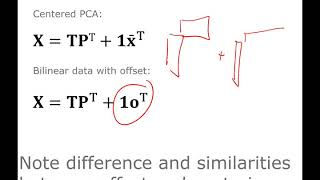
Preprocessing: Centering and Scaling in Chemometric Machine Learning
Learn techniques for centering and scaling data to enhance information in chemometric machine learning contexts like PCA and PLS models.
Functional Data Analysis in Practice
Explore practical applications of functional data analysis with insights from Qiwei Yao of the London School of Economics, covering key concepts and methodologies.
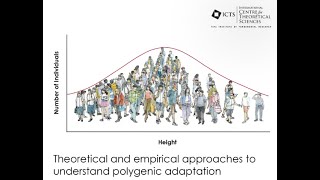
Tools of High Dimensional Data - Lecture 3
Explore high-dimensional data analysis techniques with Bruce Walsh, focusing on advanced tools and methods for complex datasets in biological evolution and genetics.
Contained Chaos - Ensemble Consistency Testing for the Community Earth System Model
Explore ensemble consistency testing for climate models, focusing on the Community Earth System Model. Learn about statistical methods to evaluate model changes and ensure software quality in climate simulations.
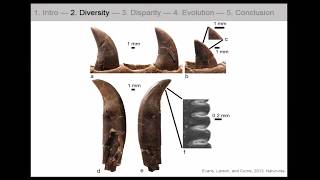
Morphology, Disparity, and Evolution of Theropod Teeth in the Late Cretaceous in Alberta
Explore theropod tooth evolution in Late Cretaceous Alberta through morphology and disparity analysis, revealing patterns across formations and time periods.
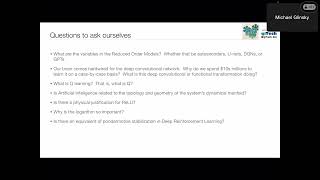
A Physics-Based Reduced Order Model Capturing the Topology of Dynamical Manifolds
Explore a transformational approach to dynamics using the Heisenberg Scattering Transformation, applied to create fast surrogate models for 2D pulsed power liner implosions in MagLIF.

Principal Component Analysis and Singular Value Decomposition - Spring 2023
Master dimensionality reduction techniques through PCA and SVD, exploring multicollinearity, vector basis, and practical applications with hands-on demonstrations for effective data analysis.
Innovations in Theoretical Computer Science 2020 - Session 10
Explores cutting-edge research in theoretical computer science, covering topics like computational hardness, random strings, decision trees, and pseudorandomness. Features presentations from leading experts in the field.
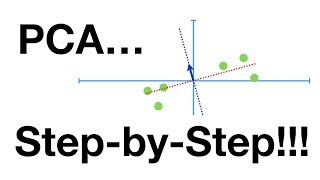
Principal Component Analysis - PCA, Step-by-Step
Step-by-step guide to Principal Component Analysis (PCA), explaining its importance in data analysis and machine learning. Covers 2D and 3D data examples, PC calculation, and interpretation of results.

Principal Component Analysis - PCA Clearly Explained - 2015
Clear explanation of Principal Component Analysis, covering dimensions, variance, loading scores, and key concepts for interpreting PCA plots in RNA-seq data analysis.
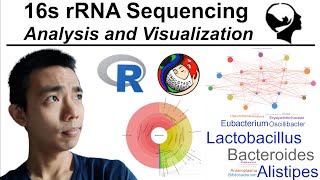
rRNA Sequencing Analysis and Visualization
Explore microbiome analysis techniques using various tools. Learn OTU clustering, diversity analysis, PCA, AMOVA, tree plotting, and visualization with Galaxy, Krona, and MEGAN6 for comprehensive 16S rRNA sequencing insights.
Principal Component Analysis for Hip Hop Songs With Tidymodels
Implement PCA using recipes to analyze the best hip hop songs of all time, exploring Spotify data and visualizing results with tidymodels.
Machine Learning for Signal Processing - Data Compression and Denoising
Explore machine learning for signal processing, focusing on data compression and noise removal using PCA. Learn linear algebra applications and alternative techniques for effective data analysis.