
The Million Dollar Equations - With Tom Crawford
Explore four of the seven unsolved million-dollar math problems, including the Riemann hypothesis and P vs NP, with Oxford mathematician Tom Crawford in this engaging lecture on complex mathematical concepts.
A Solution to the Stable Marriage Problem - Emily Riehl Public Lecture
Explore the mathematics behind the stable marriage problem, its sexist implications, and real-world applications in this engaging lecture by mathematician Emily Riehl.

Neil Turok Public Lecture - The Astonishing Simplicity of Everything
Explore the universe's simplicity at largest and tiniest scales, uncovering new physics avenues and potential technological breakthroughs with renowned physicist Neil Turok.
Einstein's Lost Key - How We Overlooked the Best Idea of the 20th Century
Explore Einstein's initial variable speed of light theory in general relativity, its historical context, and its potential as a Machian interpretation of gravity.
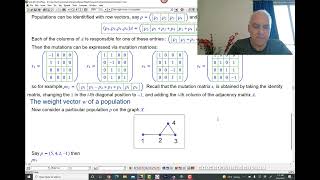
The Pentagon and Numbers Games - A Dualization of the Mutation Game
Explore the duality between the Pentagon Game and Numbers Game, examining their connections to graph dynamics and mathematical structures like ADE graphs and weight lattices.

Curt Jaimungal Interview and Theories of Everything - Sociology and Pure Maths
Exploring diverse topics from physics and mathematics to consciousness and UFOs, this wide-ranging interview delves into theories of everything, sociological aspects of science, and the intersection of academic disciplines.
A New Paradigm for Mathematics and Physics - Diffusion Symmetry
Exploring diffusion symmetry as a new paradigm for understanding symmetry in mathematics and physics, offering insights into group theory, character tables, and fusion rule algebras.
Dot Products, Pythagoras' Theorem, and Generalizations - Wild Linear Algebra A - NJ Wildberger
Algebraic approach to metrical geometry using dot products and quadrance. Introduces symmetric bilinear forms for understanding relativistic geometry, with applications to linear algebra and physics.
Curvature, Turning Numbers and Winding Numbers - Differential Geometry
Explores advanced concepts in planar curvature, including turning numbers, winding numbers, and parametric curves. Connects to complex analysis and circular motion, offering insights into differential geometry.
Metrical Structure and Curvature of a Parabola - Differential Geometry
Explore metrical structures and curvature in differential geometry, focusing on parabolas. Learn about symmetric bilinear forms, relativistic geometries, and their applications in physics.
Exceptional Structures in Mathematics and Physics From Dynamics on Graphs
Explore exceptional structures in math and physics through graph dynamics, connecting to Coxeter diagrams, root systems, and Lie algebras. Discover new combinatorial structures and their role in representation theory and modern physics.
The Geometry of the Dihedrons and Quaternions - Famous Math Problems
Explore the geometry of Dihedrons and Quaternions, comparing their properties and connections to relativity, linear algebra, and complex numbers. Gain insights into fundamental mathematical structures.
How to Construct the True Complex Numbers I - Famous Math Problems
Exploring the construction of true complex numbers using field theory and linear algebra, challenging traditional approaches and introducing novel concepts for a modern understanding.
How Chromogeometry Transcends Klein's Erlangen Program for Planar Geometries - N J Wildberger
Discover chromogeometry's three-fold symmetry in planar geometry, unifying Euclidean and relativistic geometries. Explore rational trigonometry, colored Pythagoras theorems, Euler lines, and novel perspectives on conic sections.
ADE Graphs and Lattices, Weights and Quarks
Explore ADE graphs, lattices, and their connections to mathematics and particle physics. Discover the Numbers game, weights, and the fascinating link between A2 diagrams and quark theory.
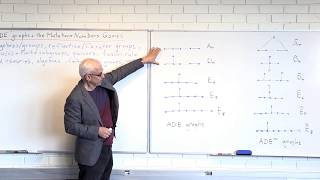
The Ubiquity of ADE Graphs, and the Mutation and Numbers Games - Math Seminars
Explore ADE graphs' mathematical significance, mutation games, and connections to advanced fields like Lie algebra, root systems, and physics in this insightful seminar on combinatorial structures.
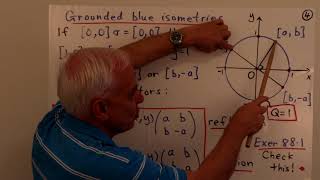
Isometry Groups in Planar Geometry - WildTrig: Intro to Rational Trigonometry - N J Wildberger
Explore isometry groups in Euclidean and relativistic geometries, focusing on grounded isometries, reflections, and rotations using an algebraic approach without infinite operations.
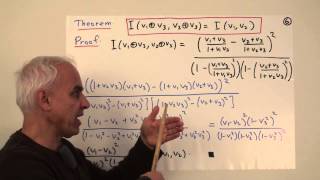
Relativistic Velocity, Core Circles and Paul Miller's Protractor - Rational Geometry
Explore core circles in rational geometry, connecting projective and Euclidean concepts. Learn about relativistic velocity addition and its implications for Einstein's special theory of relativity.
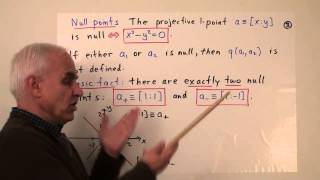
Isometry Groups of the Projective Line III - Rational Geometry Math Foundations
Exploring relativistic geometry in one dimension, extending projective geometry to incorporate Einstein's special theory of relativity and its impact on physics and mathematics.
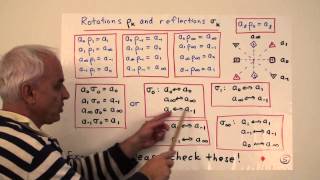
Isometry Groups of the Projective Line - Rational Geometry Math Foundations
Exploring finite field geometry: isometries, rotations, and reflections on the projective line, revealing connections to relativistic geometry and offering a new perspective on Euclidean concepts.
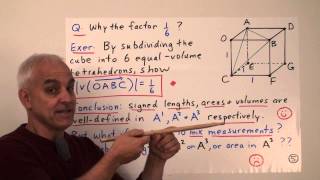
Higher Dimensions and the Roles of Length, Area, and Volume - Rational Geometry Math Foundations
Explore higher dimensions and the fundamental role of squared measurements in geometry. Discover how quadrance, quadrea, and quadrume offer more general and invariant alternatives to traditional length, area, and volume.