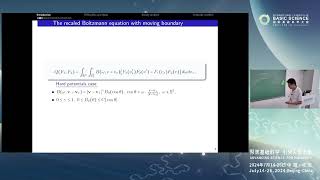
3D Kinetic Couette Flow via the Boltzmann Equation in the Diffusive Limit
Explore the rigorous connection between incompressible Couette flow and the Boltzmann equation through novel anisotropic estimates in the Wiener algebra function space.
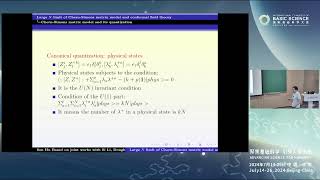
Large N of Chern-Simons Matrix Model and Conformal Field Theory
Explore the emergence of 1+1D conformal field theory from large N limit of 2+1D Chern-Simons matrix models, including Kac-Moody algebra and holographic duality.
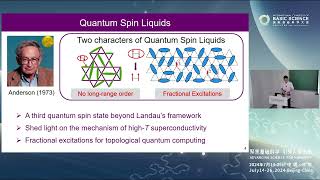
Neutron Spectroscopy Studies of Kitaev Quantum Magnets
Explore Kitaev quantum magnets through neutron spectroscopy, examining the Kitaev model, its realization in α-RuCl3, and extension to higher-spin systems like Na3Ni2BiO6.
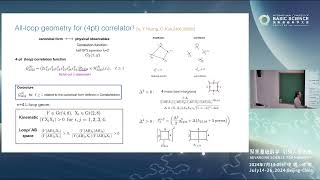
From Combinatorics to Real World Scattering - ICBS 2024
Explore combinatorial geometries in QFT and string theory, focusing on a new formulation for scattering of colored scalars, pions, and gluons.
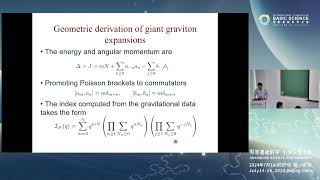
Giant Graviton Expansions, Gauge-Gravity Correspondence, and Emergent Spacetime
Explore giant graviton expansions in gauge-gravity correspondence, uncovering insights into quantum field theory, string theory, and emergent spacetime geometries.
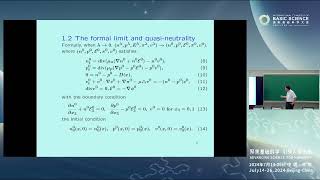
Quasi-Neutral Limit Problem of Planck-Nernst-Poisson-Navier-Stokes Equations for Electro-Hydrodynamics
Explore quasi-neutral limit problem in electro-hydrodynamics, examining multi-scaling structure stability, boundary layers, and well-posedness theory for Planck-Nernst-Poisson-Navier-Stokes equations.
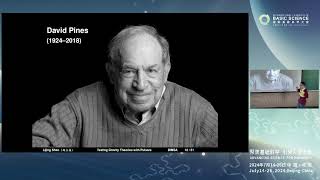
Testing Gravity Theories with Radio Pulsar Timing
Explore radio pulsar timing techniques and their application in testing alternative gravity theories using binary pulsars.
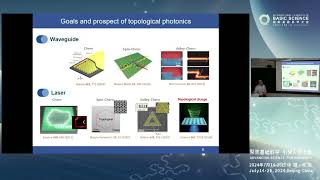
Unidirectional Light Emission from a Topological Perspective
Explore unidirectional light emission in photonic integration through topological charges, unveiling novel phenomena and applications in next-generation computing.
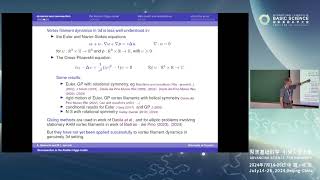
Vortex Reconnection in the 3D Critical Abelian Higgs Model
Explore vortex reconnection in 3D critical Abelian Higgs model, focusing on dynamics of nearly parallel vortex filaments and their collisions in particle physics.
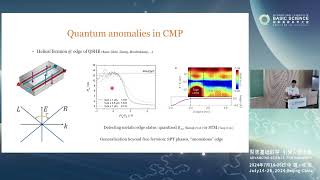
Detecting Quantum Anomalies in Open Systems
Explore novel approach for detecting quantum anomalies in open systems, focusing on mixed anomalies in spin chains and their distinctive characteristics in measurements.
Alterfold Topological Quantum Field Theory
Explore the connection between injective ground states of gapped Hamiltonians and TQFT, bridging topological orders with constructive quantum field theory.
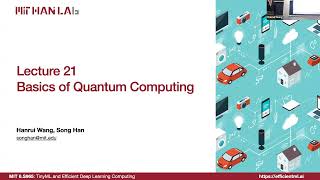
Basics of Quantum Computing - Lecture 21
Explore quantum computing fundamentals, including key concepts and potential applications in computational problem-solving and information processing.
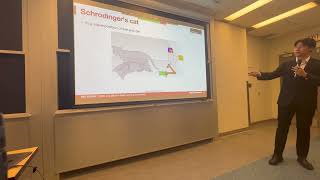
Basics of Quantum Computing - Lecture 21
Explore quantum computing fundamentals, including key concepts and potential applications in computational problem-solving and information processing.
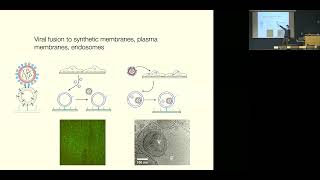
Physical Constraints on the Evolution of Viral Entry
Explore physical constraints on viral entry evolution with Dr. Peter Kasson. Gain insights into membrane dynamics, fusion mechanisms, and pandemic prediction through experimental and computational approaches.
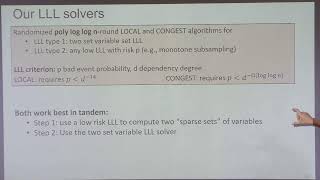
Sparsification for Communication-Efficient Distributed Symmetry-Breaking
Explore sparsification techniques for efficient distributed algorithms, focusing on local symmetry-breaking problems in graph theory and the CONGEST model.

Solving Integral Equations with Inti.jl - JuliaCon 2024
Explore Inti.jl for solving volume and boundary integral equations in mathematical physics. Learn about its user-friendly features, integration capabilities, and specialized routines for handling singular kernels.
Towards QMCPACK v4
Explore advancements in quantum Monte Carlo simulations with QMCPACK v4, focusing on new features and improvements for computational materials science research.
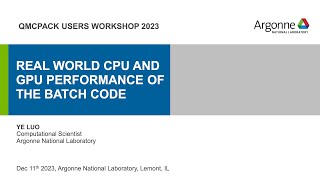
CPU and GPU Performance of the Batched Code - QMCPACK Workshop 2023
Explore CPU and GPU performance optimization techniques for batched code in quantum Monte Carlo simulations with QMCPACK.
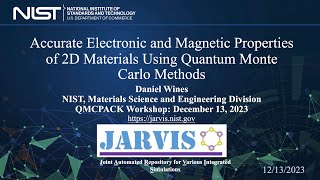
Accurate Electronic and Magnetic Properties of 2D Materials Using Quantum Monte Carlo Methods
Explore quantum Monte Carlo methods for precise electronic and magnetic property calculations in 2D materials with Daniel Wines from NIST.
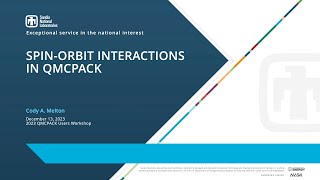
Spin Orbit Coupling in QMCPACK
Explore spin orbit coupling implementation in QMCPACK with Cody Melton's workshop presentation, covering advanced quantum mechanics concepts and computational techniques.
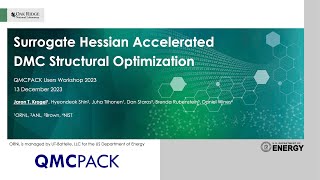
Surrogate Hessian Method for Geometry Optimization - QMCPACK Workshop 2023
Explore the surrogate Hessian method for efficient geometry optimization in quantum systems, presented by Jaron Krogel at the QMCPACK Workshop 2023.