Tutorial Session on Emergent Phenomena in Non-Equilibrium Quantum Many-Body Systems
Explore emergent phenomena in non-equilibrium quantum many-body systems through an expert-led tutorial session.
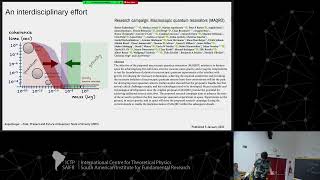
Tabletop Quantum Gravity as a Test of Modifications of Standard Quantum Theory
Explore tabletop quantum gravity experiments as tests for modified quantum theories in this concise minicourse on perturbative and nonperturbative quantum gravity.
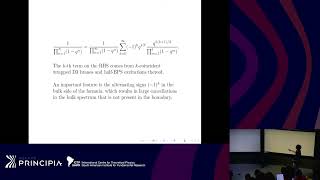
Integrability in Gauge and String Theory - On Branes and Trace Relations
Explore branes and trace relations in gauge and string theory with Ji Hoon Lee's insightful presentation on integrability concepts.
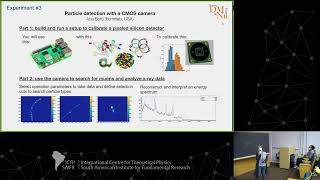
Laboratory and Hands-on Activities for Dark Matter and Neutrino Detection
Explore hands-on experiments in dark matter and neutrino detection, covering sensitivity limits, simulations, particle detection techniques, and detector characterization.
Machine Learning for Quantum Applications - Part 2
Explore advanced machine learning techniques for quantum applications, focusing on cutting-edge developments and practical implementations in quantum systems.
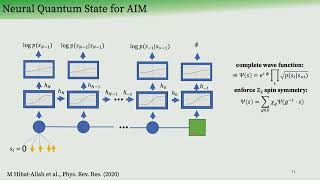
Is the Ground State of Anderson's Impurity Model a Recurrent Neural Network?
Explore the connection between Anderson's impurity model ground state and recurrent neural networks in condensed matter physics.
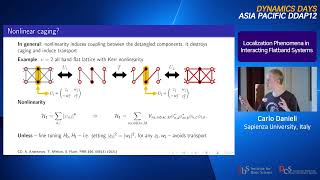
Localization Phenomena in Interacting Flatland Systems
Explore localization phenomena in flatband networks, examining compact localized eigenstates and the impact of perturbations. Discover finetuning protocols for diverse localization features in classical and quantum systems.
Multiple Wave Scattering - Previewing the Rothschild Lecture
Explore multiple wave scattering theory and applications with Prof. Liliana Borcea, previewing her Rothschild lecture and discussing collaborative research at INI.
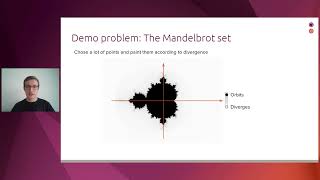
Introduction to Numerical Computation Applications Using Ubuntu WSL
Explore numerical computing on Ubuntu WSL for efficient solver development and deployment, with practical examples and insights on streamlining workflows for complex engineering problems.
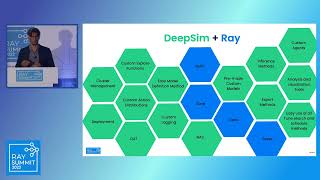
Wind Farm Optimization Using Reinforcement Learning and Large-Scale Simulation
Optimize wind farm energy production using deep reinforcement learning and large-scale simulations. Boost annual output by 1-2% through advanced yaw control strategies.

The Future of Quantum Computing - Exploring Fault-Tolerant Systems and Practical Applications
Explore the future of quantum computing, its potential applications, and the impact of fault-tolerant systems with Xanadu's CEO Christian Weedbrook.

Photonic Quantum Computing at Xanadu - APEF 2023
Explore Xanadu's photonic quantum computing advancements with CTO Zachary Vernon at APEF 2023's Emerging Technologies session.

Thinking Quantum Optimization with Neutral Atoms - QHack 2023
Explore neutral-atom quantum processors, field programmable qubit arrays, and analog quantum dynamics control for efficient problem encoding and algorithm time evolution.
Towards Qudit Quantum Computation
Explore photonic qudits and their potential in quantum information processing, covering transverse photon modes, free-space and on-chip techniques, and future applications.
Entangling Superconducting Qudits
Explore superconducting qudit-based quantum computing, focusing on efficient entanglement techniques for enhanced computational power in multi-level quantum systems.
Platonic Ququart Benchmarking - Characterizing 4-Level Quantum Systems
Explore ququart systems, implement character randomized benchmarking, and assess quantum gate errors using platonic solid symmetries and NMR techniques.
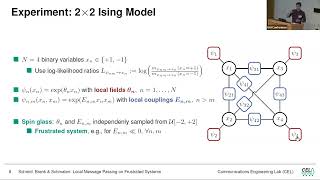
Local Message Passing on Frustrated Systems - UAI Oral Session 6
Explore an alternative message passing algorithm for cyclic graphs, challenging SPA's extrinsic principle and optimizing factor node updates for improved performance on complex networks.

Integrating and Plotting Equations of Motion - CE2120 Homework 01
Integrate and plot equations of motion for engineering applications. Master techniques for solving and visualizing dynamic systems.
The Coaching Eye - How Reliably Can Expert Coaches Observe Movement?
Expert coaches' ability to observe and analyze tennis serves, examining factors like viewing angle, age, and gender that may influence their judgments. Insights into the reliability of visual assessments in sports coaching.
Julia's Use in Nuclear Physics Data Analysis: A Case Study
Explore Julia's potential in nuclear physics data analysis, combining high performance with dynamic capabilities for efficient processing and visualization of large datasets.
High Resolution Flux Estimation with TurbulenceFlux.jl
Explore advanced flux estimation techniques using wavelet analysis in TurbulenceFlux.jl, offering improved accuracy for non-stationary environments and turbulent transport identification in ecosystem studies.