Design Optimal Discrete Magnetic Coils with Wolfram Language
Optimize discrete magnetic coil designs using spherical harmonic mapping and Wolfram Language's root-finding capabilities for precise, compact, and easily fabricated magnetic field generation.
Small-Molecule Binding to Intrinsically Disordered Proteins - Characterization and Implications for Drug Design
Explore integrative methods for characterizing disordered proteins, focusing on amyloid-β and its interaction with small molecules to prevent toxic aggregation in Alzheimer's disease.
Efficient Calculation of the Absolute Molecular Entropy
Learn efficient methods for calculating absolute molecular entropy, combining DFT and semi-empirical approaches to achieve chemical accuracy in free energy computations for realistic chemical reaction modeling.
Probing Water-2D Material Interfaces: Quantum and Classical Simulations on Defective and Rough Surfaces
Explore quantum and classical simulations of water-2D material interfaces, focusing on defects and roughness in hexagonal boron nitride. Gain insights into wettability, slip length, and interfacial properties for desalination and sensing applications.
Simulating Thousands of Atoms Using Linear Scaling BigDFT - Applications in Large-Scale Quantum Systems
Explore linear-scaling DFT for simulating thousands of atoms using BigDFT. Learn about localized support functions, fragment approaches, and applications in large-scale quantum simulations.
A Touch of Non-Linearity: Mesoscale Swimmers and Active Matter in Fluids
Explore mesoscale swimmers and active matter in fluids, focusing on the transition from Stokes to intermediate Reynolds numbers and its impact on hydrodynamic interactions and collective behavior.
Quantitative Modeling of Magnetic Materials at the Atomic Scale
Explore quantitative modeling of magnetic materials at atomic scale, focusing on atomistic spin dynamics and quantum thermostat implementation for accurate thermodynamic calculations.
A Weak Convergence Viewpoint on Invertible Coarse-Graining
Explore weak convergence in invertible coarse-graining, combining force-matching with neural networks to recover fine-grained free energy surfaces in biomolecular systems.
Fully Quantum (Bio)Molecular Simulations - Dream or Reality?
Explore quantum-mechanical and machine learning advances in molecular simulations, their potential impact, and challenges in achieving fully quantum dynamics of complex biomolecular systems.
Information Scrambling: A Path-Integral Perspective
Explore quantum information scrambling, its quantification through Lyapunov exponents, and the role of path integrals in understanding universal bounds on chaos in thermal quantum systems.
A Quantum Computing Algorithm to Speed Up Metropolis Sampling
Explore a quantum algorithm for accelerating Metropolis sampling in multidimensional systems, leveraging wave function collapses for non-local configuration space moves.
Solvated Electron: First Principles and Machine Learning Approaches
Explore advanced modeling of solvated electrons using machine learning, overcoming challenges in accuracy and efficiency to study structure, dynamics, and properties across temperatures.
Modelling Solution Chemistry for Transition Metal Complexes
Explore advanced techniques for modeling chemical reactions in solution, focusing on explicit solvent interactions and their impact on transition metal complexes and catalysis.

JOVE Convergent Polishing
Explore a convergent polishing process developed by Lawrence Livermore National Laboratory researchers for advanced materials and surfaces.

AI for Physical Models with Geometric Tools
Explore geometric tools for integrating AI into physical models, enhancing understanding and application of advanced modeling techniques.
Introduction to Quantum Computing and Quantum Technology
Explore quantum computing fundamentals, mechanics, advantages, and applications in various industries. Gain insights into quantum machine learning for data science.
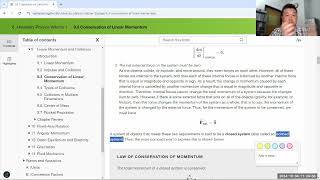
Physics 4A - Chapter 9 Overview - Fall 2024
Explore fundamental concepts of linear momentum, collisions, and conservation laws in classical mechanics. Gain insights into key principles of Newtonian physics.

Force Formulas - Static Friction, Kinetic Friction, Normal Force, Tension Force, and Free Body Diagrams
Master force formulas and free body diagrams for static friction, kinetic friction, normal force, and tension force. Gain essential physics skills through practical examples and comprehensive explanations.
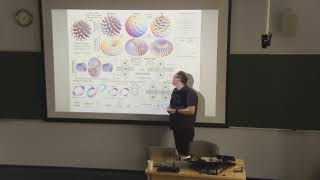
Exploring Resemblance Between Topological Charges, Vortices, Knots and Particle Physics - Part 2
Dive into the intriguing connections between topological structures and particle physics, expanding on advanced concepts in this continuation lecture.
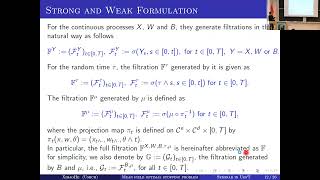
On the Limit Theory of Mean Field Optimal Stopping with Common Noise
Explore mean field optimal stopping with common noise, focusing on limit theory. Gain insights into mathematical finance concepts presented at the Eastern Conference.
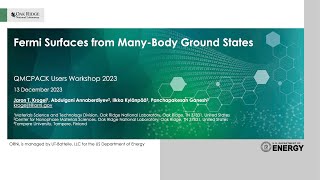
Fermi Surface Calculation with QMCPACK - 13/18
Explore Fermi surface calculations using QMCPACK in this advanced workshop presentation, focusing on cutting-edge techniques and applications in quantum physics.