Machine Learning for LHC Theory - Lecture 2
Explore advanced machine learning techniques for Large Hadron Collider theory, focusing on statistical methods and their applications in high-energy physics research.

Peter Shor - Quantum Computing - Green Family Lecture at IPAM at UCLA
Explore quantum computing's impact on information theory, computation, and cryptography, including Shor's algorithm for prime factorization and other quantum discoveries.
Quantum Machine Learning 101: An Introduction for Beginners with TensorFlow
Explore quantum machine learning basics and implement simple algorithms using TensorFlow. Gain hands-on experience in this emerging field at the intersection of quantum computing and AI.
Everything Is Quantum - Cryptography in the Age of Quantum Computing
Explore quantum computing's impact on cryptography, data protection strategies, and government surveillance. Learn about current developments, projects, and future implications for cybersecurity.

Coding Adventure: Simulating Fluids
Explore particle-based fluid simulation techniques, from basic physics to advanced concepts like smoothed particles, density calculation, and pressure forces, with practical coding examples and optimizations.
Language Models for Quantum Simulation - IPAM at UCLA
Explore how language models like GPT are revolutionizing quantum simulation, with focus on their application in learning quantum states in Rydberg atom arrays and potential impact on quantum computing.
Quantum Error Correction - Lecture 1
Explore quantum error correction fundamentals, including strategies to protect quantum information from decoherence and errors in quantum computing systems.
Quantum Algorithm for Simulating Coupled Classical Oscillators - IPAM at UCLA
Quantum algorithm for simulating classical oscillators: efficient simulation of 2^n coupled oscillators, exponential speedup over classical computers, applications in energy estimation and BQP-complete problems.
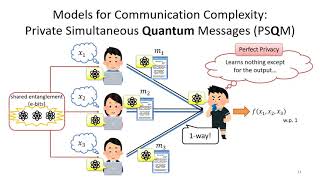
Communication Complexity of Private Simultaneous Messages Protocols - 2021 ITC Conference
Exploring communication complexity in private simultaneous messages protocols, examining quantum advantages and demonstrating gaps between classical and quantum models in secure multiparty computation.
Quantum Computing and the Entanglement Frontier
Explore quantum entanglement, computation, and error correction with Dr. John Preskill as he discusses the fundamental concepts of Theoretical Quantum Information Science and its future applications.
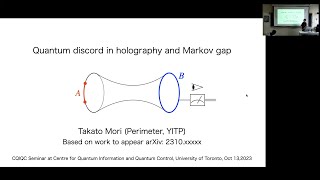
Quantum Discord in Holography and Markov Gap
Explore quantum discord in holography and its connection to the Markov gap, delving into advanced concepts in quantum information theory and their applications in theoretical physics.
Fusing Biophysics and Machine Learning for Computational Oncology
Innovative approach combining biophysics and machine learning to enhance understanding of cancer dynamics, utilizing clinical data to extract disease patterns and improve oncology research.

On Random Grid Neural Processes for Solving Forward and Inverse Problems
Explore innovative deep learning models for parametric PDEs using random grids and variational neural processes, addressing challenges in physics-informed frameworks and data integration.
Generating Approximate Ground States of Molecules Using Quantum Machine Learning
Explore quantum machine learning for generating molecular ground states, focusing on potential energy surfaces and efficient state preparation using variational quantum circuits and neural networks.
Overview of Learning Structured Quantum States - IPAM at UCLA
Explore efficient methods for learning structured quantum states, focusing on models and classes that require fewer copies for estimation, with insights on Boolean functions and alternative learning approaches.
Machine Learning Tutorial Exercise
Hands-on tutorial exploring machine learning applications in geophysical fluid dynamics, covering data analysis, modeling, and prediction techniques for climate and ocean systems.
Basic Aspects of Convolutional Neural Networks - Tutorial
Explore fundamental concepts of convolutional neural networks in this tutorial, covering key principles and applications in deep learning for image processing and pattern recognition.
Randomized Algorithms for Rounding and Rank Compression in the Tensor Train Format
Explore randomized algorithms for efficient tensor-train rounding, enhancing performance in quantum systems and condensed matter physics applications with significant computational speedups.
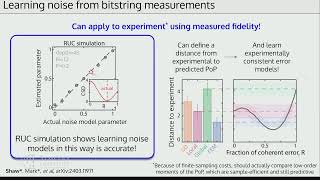
Using Chaos to Characterize a Programmable Analog Quantum Simulator
Explore chaos in analog quantum simulators, uncovering random behavior, estimating fidelity, and learning noise models for large-scale entangled states using Rydberg atom arrays.
Why You Should Believe in Quantum Computing
Explore quantum computing basics, advantages, and potential applications in cryptography and sensors. Gain insights into this revolutionary technology's impact on society and economy.
Evidence for the Utility of Quantum Computing Before Fault Tolerance
Explore noise mitigation in quantum computing, demonstrating reliable results from a 127-qubit processor and discussing the potential of pre-fault-tolerant quantum devices.