
College Physics Chapter 16 Summary - Electric Forces and Fields
Explore fundamental concepts of electric forces and fields, including charge behavior, conductors, and field calculations for various configurations.

College Physics: Motion with Constant Acceleration - Chapter 4 Summary
Master constant acceleration concepts, including kinematics, projectile motion, and apparent weight. Apply Newton's second law to solve physics problems.
College Physics: Acceleration and Newton's Second Law - Chapter 3 Summary
Explore acceleration and Newton's laws through key physics concepts, including position, velocity, and graphical representations of motion.
Introduction to Units and Unit Conversions
Master essential unit conversion skills and gain a solid foundation in scientific measurement principles.
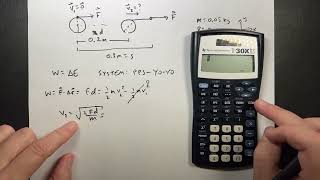
Velocity and Rotational Speed of a Sliding Yo-Yo
Explore the physics of a sliding yo-yo, calculating its velocity and angular velocity using concepts of force, motion, and rotational dynamics.

Physics Practice: Conservation of Momentum and Energy in a Space Collision
Solve a space collision problem using conservation of momentum and energy principles. Determine velocities and thermal energy changes.
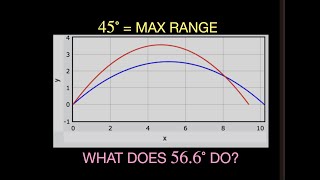
Projectile Motion: Optimal Launch Angle for Maximum Distance - 56.6 Degrees
Explore the optimal launch angle for maximum projectile distance, analyzing the significance of 56.6 degrees through mathematical modeling and Python simulation.
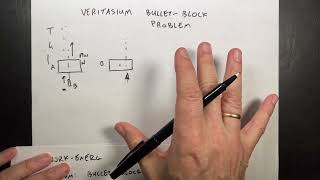
The Bullet Block Problem - Momentum and Energy in Projectile Collisions
Explore momentum and energy concepts through the intriguing bullet-block problem, analyzing how bullet impact location affects block velocity.
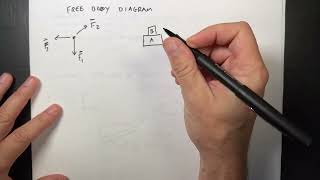
College Physics Chapter 2 Summary - Forces
Explore Newton's laws, vectors, and various forces in physics, including gravity, friction, and tension. Learn to create free body diagrams for practical applications.
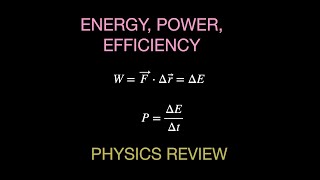
Review of Energy, Power, and Efficiency for Algebra-Based Physics - Second Semester
Explore work energy, energy types, power, and efficiency concepts in algebra-based physics. Gain a comprehensive understanding of fundamental energy principles.

Understanding Speech in the Face of Competition - Lecture 2008
Explore auditory attention, sound source separation, and speech understanding in complex environments. Learn about object formation, selective attention, and top-down knowledge in speech perception.
The Subcritical Brain and Motion Control
Explore cortical linguistics, neural circuits, and brain dynamics. Discover how mathematical properties and firing rates drive memory, information processing, and motion control, with applications for neurological impairments.

Mean Field Limits of Heterogeneous Networks - Informal Systems Seminar
Explore mean field limits of heterogeneous networks, focusing on interacting particle systems coupled on digraphs and their macroscopic behavior. Gain insights into Vlasov equations and digraph measures.

Exploring Lagrangian Data Assimilation: Methods and Uncertainty - SIAM MPE Community Meeting
Explore Lagrangian data assimilation methods and uncertainty in fluid dynamics. Learn about ensemble techniques, analytical solutions, and optimal tracer deployment for improved state estimation.
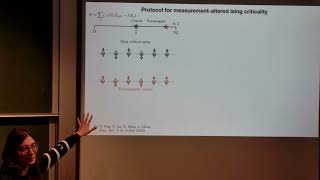
Boundary Conformal Field Theory After Measurements
Explore quantum critical systems and measurement-induced phenomena in Ising chains. Analyze impacts on order-parameter scaling and conformal invariant boundary conditions. Investigate tricritical Ising model measurements.
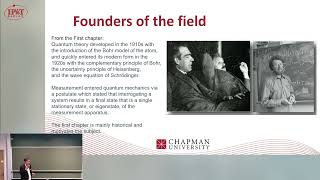
Quantum Measurement: The Stochastic Path Integral and Optimal Control
Explore quantum measurement theory, stochastic path integrals, and optimal control in monitored systems with insights from Andrew N. Jordan's new book and research.
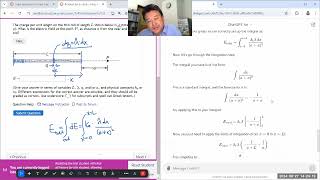
Physics 4B - Problem Solving with ChatGPT 4.0 - Set 5
Enhance problem-solving skills in physics using ChatGPT 4o, focusing on Set 5 exercises from PHYS 4B curriculum.
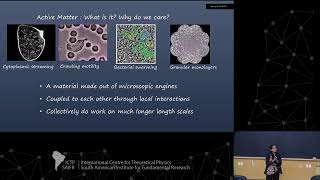
Theoretical Foundations of Active Matter: Lessons from Ideal Microscopic Models - Class 1
Explore theoretical foundations of active matter through ideal microscopic models, gaining insights into this dynamic field of physics and biology.

Computational Modeling of Active Systems - Class 1
Explore computational modeling techniques for active systems, focusing on fundamental principles and practical applications in the field of active matter.

From Active Nematics to Mechanobiology - Class 1
Explore active nematics and mechanobiology with Julia M Yeomans, delving into cutting-edge research in active matter physics and its biological applications.
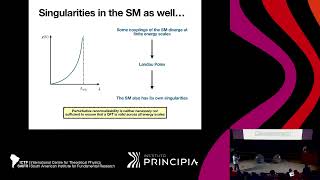
The Predictive Power of Asymptotically Safe Quantum Gravity - Can We Test It?
Explore the predictive power of Asymptotically Safe Quantum Gravity and its potential for experimental testing in this insightful talk by Antonio D. Pereira.