What Makes Holographic States Special?
Explores holographic states in quantum gravity, examining their unique properties and significance in AdS/CFT correspondence and quantum information theory.
Notions of Color Entanglement in Quantum Information Theory
Explore quantum information theory's impact on gravity, field theories, and many-body physics. Discover emergent spacetime, black holes, and quantum error correction in this cutting-edge theoretical physics lecture.
Black Hole Index from Gravitational Path Integral
Explore the Black Hole Index through gravitational path integrals, delving into quantum gravity and information theory at the intersection of physics and mathematics.
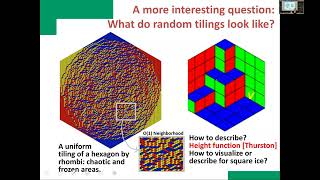
Coulomb Gas and Lattice Models
Explore Coulomb gas and lattice models in statistical physics, examining their properties, applications, and connections to other mathematical concepts.
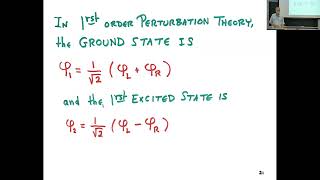
Tunneling in Magnetic Fields
Explore quantum tunneling phenomena in magnetic fields, examining their effects on particle behavior and potential applications in advanced physics and technology.
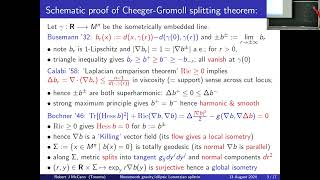
Trading Linearity for Ellipticity: A Nonsmooth Approach to Einstein's Theory of Gravity and the Lorentzian Splitting Theorems
Explore nonsmooth approaches to Einstein's gravity theory and Lorentzian splitting theorems, focusing on trading linearity for ellipticity in geometric analysis.
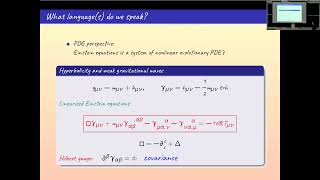
Things You Always Wanted to Know About Mathematical General Relativity
Explore key concepts in mathematical general relativity with Princeton's Igor Rodnianski, addressing common questions and demystifying complex topics in this engaging lecture.

How the Higgs Boson Was Discovered
Explore the decades-long journey to discover the Higgs boson, from early accelerator experiments to the groundbreaking 2012 announcement at CERN's Large Hadron Collider.
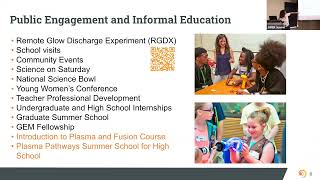
PPPL Public Engagement and Workforce Development
Explore PPPL's successful public engagement initiatives and workforce development strategies, highlighting program growth and impact on plasma physics education and outreach.
Beating Cancer with SEEIIST - Shaping Science in South-East Europe
Exploring SEEIIST: A collaborative initiative in South-East Europe for advanced cancer treatment research, fostering regional scientific cooperation and technological innovation.
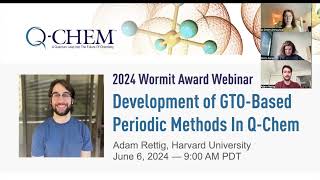
PBC Development in Q-Chem - 2024 Wormit Award
Explore advancements in Q-Chem's PBC package for periodic systems, including hybrid DFT speedup and MPI parallelization. Learn about current functionality and future development directions.
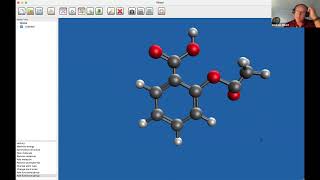
Introduction to IQmol - 2024 Virtual Winter School in Computational Chemistry - Session 1
Crash course on IQmol: build molecules, submit calculations, analyze results. Includes overview and hands-on lab exercise for Q-Chem's graphical interface.
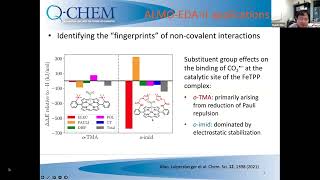
Energy Decomposition Analysis Techniques in Q-Chem - Session 3
Explore energy decomposition analysis techniques in Q-Chem, including the new force decomposition analysis method, with Yuezhi Mao from UC San Diego.
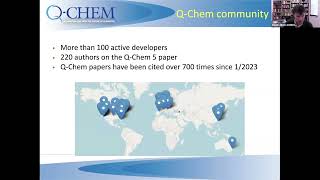
Q-Chem: An Engine for Innovation - 2024 Virtual Winter School in Computational Chemistry
Explore recent developments and new features in Q-Chem code with Martin Head-Gordon from UC Berkeley, highlighting advancements in computational chemistry software.
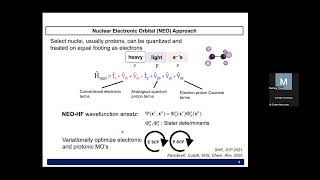
Development of Nuclear-Electronic Orbital Methods in Q-Chem 6
Explore advanced nuclear-electronic orbital methods in Q-Chem 6, including NEO-PCM and NEO-QM/MM approaches, for capturing nuclear quantum effects in chemical and biological applications.
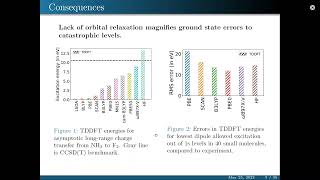
OO-DFT for Core-level Excitations and Applications to Molecular Symmetry Breaking - 2023 Besley Award
Advances in OO-DFT for modeling core-level excitations, focusing on SGM method and spin contamination. Applications to transient X-ray absorption spectroscopy, including Jahn-Teller distortion and symmetry breaking in molecular cations.
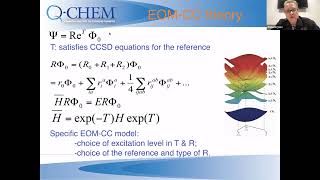
Coupled Cluster Methods for Excited States to Model Spectroscopy - 2023 VWSCC Session 09
Explore excited state equation of motion coupled cluster methods for modeling spectroscopy with Prof. Anna Krylov. Learn advanced techniques for computational chemistry applications.
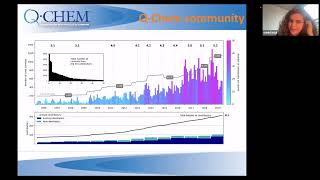
Introduction to Q-Chem Software Package - Session 1
Explore Q-Chem software: features, community, and applications in computational chemistry. Learn about ground state methods, excited states, and molecular dynamics simulations.
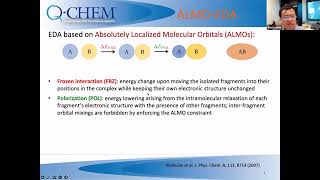
Energy Decomposition Analysis Techniques and Applications - Session 5
Explore energy decomposition analysis techniques, covering theory and applications in Q-Chem software, with Prof. Yuezhi Mao from the University of San Diego.
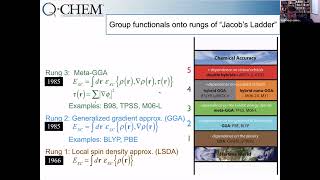
Density Functional Theory Overview - 2023 Virtual Winter School in Computational Chemistry
Explore density functional theory methods with Prof. Martin Head-Gordon, covering key concepts, functional design, and performance analysis in computational chemistry.
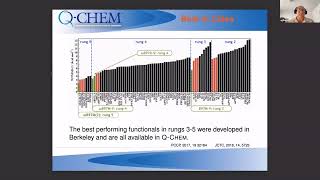
New Features in Q-Chem 6 - 2023 Virtual Winter School in Computational Chemistry
Explore the latest advancements in computational chemistry software with insights on Q-Chem 6.0 and upcoming features in version 6.1, enhancing your research capabilities.