Astrophysical Neutrino Experiments
Explore astrophysical neutrino detection methods, challenges, and recent discoveries in this comprehensive lecture on cutting-edge particle physics research and experimental techniques.
Neutrino Phenomenology: Atmospheric and Long-baseline Experiments - Lecture 3
Explore atmospheric and long-baseline neutrino phenomenology, delving into oscillations, interactions, and experimental observations to advance understanding of these elusive particles.
Quantum Aspects of Neutrinos
Explore quantum aspects of neutrinos, their oscillations, and implications for physics beyond the Standard Model in this comprehensive lecture on fundamental particle interactions.
Physics of Atmospheric Neutrinos
Explore atmospheric neutrinos: their production, propagation, detection, and role in understanding neutrino properties and Earth's structure.
New Frontiers for Constraining the Microphysics of Dark Matter
Explores cutting-edge approaches to uncover dark matter's properties using astrophysical and cosmological observations, simulations, and theoretical developments in the era of large-scale surveys.
How Light Can Dark Matter Particles Be?
Explore the lower mass limits of dark matter particles and their implications for cosmology and particle physics in this cutting-edge theoretical physics talk by Mustafa Amin.
A Global Experiment to Characterize Oceanic Internal Wave Climates
Explore oceanic internal waves' impact on global climate, mixing processes, and circulation patterns through the SQUID program's innovative global observations and data analysis techniques.
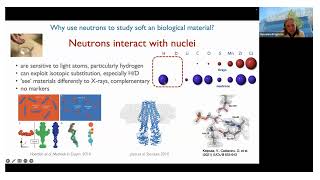
Neutron Scattering - Exploring Cell Membrane Mechanisms
Neutron scattering techniques for studying cellular membrane structure and dynamics, focusing on model membrane systems and their interactions with biologically relevant molecules.
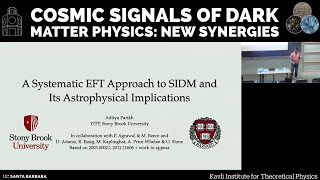
A Systematic EFT Approach to SIDM and Its Astrophysical Implications
Explores systematic EFT approach to self-interacting dark matter, discussing astrophysical implications and potential for new insights into dark matter physics through cosmic observables.

Is Dark Energy Decaying? - Exploring New Cosmological Observations
Explore revolutionary observations challenging our understanding of dark energy and the universe's expansion with Brian Greene and Michael Levi in this thought-provoking discussion.
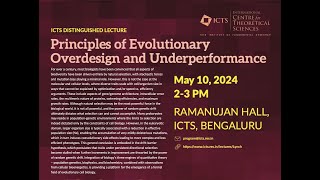
Principles of Evolutionary Overdesign and Underperformance
Explore evolutionary mechanisms beyond natural selection, examining how random genetic drift influences molecular and cellular traits, challenging traditional views on biodiversity's drivers.
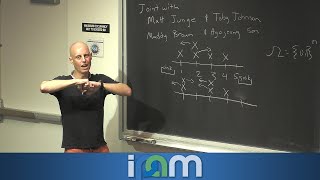
The Density Conjecture for Activated Random Walk
Explore self-organized criticality in activated random walk models, examining critical densities across various configurations and their implications for understanding energy release patterns in physical systems.
Interacting Polya Urns - Statistical Mechanics Beyond 2D
Explore interacting Polya urns on graphs, their asymptotic behavior, and convergence to equilibrium in this statistical mechanics presentation by Omer Angel at UCLA's IPAM workshop.
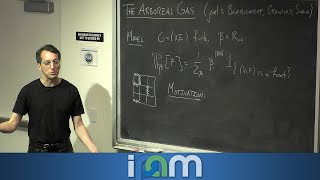
The Arboreal Gas - Percolative Properties of Random Forests
Explore the percolative properties of random forests in the arboreal gas model, examining the formation of giant trees and its applications to branched polymer gelation.
The Plaquette Random Cluster Model and Potts Lattice Gauge Theory
Explore phase transitions in Potts lattice gauge theory, focusing on Wilson loop expectations and their transition from area to perimeter law, using a generalized random cluster model approach.
Poisson-Dirichlet Distribution for the Interchange Process in Five Dimensions
Explores the emergence of macroscopic cycles in the interchange process on high-dimensional tori, proving convergence to Poisson-Dirichlet distribution for cycle lengths in dimensions 4 and above.
Iterated Integrals of Modular Forms in String Theory
Explore iterated integrals of modular forms in string theory, their connection to scattering amplitudes, and the concept of multiple modular values in physics.
Quantum Spin Liquid and Spin-Liquid Physics in Doped t-J Model
Explore quantum spin liquids and their physics in doped t-J models with Donna Sheng. Gain insights into cutting-edge research on strongly correlated gapless quantum many-body systems.
Hunting Spin Liquids: Checking Out the Terrain and Identifying the Tracks
Explore spin liquids in quantum many-body systems with expert Leon Balents. Learn about current research, challenges, and advancements in understanding these exotic quantum states.
SO(5) Multicriticality in Two-Dimensional J-Q Models
Exploration of SO(5) multicriticality in 2D J-Q models, discussing deconfined quantum critical points, quantum spin liquids, and related phenomena in strongly correlated gapless quantum systems.
Monopoles, Duality, and Deconfined Quantum Tricriticality
Explore monopoles, duality, and deconfined quantum tricriticality in this advanced physics talk. Gain insights into cutting-edge research on strongly correlated gapless quantum many-body systems.