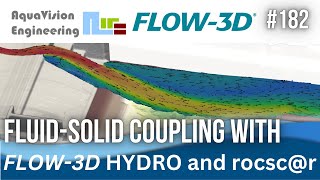
Fluid-Solid Coupling with FLOW-3D HYDRO and RocScour - Rock Scour Assessment in Water Infrastructure
Explore rock scour assessment in water infrastructure using numerical modeling and fluid-solid coupling. Learn about CFD, Flow-3D Hydro, and computational methods through case studies and practical examples.
The Muon Shot and the Future of Particle Physics
Explore the future of particle physics with a focus on muon colliders, addressing mysteries like mass origin and dark matter. Learn about cutting-edge research and potential breakthroughs in fundamental physics.

Links between Eddy Horizontal and Vertical Structure: A Geostrophic Turbulence Perspective
Explores connections between horizontal and vertical eddy structures in geostrophic turbulence, offering insights into ocean dynamics and energy transfers across scales.

A Global Experiment to Characterize Oceanic Internal Wave Climates
Explore the SQUID program's global study of oceanic internal waves, their impact on deep-sea mixing, and implications for climate models and ocean circulation patterns.

Hybrid Filtering for Lagrangian Data Assimilation and Tipping Points in Earth Systems
Explore hybrid filtering for Lagrangian data assimilation and tipping points in Earth systems. Gain insights into advanced geophysical fluid dynamics techniques and their applications in climate science.
Hitchin Systems - An Introduction to Complex Geometric Structures
Explore Hitchin systems with Marina Logares, delving into their mathematical properties and applications in algebraic geometry and theoretical physics.
Robust Equation Discovery and Sparse Sensing with Guarantees
Explore statistical mechanics for robust sparse equation discovery and optimal sensor placement, with applications in nuclear digital twins and high-dimensional field reconstruction.
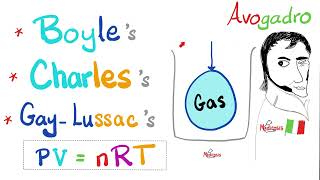
Gas Laws: Boyle's, Charles', Gay-Lussac's, and Avogadro's Laws - Ideal Gas Equation and Gas Density
Comprehensive overview of gas laws, including Boyle's, Charles', Gay-Lussac's, and Avogadro's laws, as well as the ideal gas equation and gas density calculations. Essential for chemistry exams and understanding gas behavior.

How to Solve It: A Problem-Solving Approach Based on Polya's Method
Explore problem-solving strategies inspired by George Pólya's approach, enhancing critical thinking and analytical skills for tackling complex physics problems effectively.

Coupled Oscillators: Matrices - Lecture by Supurna Sinha
Explore coupled oscillators and matrix applications in physics. Gain insights into theoretical aspects through hands-on experiments and open-ended discussions. Designed for women pursuing physics careers.
Forum on Physics and Society Awardee Session - APS April Meeting 2024
Honoring physics contributions to society: developing countries' science advocacy, nuclear plant seismic safety, and advancing science through inclusion in government roles.
Doing Math at the Speed of Light
Explore optical computing's evolution from ENIAC to nanoscale devices. Discover "Swiss Cheese metamaterials" and light-based computational methods solving equations at near-light speeds.
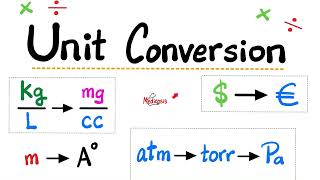
Unit Conversion - How to Convert Units of Measurement for Volume, Pressure, Density, and Currency Exchange
Master unit conversions for volume, pressure, density, and currency with practical examples and clear explanations. Gain confidence in handling various measurement systems for academic and real-world applications.
Searches for Continuous Gravitational Waves: Methods and Results - Lecture 1
Explore methods and results for detecting continuous gravitational waves from sources like rapidly spinning neutron stars and exotic phenomena in our galaxy.
Rapidly Spinning Neutron Stars and Emission Mechanisms - Lecture 1
Explore rapidly spinning neutron stars, their emission mechanisms, and potential for continuous gravitational waves in this comprehensive lecture by Keith Riles.
Stability and Chaos in Dynamical Last Passage Percolation
Explore stability and chaos in dynamical last passage percolation, examining energy landscapes, ground states, and the transition from stability to chaos using probabilistic and geometric techniques.

Reproducing the Calculations from Interstellar - Black Hole Simulations and Wormhole Travel
Explore the scientific accuracy of Interstellar, including black hole simulations, wormhole travel, and time dilation, in this comprehensive analysis of the film's key concepts and scenes.
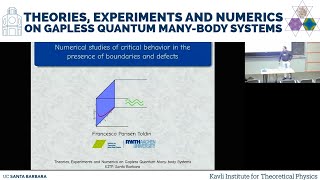
Numerical Studies of Critical Behavior in the Presence of Boundaries and Defects
Explore critical behavior in systems with boundaries and defects through numerical studies. Gain insights into strongly correlated gapless quantum many-body systems and their theoretical implications.
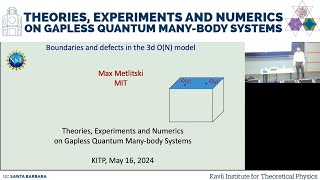
Boundaries and Defects in the 3D O(N) Model
Explores boundaries and defects in 3D O(N) models, discussing quantum critical points, symmetries, and gapless states. Part of a conference on strongly correlated gapless quantum many-body systems.
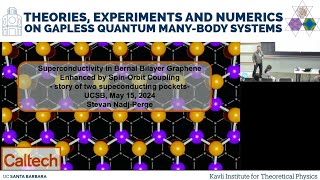
Orbit Proximitized Bernal Bilayer Graphene
Explore the fascinating properties of proximitized Bernal bilayer graphene and its orbital effects in this advanced physics lecture by Caltech researcher Stevan Nadj Perge.
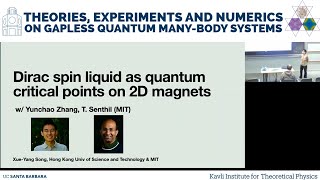
Dirac Spin Liquid and Quantum Critical Point on Square Lattice
Explore quantum critical points and Dirac spin liquids on square lattices with MIT researcher Xueyang Song. Gain insights into gapless quantum many-body systems and their implications in condensed matter physics.