An Introduction to OSL Dating and Luminescence Signals
Explore the fundamentals of Optically Stimulated Luminescence dating, its applications in sedimentology, and how luminescence signals provide insights into transport-deposition processes.
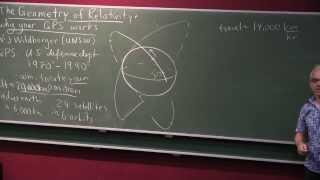
The Geometry of Relativity and GPS Technology
Explore the fascinating intersection of GPS technology and Einstein's relativity theories, uncovering how these scientific principles ensure accurate global positioning in our everyday lives.
Length Contraction, Time Dilation, and Velocity Addition in Special Relativity - Lecture 39
Explore Einstein's Special Relativity through a novel approach, deriving length contraction, time dilation, and velocity addition using Lorentz transformations and linear algebra concepts.
An Elementary Introduction to Special Relativity - Lecture 1
Explore Einstein's Special Relativity through a unique lens, using basic Newtonian mechanics and the concept of inertial observers. Learn how bats' echo location illustrates fundamental principles in this innovative approach.
Oriented Circles and 3D Relativistic Geometry - Part 1
Explores 3D relativistic geometry, hyperboloids as relativistic spheres, and connections with oriented circles. Introduces cyclography and its relation to relativistic quadrance.
Teleportation Tutorial in 3D Animation
Learn to create stunning teleportation effects in After Effects, enhancing your video projects with seamless transitions and captivating visual tricks.
Dimensional Formula - MLT System and SI Units in Physics and Mathematics
Comprehensive overview of dimensional analysis in physics, covering MLT system, SI units, and various physical quantities. Ideal for exam preparation and understanding fundamental concepts.
Relaxation to Equilibrium of a Two-Dimensional Quantum Vortex Gas
Explore the relaxation dynamics of a 2D quantum vortex gas, examining equilibrium states and collective behavior in quantum fluids. Gain insights into turbulence and vortex dynamics in quantum systems.
Addressing Individual Layers in Artificial 2D Heterostructures
Explore emergent phenomena in 2D synthetic quantum materials, focusing on electronic, magnetic, and topological aspects in artificially engineered heterostructures and twisted materials.
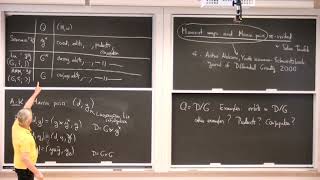
Manin Pairs and Moment Maps Revisited
Explore advanced concepts in Hamiltonian geometry, focusing on Manin pairs and moment maps, with insights from University of Toronto's Eckhard Meinrenken.
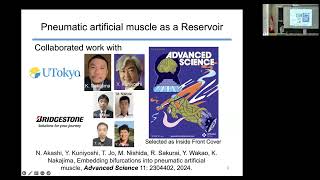
Training Autonomous Dynamics of a Soft Body - Embedding Bifurcation Structures Using Physical Reservoir Computing
Explore physical reservoir computing for embedding bifurcation structures in autonomous dynamics of soft bodies, focusing on innovative machine learning applications in dynamical systems.
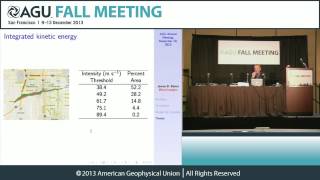
Are Tornadoes Getting Stronger - New Analysis Techniques
New analysis technique examines tornado strength trends by assessing damage paths. Research explores long-term patterns in tornado intensity, offering insights into potential changes in severe weather phenomena.
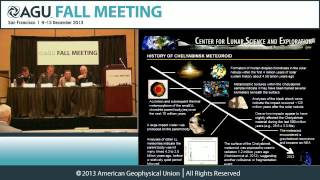
Lessons From the Chelyabinsk Airburst - Scientific Findings and Implications
Experts discuss latest findings on the 2013 Chelyabinsk meteor airburst, its effects, and implications for future threats from smaller meteors to populated areas.
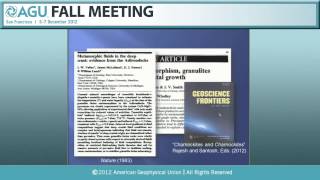
Deep Crustal Metamorphic Carbon Cycling in Collisional Orogens - Daly Lecture
Explore deep crustal metamorphic carbon cycling in mountain belts, examining CO2 release processes, flux rates, and potential impacts on global carbon cycles and climate change.
Voyager Mission Update: Latest Findings from the Edge of the Solar System
NASA scientists discuss Voyager mission's latest findings at the edge of our solar system, including cosmic rays, comets, and future communication prospects with the spacecraft.
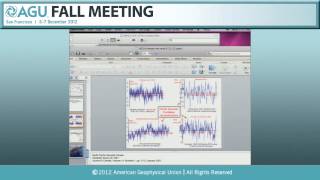
Nonlinear and Scaling Processes in the Atmosphere and Ocean at All Scales
Explore cutting-edge research on nonlinear and scaling processes in atmospheric and oceanic systems, covering climate reconstructions, sensitivity, long-range memory, megadroughts, turbulence, and micro-scale phenomena.
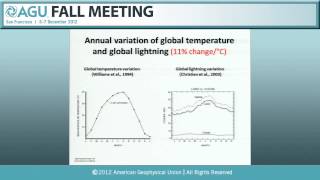
Lightning and Climate - Franklin Lecture 2012
Exploring lightning's role in climate change, its correlation with temperature and water vapor, and its potential as a climate indicator. Discusses challenges in long-term monitoring and the impact of aerosols on lightning activity.
Finding Our Way in Dark Matter and Energy - Latest Developments in Astrophysics
Explore cutting-edge astrophysics with Dr. Thaller, delving into dark matter, dark energy, and the universe's mysteries. Gain insights on infrared surveys, gravitational lensing, and the latest astronomical discoveries.
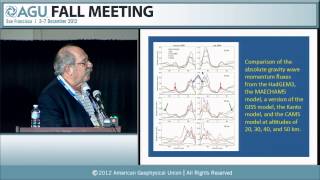
Gravity Waves in the Atmosphere and Ocean - Part 1
Explore cutting-edge research on gravity waves in atmosphere and oceans. Topics include aviation turbulence, internal wave dynamics, predictability, observations, and climate model comparisons.
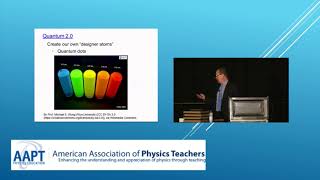
Quantum Optics and Entanglement - 2018 Richtmyer Memorial Lecture
Explore quantum mechanics through innovative teaching methods with Mark Beck, recipient of the 2018 Richtmyer Memorial Lecture Award. Gain insights from his expertise in optics and physics education.
2018 Oersted Medal Award Presentation - Physics Education and Community Engagement
Explore the career and contributions of Barbara L. Whitten, an esteemed physicist and educator, as she receives the prestigious 2018 Oersted Medal for her impact on physics education.