
Unifying Nature's Laws - The State of String Theory
Leading string theorists discuss the current state and potential of string theory as a unified description of nature's laws, exploring its mathematical elegance and promise as a "theory of everything."
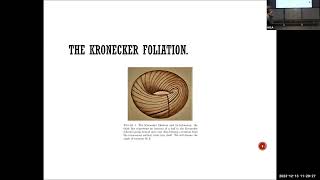
Hodge Numbers in Quantum Toric Geometry
Explore Quantum Toric Geometry and its impact on Hodge numbers in non-algebraic complex manifolds. Discover enriched perspectives in this collaborative research presentation.
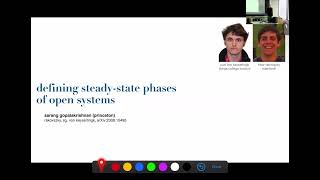
Defining Stable Phases of Open Quantum Systems
Explore stable phases in open quantum systems with Princeton researcher Sarang Gopalakrishnan, examining key concepts and recent developments in quantum information theory.
Structural Analysis of Pion With Distribution Functions - Talks by Satyajit Puhan & Bhumika Pandya
Explore pion structure through distribution functions in talks by Satyajit Puhan and Bhumika Pandya, part of a workshop on probing hadron structure at the Electron-Ion Collider.
Axial-Vector Bottom-Charm Tetraquarks
Explore axial-vector bottom-charm tetraquarks through expert talks, delving into advanced particle physics concepts and cutting-edge research in hadron structure and quark interactions.
Valence Quark and Gluon TMDs of Spin-1 QCD System - A Light-Front Hamiltonian by Satvir Kaur
Explore valence quark and gluon TMDs in spin-1 QCD systems using light-front Hamiltonian approach. Gain insights into hadron structure and fundamental particle interactions.
The Drell-Yan Process with Pions and Polarized Proton
Explore the Drell-Yan process in pion-proton collisions, focusing on polarized protons and its implications for understanding hadron structure and quark-gluon dynamics in particle physics.
The Pion Electromagnetic Form Factor at Jefferson Lab and Future Electron-Ion - by Vijay Kumar
Explores pion electromagnetic form factor research at Jefferson Lab and future electron-ion collider implications, discussing experimental techniques and theoretical insights in hadron structure studies.
Using Dynamics to Constrain Connectivity of Neuronal Population in Respiratory Brainstem
Explores models of neuronal connectivity in respiratory brainstem, focusing on synchronized bursting activity and network architecture insights using multi-state bootstrap percolation.

Angularity Event Shapes in High Energy Scattering by Tanmay Maji
Explore angularity event shapes in high-energy particle collisions, examining their role in understanding hadron structure and quark-gluon interactions at the electron-ion collider.
Machine Learning Knowledge Transfer - From LHC to EIC by Sanmay Ganguly
Explore machine learning applications in particle physics, transferring knowledge from LHC experiments to the upcoming Electron-Ion Collider for advanced proton and neutron structure analysis.
Jets and Heavy Flavor Production at The EIC by Prabhakar Palani
Explore jets and heavy flavor production at the Electron-Ion Collider, examining their role in probing hadron structure and advancing our understanding of fundamental particle physics.
Second Order QCD Corrections to Semi-Inclusive DIS by Narayan Rana
Explores advanced QCD calculations for semi-inclusive deep inelastic scattering, relevant to understanding hadron structure and quark-gluon interactions at the electron-ion collider.
Jets at EIC - Theory by Felix Ringer
Explore jet physics theory for the Electron-Ion Collider, covering fundamental concepts, analysis techniques, and implications for probing hadron structure at unprecedented levels.
Gluon Distributions in the Proton
Explore gluon distributions in protons, crucial for understanding hadron structure. Learn about cutting-edge research and its implications for particle physics at the electron-ion collider.
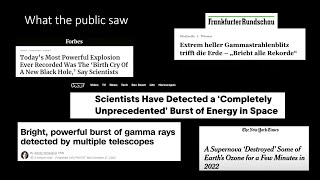
Gamma-Ray Bursts: The Brightest Explosions in the Universe - From Discovery to the BOAT
Explore gamma-ray bursts, the universe's most energetic events. Learn about their detection, origins, and the record-breaking 'Brightest Of All Time' burst from 2022.
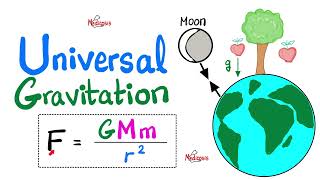
Universal Gravitational Law, Gravitational Field Intensity, and Satellite Velocity - Physics Concepts
Explore Newton's Universal Gravitational Law, gravitational field intensity, and satellite motion. Learn key concepts of gravity, centripetal force, and orbital mechanics for physics exams.
The Strange Energy Spectrum of Approximate Matrix Product Ground States - Lecture
Explore the unique energy spectrum of approximate matrix product ground states in DMRG, including variance sampling techniques and extrapolation methods for improved accuracy in quantum simulations.
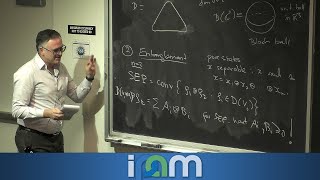
Monogamy of Highly Symmetric States in Quantum Entanglement
Explore entanglement limits in highly symmetric quantum states on complete graphs, using semidefinite programming and representation theory to solve long-standing problems.
Defective Tensor Network Varieties
Explore defective tensor networks and their anomalies in algebraic varieties, focusing on graph structure, dimensions, and unexpected deviations from parameter-based expectations.
Tailoring Coupled Cluster Theory with Matrix Product States
Explore the fusion of coupled cluster theory and DMRG for tackling strongly correlated systems in computational chemistry, with insights on mathematical and computational advancements.