Routes to New Phenomena by Violating the Chiral Doubling Theorem - Taylor Hughes
Explore new phenomena in theoretical physics by examining violations of the Chiral Doubling Theorem with Taylor Hughes, uncovering insights at the intersection of specialized fields.
Mineral Mapping & Volatiles at the Lunar Poles
Explore lunar mineral mapping and volatiles at the poles in this talk on gravitational-wave detection missions, discussing technological advancements and scientific opportunities for breakthrough observations.
Overview of the Indian Lunar Exploration Program by Tirtha Pratim Das
Explore India's lunar missions, their scientific objectives, and future plans. Gain insights into the country's space exploration efforts and contributions to lunar research.
T-Duality With Fixed Points
Explore T-duality's mathematical framework, focusing on symmetries between quantum field theories and its application to torus actions with fixed points using elliptic tangent bundles.
The Heliosphere: Structure, Dynamics, and Interactions - 1999 Parker Lecture
Explore the heliosphere, solar wind, and interstellar phenomena in this AGU lecture by L. A. Fisk, covering key concepts and recent discoveries in space physics.
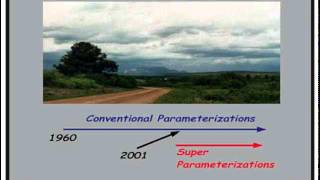
Bjerknes Lecture: Cloud System Resolving Models and Parameterization - AGU Fall Meeting 2001
Explore cloud parameterization and system-resolving models in climate science. Gain insights into innovative approaches for modeling complex atmospheric processes and their implications.
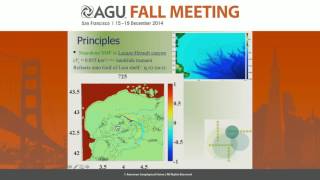
Development of Algorithms for Tsunami Detection by High Frequency Radar - Mediterranean Sea Case Studies
Explores algorithms for tsunami detection using High Frequency Radar, based on Mediterranean Sea simulations. Covers traditional systems, physics, detection methods, and new correlation-based algorithms.
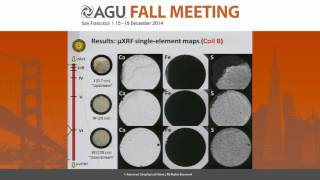
Effects of CO2-Induced Reaction on Transport Properties of Debonded Well Cement-Casing Interfaces
Explores CO₂-induced reactions on debonded well cement-casing interfaces through reactive flow-through experiments, examining permeability changes and microstructural effects for carbon storage applications.
Disaster Resilience and Cosmic Exploration - Keynote Lectures
Renowned scientists Lucy Jones and Takaaki Kajita discuss disaster resilience, science communication, and cosmic exploration through neutrinos, gravitational waves, and gamma rays.
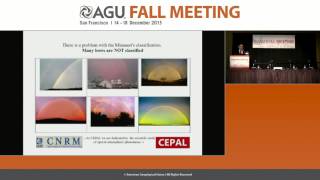
Why All Rainbows Don't Look Alike - New Classification System
Explore the science behind rainbow variations through a new classification system based on hundreds of images, offering insights into color band differences and atmospheric phenomena.
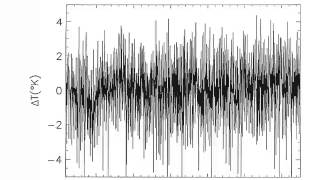
Complexity and Self-Organization in Earth Systems - Lorenz Lecture 2002
Explore self-organized complexity, predictability, and universal statistical distributions in natural systems through Donald L. Turcotte's insightful Lorenz Lecture at the 2002 AGU Fall Meeting.
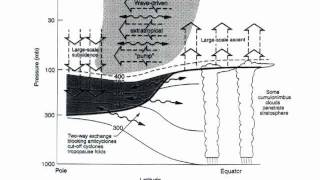
Solar-Terrestrial Coupling and Atmospheric Dynamics - 2001 Nicolet Lecture
Explore vertical motions, polar mesopause, and temperature trends in the atmosphere. Gain insights into supersaturation, plasma, and tropopause dynamics from renowned scientist George C. Reid.
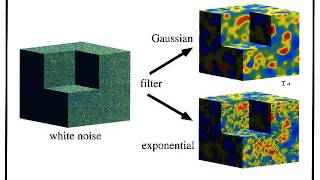
Restless Mantle: Imaging and Wavefront Healing - Gutenberg Lecture 2002
Explore seismic wave behavior, mantle dynamics, and tomography techniques in this lecture on Earth's interior structure, wavefront healing, and implications for deep mantle plumes.
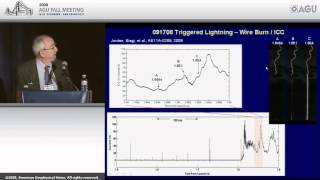
Recent Lightning Experiments - From Ball Lightning to Gamma Rays
Recent lightning experiments at the International Center for Lightning Research and Testing, exploring phenomena from ball lightning to gamma rays, presented by Martin A. Uman from the University of Florida.
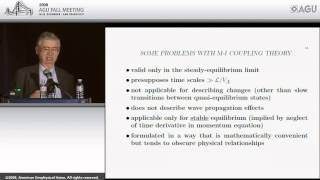
Understanding the Magnetosphere: The Counter-intuitive Simplicity of Cosmic Electrodynamics
Explore cosmic electrodynamics and the magnetosphere's counter-intuitive simplicity. Gain insights into energy transfer, coupling theory, and the interplay between classical and quantum physics in space.
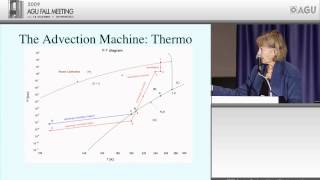
Enceladus: Oasis or Ice Ball? - Exploring Saturn's Enigmatic Moon
Explore Enceladus's intriguing features, from its size and chemistry to its unique terrains and geysers, drawing parallels with Earth's geothermal phenomena like Old Faithful.
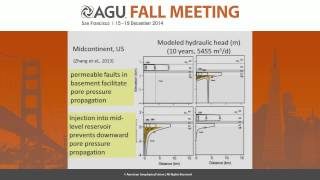
Connecting Wastewater Injection and Seismicity through Pore Pressure - AGU Lecture
Explore the link between wastewater injection and seismic activity through pore pressure analysis, covering key factors, physics, and modeling techniques.
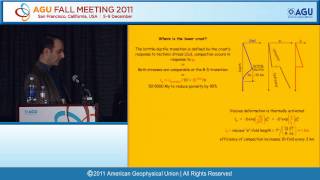
Modern and Ancient Deep Earth Volatile Cycles and Hydromechanical Modeling of Fluid Flow - Bowen Lectures 2011
Explore deep Earth volatile cycles and hydromechanical modeling of fluid flow in the lower crust with expert presentations on modern and ancient processes shaping our planet's interior.
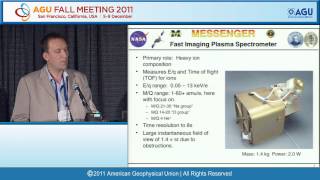
Mercury - The View from Orbit III
Explore the latest findings from Mercury's orbit, including geological insights and planetary observations from recent space missions.
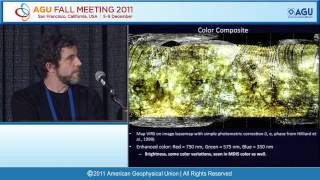
Mercury - The View from Orbit II
Explore the latest findings from Mercury's orbit, including new data and insights from recent space missions. Discover the planet's unique features and geological history.
Computational Fluid Dynamics Analysis With Kubernetes, Kubeflow, and OpenFOAM - Erik Jacobs
Explore how Kubernetes, Kubeflow, and OpenFOAM can optimize computational fluid dynamics analysis, improving resource utilization and operational efficiency in high-performance computing environments.