Periodically Refreshed Baths - A Numerical Technique and a Thermodynamic Cycle by Archak Purkayastha
Explore numerical techniques and thermodynamic cycles for periodically refreshed baths, advancing understanding of driven complex systems and their applications in quantum physics.
Introduction to Precision Measurements and Quantum Metrology
Explore precision measurements and quantum metrology, covering theory, estimation, and techniques using atoms, photons, and NV-centers. Gain insights for future research in quantum technologies.
Roles of Accurate Many-body Calculations for High-precision Spectroscopic Analysis
Explores the importance of precise many-body calculations in high-precision spectroscopic measurements, emphasizing their role in advancing quantum metrology and precision measurement techniques.

Quantum Sensor Networks - Lecture 1
Explore quantum sensor networks in this lecture, covering theory, applications, and advancements in precision measurements using quantum resources like entanglement and superposition.
Caustics and Branched Flow in Periodically and Quasi-periodically Driven Systems by Duncan O’Dell
Explore caustics and branched flow in driven systems, examining periodic and quasi-periodic dynamics. Gain insights into complex physical phenomena and their theoretical foundations.
Multiple Attractors in a Periodically Boundary Driven Classical Anharmonic Chain by Abhishek Dhar
Explore multiple attractors in periodically boundary-driven classical anharmonic chains, examining complex system dynamics and their implications for theoretical physics.
Non-stationary Quantum Many-body Dynamics - Lecture 2
Explore non-stationary quantum many-body dynamics in this advanced physics lecture, delving into complex systems and their behavior under periodic and quasi-periodic driving forces.
Quantum Scars in Pure Lattice Gauge Theories by Arnab Sen
Explore quantum scars in pure lattice gauge theories, examining their dynamics, localization-delocalization physics, and implications for complex quantum systems.
Measurement and Feedback-Driven Entanglement Transition
Explores measurement and feedback-driven entanglement transitions, discussing their impact on quantum systems and potential applications in quantum information and condensed matter physics.
Classical Limit of a Measurement-Induced Transition by Sumilan Banerjee
Exploration of measurement-induced transitions in quantum systems and their classical limits, focusing on theoretical aspects and implications for complex driven systems.
Many-Body Quantum Chaos, Spectral Form Factor, and Ginibre Ensemble by Amos Chan
Explore quantum chaos, spectral form factors, and Ginibre ensembles in many-body systems. Gain insights into complex quantum phenomena and their mathematical representations.
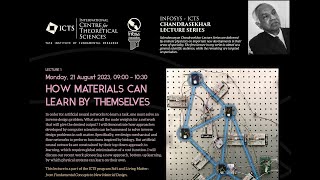
Glassy Dynamics and Plasticity - Building ML-Based Theories - Lecture 3
Explore ML-based theories for glassy dynamics and plasticity, focusing on bottom-up learning approaches in soft matter physics and their applications in designing functional materials.
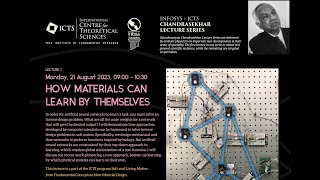
Materials that Learn by Themselves: Fundamental Concepts for New Materials - Lecture 1
Explore how physical systems can learn autonomously through bottom-up approaches, challenging traditional artificial neural networks and solving inverse design problems in soft matter.
Liquid Crystals - Lecture 2
Comprehensive exploration of liquid crystal properties, phases, and applications in materials science, focusing on advanced concepts and recent developments in the field.
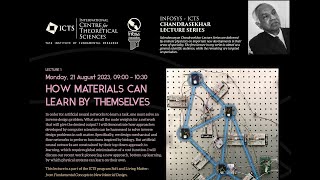
Materials that Learn by Themselves - Fundamental Concepts for New Material Design - Lecture 2
Explore fundamental concepts of self-learning materials, focusing on bottom-up learning approaches in soft matter physics and their applications in designing mechanical and flow networks.
How Motor Arrangement on Cargo Surface Influences Collective Transport by Ambarish Kunwar
Explores how motor protein arrangement on cargo surfaces affects collective transport in cells, examining factors influencing efficiency and coordination in intracellular movement.
Liquid Crystals Fundamental Aspects - Lecture 1
Explore fundamental aspects of liquid crystals, including their unique properties, classifications, and applications in various fields of science and technology.
Applications of Atomic Clocks by Tanja Mehlstäubler
Explore cutting-edge applications of atomic clocks in precision measurements and quantum metrology. Discover how these advanced timekeeping devices revolutionize scientific research and technological innovation.
Modern Numerical Methods in Computational Relativity - Lecture 5
Explore advanced numerical techniques in computational relativity, focusing on simulating black hole mergers and other high-energy astrophysical phenomena for gravitational-wave astronomy.
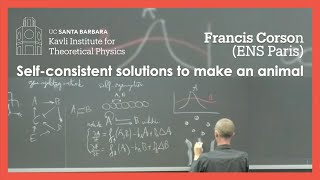
Self-Consistent Solutions to Make an Animal - KITP Blackboard Talk by Francis Corson
Explore self-consistent solutions in animal development through Francis Corson's theoretical physics lecture, bridging biological concepts with mathematical modeling and pattern formation principles.
Large-Scale Ocean Circulation and Climate - Interannual Climate Variability by Anand Gnanadesikan
Explore interannual climate variability and its connection to large-scale ocean circulation. Gain insights into the complex interactions between oceans and climate systems, enhancing understanding of global climate patterns.