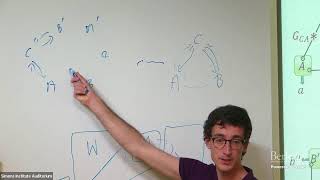
The Most General Causal Theory of Correlations Restricted to Bounded Multipartite
Explore quantum correlations, Bell's theorem, and causal theories. Investigate limitations of bipartite and multipartite nonlocal resources in explaining quantum phenomena.
Particle in a Box Part 2 - Interpreting the Results
Explore orthogonality, expectation values, and subtle aspects of quantum particle solutions in an infinite square well, building on previous Schrödinger equation insights.
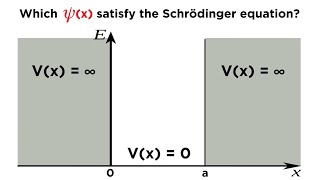
Particle in a Box Part 1 - Solving the Schrödinger Equation
Explore the Schrödinger equation's application to the "Particle in a Box" problem, solving for eigenfunctions and eigenenergies in an infinite square well potential.
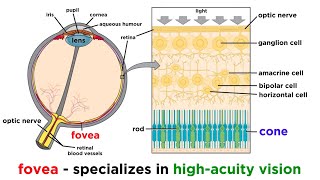
Visual Processing and the Visual Cortex
Explore the fascinating journey of visual information from the retina to the brain's visual cortex, uncovering the intricate processes behind our perception of the world around us.

The Life and Death of Stars - White Dwarfs, Supernovae, Neutron Stars, and Black Holes
Explore the fascinating journey of stars, from birth to spectacular death, including white dwarfs, supernovae, neutron stars, and black holes. Uncover the mysteries of stellar evolution and remnants.
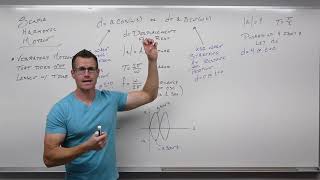
Simple Harmonic Motion in Trig - Precalculus - Trigonometry
Explore the connection between Simple Harmonic Motion and trigonometric functions, understanding its functional models and applications in physics and mathematics.
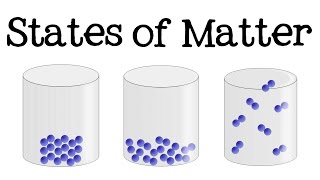
Earth Science
Comprehensive exploration of Earth's physical features, processes, and phenomena, covering topics from states of matter to biomes, weather, and geological formations.
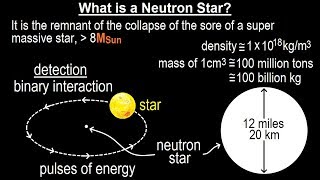
Astronomy - Neutron Stars & Pulsars
Explore neutron stars and pulsars, covering their formation, structure, properties, and behavior. Learn about key concepts like neutron degeneracy, quark pressure, and synchrotron radiation in pulsars.
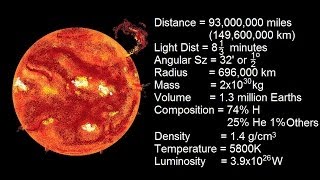
Astronomy - The Sun
Comprehensive exploration of the Sun's structure, processes, and phenomena, from its core to its atmosphere, including fusion, sunspots, and solar wind.
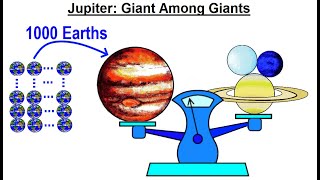
Astronomy - Jupiter
Comprehensive exploration of Jupiter's characteristics, including composition, atmosphere, interior structure, magnetic field, rings, and moons, with detailed explanations of its unique features.
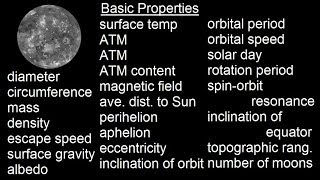
Astronomy - Mercury
Comprehensive exploration of Mercury's properties, orbit, geology, atmosphere, and space missions, including detailed analysis of Mariner 10 and MESSENGER missions and their discoveries.
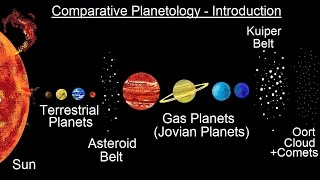
Astronomy - The Solar System - Comparative Planetology
Comprehensive exploration of solar system planets, comparing their physical properties, orbits, atmospheres, and compositions. Includes discussions on moons, asteroids, comets, and water distribution.
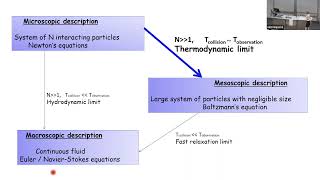
Dynamics of Dilute Gases: A Statistical Approach
Explore statistical approaches to understanding dilute gas dynamics with mathematician Laure Saint-Raymond in this insightful lecture on advanced mathematical physics concepts.

On the Complexity of Quantum Many Body Systems
Explores recent advancements in representing and computing ground states of 1D quantum systems efficiently using concepts from quantum computation and information theory.
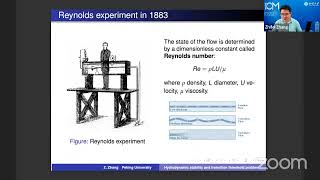
Hydrodynamic Stability at High Reynolds Number and Transition Threshold Problem
Explores hydrodynamic stability theory, focusing on laminar flow instability and turbulence transition at high Reynolds numbers. Discusses key physical effects and recent progress in linear inviscid damping and enhanced dissipation for shear flows.
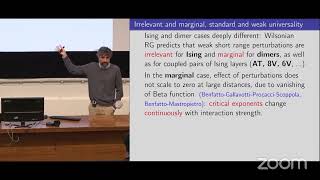
Scaling Limits and Universality of Ising and Dimer Models
Explore scaling limits and universality in statistical mechanics, focusing on non-planar Ising models and interacting dimers. Gain insights into critical phenomena and macroscopic behavior of interacting systems.
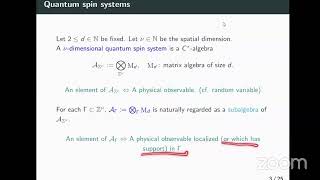
Classification of Gapped Ground State Phases in Quantum Spin Systems
Explore quantum spin systems and gapped ground state phases with Yoshiko Ogata's in-depth analysis of classification methods and theoretical frameworks.
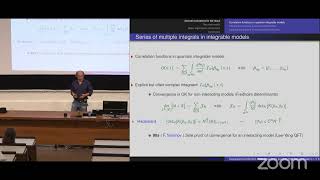
Convergence of the Two-Point Form Factor Series in the 1+1 Dimensional Sinh-Gordon Model
Explores convergence of form factor series in 1+1D Sinh-Gordon model, developing techniques to prove convergence and estimate large-n behavior of n-fold integrals, advancing mathematical foundations of integrable quantum field theories.
Algebraic-Geometrical Methods in the Theory of Integrable Systems
Explore algebraic-geometrical methods in integrable systems theory with renowned mathematician Igor Krichever, delving into advanced mathematical concepts and their applications.
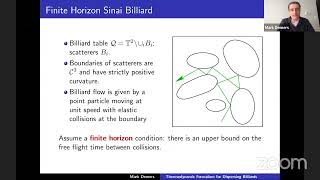
Thermodynamic Formalism for Dispersing Billiards
Explores mathematical billiards in statistical mechanics, focusing on dispersing billiards. Discusses equilibrium states, geometric potentials, and spectral analysis, with insights into SRB measures and maximal entropy.
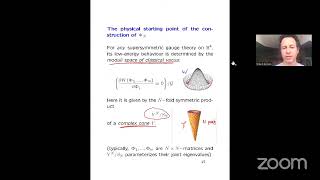
Emergent Complex Geometry and the Gauge/Gravity Duality
Explore emergent complex geometry and gauge/gravity duality with mathematician Robert Berman in this insightful lecture on cutting-edge mathematical physics concepts.