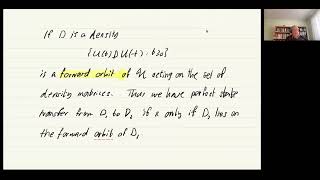
Algebraic Graph Theory and Quantum Computing - Lecture 16
Explore connections between algebraic graph theory and quantum computing, examining mathematical concepts and their applications in quantum information science.
Random Aggregation on the Complex Plane and the Hastings-Levitov Models
Explore random aggregation on complex planes through ALE models, including Hastings-Levitov models. Discover scaling limits, fluctuations, and connections to fundamental discrete models in statistical mechanics.
Homological Percolation in a Torus
Explore homological percolation on tori, examining phase transitions in higher dimensions using algebraic topology. Discover new perspectives on percolation beyond traditional giant components.
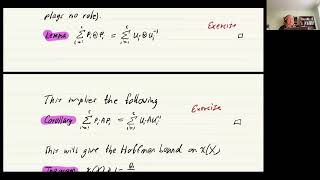
Algebraic Graph Theory and Quantum Computing - Lecture 25
Explore the intersection of algebraic graph theory and quantum computing, delving into advanced mathematical concepts and their applications in quantum information science.
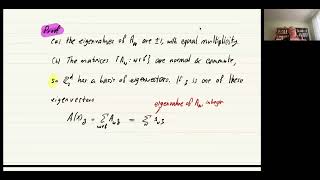
Algebraic Graph Theory and Quantum Computing - Lecture 12
Explore connections between algebraic graph theory and quantum computing, delving into mathematical concepts that bridge these fields and their practical applications.
Global Asymptotics of Jack-Deformed Random Young Diagrams via Lukasiewicz Paths
Explores discrete analogues of log-gas systems, examining universal formulas for global asymptotics in various temperature regimes, using weighted lattice paths and revealing phase transition phenomena.
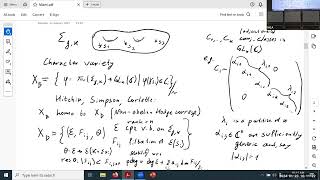
Cohomology Rings of Character Varieties
Explore cohomology rings of character varieties, including P=W conjecture proof and zero-dimensional COHA computation. Discover connections to Hilbert scheme of C^2 for punctured sphere case.
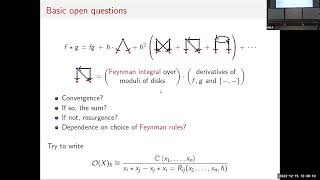
Hodge Theory for Poisson Varieties and Nonperturbative Quantization
Explore Hodge theory for Poisson varieties and nonperturbative quantization, focusing on K-theory and mixed Hodge structures to simplify complex calculations in deformation quantization.
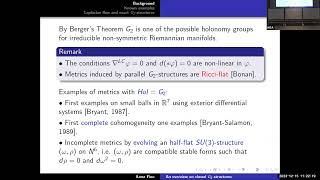
An Overview on Closed G2-Structures
Overview of closed G_2-structures on 7-manifolds, exploring their definition, examples, and applications in holonomy G_2-metrics. Discusses Hitchin flow equations and the Laplacian G_2-flow in compact settings.
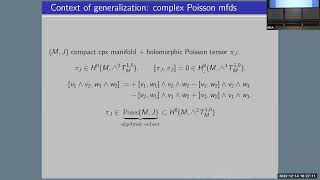
Calabi Problem in Generalized Kahler Geometry
Explores generalized Kahler structures, their connection to Kahler manifolds with holomorphic Poisson structures, and presents an approach to the Calabi problem in this context, with focus on toric complex Poisson varieties.
Best Lipschitz Maps and Transverse Measures - Part 2
Explores best Lipschitz maps between hyperbolic surfaces, focusing on approximation methods, transverse measures, and their connection to infinitesimal earthquakes in Teichmüller theory.
A Braided Monoidal 2-Category via Soergel Bimodules
Explore braided monoidal 2-categories through Soergel bimodules, examining quantum group representations and categorification in relation to Hecke algebras and quantum link invariants.
The Nil-Brauer Category - Categorification and Applications
Exploration of the nil-Brauer category, its relation to quantum groups, and applications in categorification and Soergel bimodules, presented by Jonathan Brundan at IPAM's workshop.
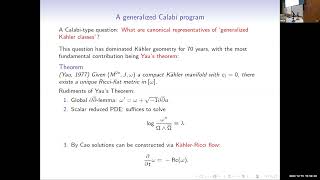
Calabi-Yau Theory in Generalized Kahler Geometry
Explore Calabi-Yau theory's extension to generalized Kahler geometry, examining connections to supergravity and geometric flow approaches for constructing solutions.
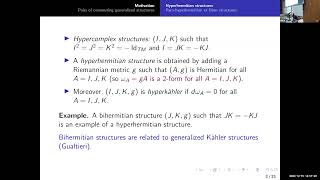
Commuting Pairs of Generalized Structures, Para-Hyper-Hermitian and Born Geometry
Explore generalized structures on manifolds, focusing on commuting pairs and their integrability. Delve into para-hyper-Hermitian and Born geometry within this context.
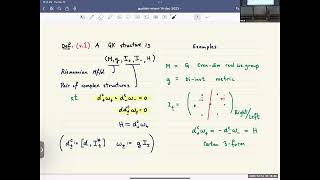
Double Groupoids and Generalized Kahler Structures
Explore double groupoids and generalized Kahler structures, focusing on holomorphic symplectic groupoids and their role in describing generalized Kahler metrics using a single real scalar function.
Future of Hitchin Mathematics - Round Table Discussion
Experts discuss advancements and future directions in Hitchin mathematics, exploring its impact on various mathematical fields and potential applications.
Conservative Adaptive Rank Integrators for Nonlinear Kinetic Models
Explore low-rank time integrators for PDEs, including explicit and implicit schemes, with applications to Vlasov, heat, Fokker-Planck, and advection-diffusion equations.
Wave Localization and the Landscape Law
Explore wave localization in complex media, introducing the landscape concept for predicting eigenfunctions, decay patterns, and eigenvalues. Discover new insights on Schrödinger operators and quantum observables.
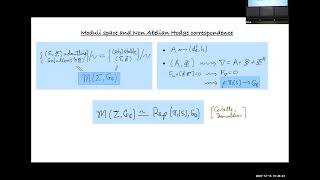
Components of Higgs Bundle Moduli Spaces - A Legacy of Hitchin's Ideas
Explore Higgs bundle moduli spaces, their components, and the lasting impact of Hitchin's groundbreaking ideas in this mathematical lecture by Steven Bradlow.
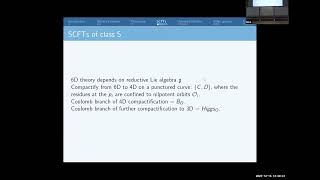
Variations on a Theme of Hitchin's System
Explores recent developments in Hitchin's system, including connections to SCFTs, extensions to integrable systems, geometry of the base, and links to the Deligne-Simpson problem.