Product Mixing, Quantum Separation, and Comfortable Juntas
Explores product mixing in special unitary groups, solving Gowers' problem and its applications in quantum communication, with sharp results on subset distributions in SU_n.

Statistics for Data Analysis with Exercises - Lecture 3
Explore advanced statistical methods for data analysis in high-energy physics, focusing on practical applications and exercises to enhance understanding and skills in this specialized field.
Quasi-Crystals, Fractals, and Other Beauties by Cristiane Morais Smith
Explore quasi-crystals, fractals, and related mathematical structures in this lecture by Cristiane Morais Smith, delving into their fascinating properties and applications in physics and beyond.
Chaos Theory and Geometry - Can They Predict Our World? With Tim Palmer
Explore chaos theory's geometry to predict uncertain phenomena like weather, pandemics, and quantum physics. Discover insights into the universe and ourselves through fractal patterns and probabilistic approaches.
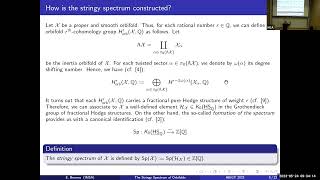
The Stringy Spectrum of Orbifolds
Explore the stringy spectrum as an additive invariant of orbifolds, its properties, and its connection to isolated hypersurface singularities through examples and explanations.
From Abelian Anyons in Moiré Matter to Non-Abelions in Synthetic Quantum Systems - Ashvin Vishwanath
Explore the interplay of topology, symmetry, and interactions in quantum systems, from Abelian anyons in moiré matter to non-Abelions in synthetic structures, with insights on recent theoretical and experimental advancements.

Navier-Stokes Equations
Explore the fascinating Navier-Stokes equations with Oxford mathematician Tom Crawford, discussing their significance and the $1 million Millennium Prize challenge they present.
Coding a Fourth-Order Runge-Kutta Integrator in Python and Matlab
Learn to implement a 4th-order Runge-Kutta integrator in Python and Matlab, and apply it to simulate the chaotic Lorenz 1963 system. Gain practical coding skills for numerical integration.
Numerical Integration of ODEs with Forward Euler and Backward Euler in Python and Matlab
Explore Forward and Backward Euler integration methods for ODEs using Python and Matlab. Compare stability, error, and implementation on a spring-mass-damper system with analytic solutions.

Deriving the Heat Equation in 2D and 3D and in N Dimensions with Control Volumes and Vector Calculus
Explore the derivation of the heat equation in multiple dimensions using Gauss's theorem, control volumes, and vector calculus techniques for a comprehensive understanding of heat transfer.

Partial Differential Equations Overview
Explore the mathematical language of physical phenomena with an overview of partial differential equations, covering canonical PDEs, linear superposition, and nonlinear PDEs like Burgers Equation.
Nonlinear Interaction of Vortex Sheets in Multi-Interface
Explores nonlinear vortex sheet interactions in multi-interface fluid instabilities, focusing on Kelvin-Helmholtz, Rayleigh-Taylor, and Richtmyer-Meshkov phenomena. Presents advanced research in fluid dynamics and instability mechanisms.
Circuits - Linear Algebra for Physics with Python
Explore linear algebra applications in circuit analysis using Python, enhancing problem-solving efficiency for STEM students and professionals.

Weirdly Concrete Problem 1 - Exploring XKCD's Unsolved Math Problem
Explore XKCD's unsolved math problem through coding and simulation. Dive into a fascinating mathematical puzzle with practical applications and computational approaches.
Finite Differences and Successive Over Relaxation - Jupyter Notebook Assignment Development
Explore finite differences and successive over-relaxation methods in computational physics through a guided Jupyter notebook project, enhancing problem-solving skills in numerical analysis.
Jupyter Notebook Assignment - Runge-Kutta Method Development - Vlog 3
Explore the Runge-Kutta Method in computational physics, comparing it with Euler-Cromer. Develop skills in numerical analysis and scientific computing using Jupyter Notebooks.

Numerical Modeling of the 2014 Oso, Washington, Landslide
Explore numerical simulations of the 2014 Oso landslide, examining factors behind its devastating runout. Learn how initial sediment conditions can dramatically influence landslide behavior and consequences.
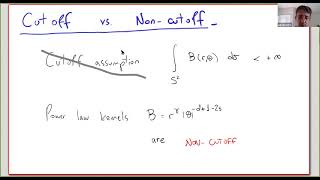
Gaussian Lower Bounds for the Boltzmann Equation Without Cut-off - SIAM PDE Seminar
Explore Gaussian lower bounds for the Boltzmann equation, examining particle density evolution in gases and conditional estimates for solving global well-posedness challenges in fluid dynamics.
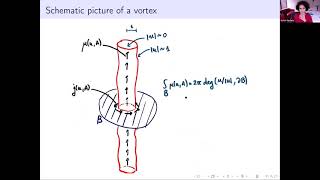
Ginzburg-Landau Model in Superconductivity - Old and New Results
Explore Ginzburg-Landau model of superconductivity, analyzing vortex patterns in 2D and 3D, energy minimizers, and vortex dynamics with expert Sylvia Serfaty from NYU's Courant Institute.
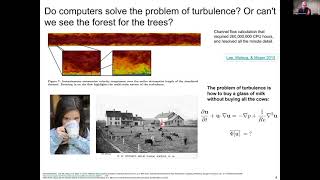
Auxiliary Functionals - A Path to Solving the Problem of Turbulence
Explore innovative approaches to solving turbulence in fluid dynamics using auxiliary functionals and sum-of-squares polynomial optimization, with applications to Kuramoto-Sivashinsky and Navier-Stokes equations.
Speeding up Langevin Dynamics by Mixing
Explore a method to accelerate Langevin dynamics using mixing drift, improving convergence to stationary distribution in polynomial time for systems with multiple local minima.